

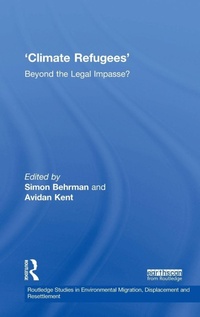
Climate Refugees
Beyond the Legal Impasse?
1st Edition
Published on 6. February 2018
Book
Hardback
288 pages
978-1-138-08881-8 (ISBN)
Description
Current estimates of the numbers of people who will be forced from their homes as a result of climate change by the middle of the century range from 50 to 200 million. Therefore, even the most optimistic projections envisage a crisis of migration that will dwarf any we have seen so far. And yet attempts to develop legal mechanisms to deal with this impending crisis have reached an impasse that shows little sign of being overcome. This is in spite of the rapidly growing academic study and policy development in the area of climate change generally.
'Climate Refugees': Beyond the Legal Impasse? addresses a fundamental gap in academic literature and policy making - namely the legal 'no-man's land' in which the issue of climate refugees currently resides. Past proposals for the regulation of climate-induced migration are evaluated, inter alia by their original authors, and the volume also looks at current attempts to regulate climate-induced migration, including by officials from the International Organization for Migration (IOM), the office of the United Nations High Commissioner for Refugees (UNHCR) and the Platform on Displacement Disaster (PDD).
Bringing together experts from a variety of academic fields, as well as officials from leading international organisations, this book will be of great interest to students and researchers of Environmental Law, Refugee Law, Human Rights Law, Environmental Studies and International Relations.
'Climate Refugees': Beyond the Legal Impasse? addresses a fundamental gap in academic literature and policy making - namely the legal 'no-man's land' in which the issue of climate refugees currently resides. Past proposals for the regulation of climate-induced migration are evaluated, inter alia by their original authors, and the volume also looks at current attempts to regulate climate-induced migration, including by officials from the International Organization for Migration (IOM), the office of the United Nations High Commissioner for Refugees (UNHCR) and the Platform on Displacement Disaster (PDD).
Bringing together experts from a variety of academic fields, as well as officials from leading international organisations, this book will be of great interest to students and researchers of Environmental Law, Refugee Law, Human Rights Law, Environmental Studies and International Relations.
More details
Series
Language
English
Place of publication
London
United Kingdom
Publishing group
Taylor & Francis Ltd
Target group
College/higher education
Illustrations
6 s/w Abbildungen, 2 s/w Zeichnungen, 4 s/w Tabellen
4 Tables, black and white; 2 Line drawings, black and white; 6 Illustrations, black and white
Dimensions
Height: 240 mm
Width: 161 mm
Thickness: 21 mm
Weight
625 gr
ISBN-13
978-1-138-08881-8 (9781138088818)
Copyright in bibliographic data and cover images is held by Nielsen Book Services Limited or by the publishers or by their respective licensors: all rights reserved.
Schweitzer Classification
Other editions
Additional editions
Book
02/2018
1st Edition
Routledge
€71.60
Shipment within 10-20 days
E-Book
02/2018
1st Edition
Routledge
€64.49
Available for download
E-Book
02/2018
1st Edition
Routledge
€64.49
Available for download
Persons
Simon Behrman is a lecturer at the Law School at Royal Holloway, University of London, UK.
Avidan Kent is a lecturer at the University of East Anglia, UK, and a Fellow of the Centre for International Sustainable Development Law (McGill/Cambridge University).
Avidan Kent is a lecturer at the University of East Anglia, UK, and a Fellow of the Centre for International Sustainable Development Law (McGill/Cambridge University).
Content
Acknowledgments
List of Editors
List of Contributors
List of Abbreviations
PART I: FOUNDATIONS
Chapter 1: Overcoming the Legal Impasse? Setting the scene
Chapter 2: 'Climate Refugees': A Legal Mapping Exercise
Chapter 3: A New Category of Refugees? 'Climate Refugees' and a Gaping Hole in International Law
Chapter 4: Norm Formalization in International Policy Cooperation - A Framework for Analysis
PART II: DEFINING AND CATEGORISING
Chapter 5: Justice and Climate Migration: The Importance of Nomenclature in the Discourse on Twenty-First Century Mobility
Chapter 6: Who Are "Climate Refugees"? Academic Engagement in the Post-Truth Era
PART III: GOVERNING CLIMATE REFUGEES: THE PERSPECTIVE OF INTER-GOVERNMENTAL ORGANIZATIONS
Chapter 7: Advancing the Global Governance of Climate Migration through the United Nations Framework Convention on Climate Change and the Global Compact on Migration: Perspectives from the International Organization for Migration
Chapter 8: Enhancing Legal Protection for People Displaced in the Context of Disasters and Climate Change: Challenges and Opportunities
Chapter 9: State-Led, Regional, Consultative Processes: Opportunities to Develop Legal Frameworks on Disaster Displacement
PART IV: REGULATING CLIMATE REFUGEES WITHIN EXISTING LEGAL REGIMES
Chapter 10: Drawing Upon International Refugee Law: The Precautionary Approach to Protecting Climate Change-Displaced Persons
Chapter 11: Public International Law's Applicability to Migration as Adaptation: Fit for Purpose?
Chapter 12: Climate Migrants' Right to Enjoy their Culture
Chapter 13: Beyond the Shortcomings of International Law: A Proposal for the Legal Protection of Climate Migrants
PART V: ENVISIONING SUI GENERIS PATHWAYS
Chapter 14: Towards an International Legal Status of Environmentally Displaced Persons
Chapter 15: Cross-Border Displacement Due to Environmental Disaster: A Proposal for UN Guiding Principles to Fill the Legal Protection Gap
Chapter 16: Global Governance to Protect Future Climate Refugees
List of Editors
List of Contributors
List of Abbreviations
PART I: FOUNDATIONS
Chapter 1: Overcoming the Legal Impasse? Setting the scene
Chapter 2: 'Climate Refugees': A Legal Mapping Exercise
Chapter 3: A New Category of Refugees? 'Climate Refugees' and a Gaping Hole in International Law
Chapter 4: Norm Formalization in International Policy Cooperation - A Framework for Analysis
PART II: DEFINING AND CATEGORISING
Chapter 5: Justice and Climate Migration: The Importance of Nomenclature in the Discourse on Twenty-First Century Mobility
Chapter 6: Who Are "Climate Refugees"? Academic Engagement in the Post-Truth Era
PART III: GOVERNING CLIMATE REFUGEES: THE PERSPECTIVE OF INTER-GOVERNMENTAL ORGANIZATIONS
Chapter 7: Advancing the Global Governance of Climate Migration through the United Nations Framework Convention on Climate Change and the Global Compact on Migration: Perspectives from the International Organization for Migration
Chapter 8: Enhancing Legal Protection for People Displaced in the Context of Disasters and Climate Change: Challenges and Opportunities
Chapter 9: State-Led, Regional, Consultative Processes: Opportunities to Develop Legal Frameworks on Disaster Displacement
PART IV: REGULATING CLIMATE REFUGEES WITHIN EXISTING LEGAL REGIMES
Chapter 10: Drawing Upon International Refugee Law: The Precautionary Approach to Protecting Climate Change-Displaced Persons
Chapter 11: Public International Law's Applicability to Migration as Adaptation: Fit for Purpose?
Chapter 12: Climate Migrants' Right to Enjoy their Culture
Chapter 13: Beyond the Shortcomings of International Law: A Proposal for the Legal Protection of Climate Migrants
PART V: ENVISIONING SUI GENERIS PATHWAYS
Chapter 14: Towards an International Legal Status of Environmentally Displaced Persons
Chapter 15: Cross-Border Displacement Due to Environmental Disaster: A Proposal for UN Guiding Principles to Fill the Legal Protection Gap
Chapter 16: Global Governance to Protect Future Climate Refugees