

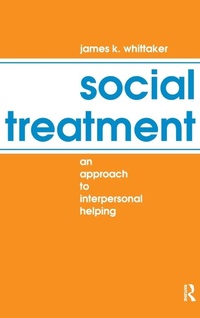
Social Treatment
An Approach to Interpersonal Helping
1st Edition
Published on 13. July 2017
Book
Hardback
280 pages
978-1-138-53306-6 (ISBN)
Description
The book has two principal purposes: To provide an introduction to interpersonal helping in the context of social work practice, and to develop a conceptual framework for interpersonal helping --called social treatment--that will enable the social worker and members of other helping professions effectively to use all the various methods and strategies currently practiced. The book offers an orderly and systematic way of proceeding through a complex and often confused area of practice; in it, large issues--such as remediation versus prevention--are explored along with concrete suggestions for intervention with individuals, families, and small groups.
Theoretical systems are considered not merely for the techniques they suggest but also for the values and views of man inherent in them. The helping process itself is analyzed from the point of view of the consumer as well as the worker. A conceptual framework for practice is developed that allows for systematic eclecticism in theory and technique, providing a framework for evaluating and comparing different methods of social treatment. The author defines social treatment as "an approach to interpersonal helping which utilizes direct and indirect strategies of intervention to aid individuals, families, and small groups in improving social functioning and coping with social problems."
Beginning with a discussion of the concept of remediation within the context of the larger contemporary issues of social reform and environmental protection, Professor Whittaker proceeds to consider several critical issues in present social work practice, such as client advocacy, service delivery systems, and professionalization. Subsequent chapters discuss the multiple roles that social work practitioners perform, the major theoretical bases of social treatment, the treatment sequence from intake to after care, and the full range of helping activities that practitioners undertake indirectly on behalf of their clients. The final chapter explores current trends and future directions in social treatment. In the Appendix, a framework for evaluating methods of interpersonal helping is developed and 21 approaches to social treatment are described and resource bibliographies are provided.
This book--brief, lucid, and systematic--is a major step toward that redefinition, and will be invaluable to beginning students and advanced practitioners in social work and in all the other professional and paraprofessional fields engaged in providing human services.
Theoretical systems are considered not merely for the techniques they suggest but also for the values and views of man inherent in them. The helping process itself is analyzed from the point of view of the consumer as well as the worker. A conceptual framework for practice is developed that allows for systematic eclecticism in theory and technique, providing a framework for evaluating and comparing different methods of social treatment. The author defines social treatment as "an approach to interpersonal helping which utilizes direct and indirect strategies of intervention to aid individuals, families, and small groups in improving social functioning and coping with social problems."
Beginning with a discussion of the concept of remediation within the context of the larger contemporary issues of social reform and environmental protection, Professor Whittaker proceeds to consider several critical issues in present social work practice, such as client advocacy, service delivery systems, and professionalization. Subsequent chapters discuss the multiple roles that social work practitioners perform, the major theoretical bases of social treatment, the treatment sequence from intake to after care, and the full range of helping activities that practitioners undertake indirectly on behalf of their clients. The final chapter explores current trends and future directions in social treatment. In the Appendix, a framework for evaluating methods of interpersonal helping is developed and 21 approaches to social treatment are described and resource bibliographies are provided.
This book--brief, lucid, and systematic--is a major step toward that redefinition, and will be invaluable to beginning students and advanced practitioners in social work and in all the other professional and paraprofessional fields engaged in providing human services.
More details
Language
English
Place of publication
London
United Kingdom
Publishing group
Taylor & Francis Ltd
Target group
College/higher education
Dimensions
Height: 235 mm
Width: 157 mm
Thickness: 20 mm
Weight
563 gr
ISBN-13
978-1-138-53306-6 (9781138533066)
Copyright in bibliographic data and cover images is held by Nielsen Book Services Limited or by the publishers or by their respective licensors: all rights reserved.
Schweitzer Classification
Other editions
Additional editions
E-Book
07/2017
Routledge
€64.49
Available for download
E-Book
07/2017
Routledge
€64.49
Available for download
Book
07/2006
8th Edition
AldineTransaction
€71.60
Shipment within 10-15 days
Person
Christina Behrendt
Content
1: Dilemmas of the Helping Person in an Age of Ecological and Social Crisis; 2: Issues in Social Treatment; 3: Social Treatment: An Introduction; 4: Theoretical Bases of Social Treatment; 5: The Social Treatment Sequence I: Direct Helping in the Beginning, Intermediate, and Ending Phases; 6: The Social Treatment Sequence II: Indirect Intervention on Behalf of Clients; 7: The Future for Social Treatment