

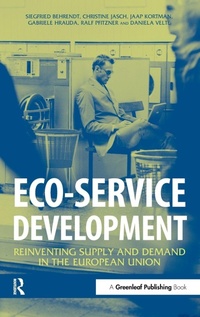
Eco-service Development
Reinventing Supply and Demand in the European Union
1st Edition
Published on 1. January 2003
Book
Hardback
216 pages
978-1-874719-44-1 (ISBN)
Description
Sustainable development will not be possible without fundamental improvements in resource productivity and energy efficiency, the adaptation of material flows into natural cycles as well as a radical change in production and consumption patterns. In essence, what is required is not only an ecological approach to product design but also new marketing and consumption patterns for products that can satisfy our needs in a more environmentally sound way.In recent years there has been growing interest in the possibilities of eco-services to achieve some of these aims. Ecologically oriented leasing, renting, pooling and sharing, where the emphasis is placed on the sale of a product's use rather than on the product itself, offer great possibilities for innovation and environmental impact reduction. At the same time, there are opportunities to create new commercial enterprises, produce added value to production and distribution functions, and therefore create jobs.
Up until now, however, there has been little research about the state of the art in eco-services, how new services can be developed, what the attitudes of consumers are to services rather than products and what the consequences of such a structural adjustment would be for firms. Eco-service Development addresses this lack of research, first by providing a comprehensive inventory and analysis of current eco-services in four European countries: Germany, Austria, the Netherlands and Spain. It then systematically explores the options open to market participants, the potential for environmental impact reduction, potential barriers to eco-services (such as consumer and producer resistance) and, finally, with what political and legal instruments ecologically oriented services can best be promoted. The book analyzes eight consumer sectors - washing, cleaning, cooking, entertainment, gardening, do-it-yourself, mobility and leisure time - from the point of view of both supply and demand and highlights the optimization potential and development perspectives for commercial new use eco-service concepts.
This book is the most comprehensive analysis yet published of how eco-services are being implemented and how they could best be encouraged and contains valuable lessons for policy-makers, interested businesses and all those in the academic community searching for ways to dematerialize the economy.
Up until now, however, there has been little research about the state of the art in eco-services, how new services can be developed, what the attitudes of consumers are to services rather than products and what the consequences of such a structural adjustment would be for firms. Eco-service Development addresses this lack of research, first by providing a comprehensive inventory and analysis of current eco-services in four European countries: Germany, Austria, the Netherlands and Spain. It then systematically explores the options open to market participants, the potential for environmental impact reduction, potential barriers to eco-services (such as consumer and producer resistance) and, finally, with what political and legal instruments ecologically oriented services can best be promoted. The book analyzes eight consumer sectors - washing, cleaning, cooking, entertainment, gardening, do-it-yourself, mobility and leisure time - from the point of view of both supply and demand and highlights the optimization potential and development perspectives for commercial new use eco-service concepts.
This book is the most comprehensive analysis yet published of how eco-services are being implemented and how they could best be encouraged and contains valuable lessons for policy-makers, interested businesses and all those in the academic community searching for ways to dematerialize the economy.
Reviews / Votes
In essence, the book presents the business case for employing eco-services ... each section discusses the situation in depth, taking into consideration such issues as market penetration and environmental relief potentials ... What is interesting about the book is its candour: it details the liabilities and the benefits of eco-service with equal consideration. - www.socialfunds.com - www.socialfunds.com || This book describes steps the EU has taken ... [toward] changes in resource productivity and energy efficiency and the adaptation of material flows into natural cycles ... not only for product design but also for marketing and consumption. - 'Business Horizons', March/April 2004 |
| This book is one of the first to report on empirical research into the area of current (eco-) services ... and was executed by a multi-national team ... based on a research project for the European Commission ... it provides a useful basis for future research in this area, identifying many of the weak spots in our current knowledge - Resources, Conservation and Recycling, 40 (2004)
More details
Language
English
Place of publication
Saltaire
United Kingdom
Publishing group
Taylor & Francis Ltd
Target group
College/higher education
Professional and scholarly
Postgraduate and Professional Practice & Development
Dimensions
Height: 240 mm
Width: 161 mm
Thickness: 16 mm
Weight
496 gr
ISBN-13
978-1-874719-44-1 (9781874719441)
Copyright in bibliographic data and cover images is held by Nielsen Book Services Limited or by the publishers or by their respective licensors: all rights reserved.
Schweitzer Classification
Other editions
Additional editions
Siegfried Behrendt | Christine Jasch | Jaap Kortman
Eco-service Development
Reinventing Supply and Demand in the European Union
E-Book
09/2017
Routledge
€86.99
Available for download
Siegfried Behrendt | Christine Jasch | Jaap Kortman
Eco-service Development
Reinventing Supply and Demand in the European Union
E-Book
09/2017
Routledge
€86.99
Available for download
Persons
Behrendt, Siegfried; Jasch, Christine; Kortman, Jaap; Hrauda, Gabriele; Pfitzner, Ralf; Velte, Daniela
Content
Preface 1. Introduction2. Research questions and methodology3. Definition of the research topic4. The situation in Austria, Germany, Spain and the Netherlands5. Fields of action for property-independent consumption6. Analysis of fields of action7. Opportunities for eco-services: outlook8. Conclusions and recommendations Bibliography