

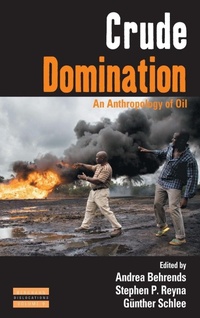
Crude Domination
An Anthropology of Oil
1st Edition
Published on 1. October 2011
Book
Hardback
334 pages
978-0-85745-255-9 (ISBN)
Description
Crude Domination is an innovative and important book about a critical topic - oil. While there have been numerous works about petroleum from 'experience-far' perspectives, there have been relatively few that have turned the 'experience-near' ethnographic gaze of anthropology on the topic. Crude Domination does just this among more peoples and more places than any other volume. Its chapters investigate nuances of culture, politics and economics in Africa, Latin America, and Eurasia as they pertain to petroleum. They wrestle with the key questions vexing scholars and practitioners alike: problems of the economic blight of the resource curse, underdevelopment, democracy, violence and war. Additionally they address topics that may initially appear insignificant - such as child witches and lionmen, fighting for oil when there is no oil, reindeer nomadism, community TV - but which turn out on closer scrutiny to be vital for explaining conflict and transformation in petro-states. Based upon these rich, new worlds of information, the text formulates a novel, domination approach to the social analysis of oil.
Reviews / Votes
"This book is chiefly valuable for the nuanced, in-depth reporting of the cases, especially the violent ones. Valuable for scholars of resource conflict, and necessary reading for anyone deeply researching oil politics." ? Choice"Here is anthropology at its critical and relevant best. Nothing could be more topical than the role of oil in contemporary global turmoil and "the crazy curse" that it casts over all manner of human endeavour and hope. The essays in this important book offer major insights into the heart of the crisis of capital and the local cultural phantasmagoria expressing its cruel paradoxes. The ethnographic analyses expand important arguments in other disciplines (especially economics and political science) and demonstrate the valuable necessity of anthropological perspectives. This is a must read for anthropologists and those in other disciplines who are concerned with the dynamics of global power as this is exposed in the struggle over the control of scarce resources and its tragic human effects." ? Bruce Kapferer, University of Bergen
More details
Series
Language
English
Place of publication
Oxford
United Kingdom
Target group
Professional and scholarly
Product notice
Library binding
Illustrations
7 Tables, unspecified; 7 Figures
Dimensions
Height: 235 mm
Width: 157 mm
Thickness: 23 mm
Weight
636 gr
ISBN-13
978-0-85745-255-9 (9780857452559)
DOI
10.3167/9780857452559
Copyright in bibliographic data and cover images is held by Nielsen Book Services Limited or by the publishers or by their respective licensors: all rights reserved.
Schweitzer Classification
Other editions
Additional editions
E-Book
10/2011
1st Edition
Berghahn Books
€32.49
Available for download
E-Book
10/2011
1st Edition
Berghahn Books
€24.49
Available for download
Persons
Andrea Behrends is an Assistant Professor in Anthropology at the University of Halle-Wittenberg and former Research Fellow at the Max Planck Institute for Social Anthropology.
Content
List of Figures
PART I: GENERALITIES
Chapter 1. The Crazy Curse and Crude Domination: Towards an Anthropology of Oil
Stephen Reyna and Andrea Behrends
Chapter 2. Oiling the Race to the Bottom
Jonathan Friedman
PART II: AFRICA
Chapter 3. Blood Oil: The Anatomy of a Petro-Insurgency in the Niger Delta, Nigeria
Michael Watts
Chapter 4. Fighting for oil when there is no oil yet - The Darfur-Chad border
Andrea Behrends
Chapter 5. Elfs and Witches: Oil Cleptocrats and the Destruction of Social Order in Congo-Brazzaville
Kajsa Ekholm Friedman
Chapter 6. Constituting Domination/Constructing Monsters:Imperialism, Cultural Desire, and anti-Beowulfs in the Chadian Petro-state
Stephen P. Reyna
PART III: LATIN AMERICA
Chapter 7. The Persistent Imaginary of 'the People's Oil': Nationalism, Globalisation and the Possibility of Another Country in Brazil, Mexico and Venezuela
John Gledhill
Chapter 8."Now That the Petroleum is Ours:" Community Media, State Spectacle, and Oil Nationalism in Venezuela
Naomi Schiller
Chapter 9. Flashpoints of Sovereignty: Territorial Conflict and Natural Gas in Bolivia
Bret Gustafson
PART IV. POST-SOCIALIST RUSSIA
Chapter 10. Oil Without Conflict? The Anthropology of Industrialisation in Northern Russia
Florian Stammler
Chapter 11. 'Against... Domination': Oil and War in Chechnya
Galina Khizrieva and Stephen P. Reyna
Afterword Suggestions for a Second Reading: An Alternative Perspective on Contested Resources as an Explanation for Conflict
Guenther Schlee
Notes on Contributors
PART I: GENERALITIES
Chapter 1. The Crazy Curse and Crude Domination: Towards an Anthropology of Oil
Stephen Reyna and Andrea Behrends
Chapter 2. Oiling the Race to the Bottom
Jonathan Friedman
PART II: AFRICA
Chapter 3. Blood Oil: The Anatomy of a Petro-Insurgency in the Niger Delta, Nigeria
Michael Watts
Chapter 4. Fighting for oil when there is no oil yet - The Darfur-Chad border
Andrea Behrends
Chapter 5. Elfs and Witches: Oil Cleptocrats and the Destruction of Social Order in Congo-Brazzaville
Kajsa Ekholm Friedman
Chapter 6. Constituting Domination/Constructing Monsters:Imperialism, Cultural Desire, and anti-Beowulfs in the Chadian Petro-state
Stephen P. Reyna
PART III: LATIN AMERICA
Chapter 7. The Persistent Imaginary of 'the People's Oil': Nationalism, Globalisation and the Possibility of Another Country in Brazil, Mexico and Venezuela
John Gledhill
Chapter 8."Now That the Petroleum is Ours:" Community Media, State Spectacle, and Oil Nationalism in Venezuela
Naomi Schiller
Chapter 9. Flashpoints of Sovereignty: Territorial Conflict and Natural Gas in Bolivia
Bret Gustafson
PART IV. POST-SOCIALIST RUSSIA
Chapter 10. Oil Without Conflict? The Anthropology of Industrialisation in Northern Russia
Florian Stammler
Chapter 11. 'Against... Domination': Oil and War in Chechnya
Galina Khizrieva and Stephen P. Reyna
Afterword Suggestions for a Second Reading: An Alternative Perspective on Contested Resources as an Explanation for Conflict
Guenther Schlee
Notes on Contributors