

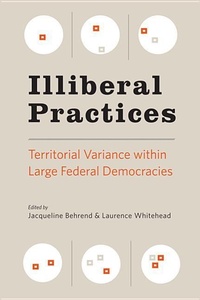
Illiberal Practices
Territorial Variance within Large Federal Democracies
Will be published approx. on 10. August 2016
Book
Paperback/Softback
344 pages
978-1-4214-1958-9 (ISBN)
Description
Within subunits of a democratic federation, lasting political practices that restrict choice, limit debate, and exclude or distort democratic participation have been analyzed in recent scholarship as subnational authoritarianism. Once a critical number of citizens or regions band together in these practices, they can leverage illiberal efforts at the federal level. This timely, data-driven book compares federations that underwent transitions in the first, second, and third waves of democratization and offers a substantial expansion of the concept of subnational authoritarianism. The eleven expert political scientists featured in this text examine the nature and scope of subnational democratic variations within six large federations, including the United States, India, Mexico, Brazil, Argentina, and Russia. Illiberal Practices makes the case that subnational units are more likely to operate by means of illiberal structures and practices than as fully authoritarian regimes. Detailed case studies examine uneven levels of citizenship in each federal system.
These are distributed unequally across the different regions of the country and display semi-democratic or hybrid characteristics. Appropriate for scholars and students of democratization, authoritarianism, federalism, decentralization, and comparative politics, Illiberal Practices sheds light on the uneven extension of democracy within countries that have already democratized. Contributors: Jacqueline Behrend, Andre Borges, Julian Durazo Herrmann, Carlos Gervasoni, Edward L. Gibson, Desmond King, Inga A.-L. Saikkonen, Celina Souza, Maya Tudor, Laurence Whitehead, Adam Ziegfeld
These are distributed unequally across the different regions of the country and display semi-democratic or hybrid characteristics. Appropriate for scholars and students of democratization, authoritarianism, federalism, decentralization, and comparative politics, Illiberal Practices sheds light on the uneven extension of democracy within countries that have already democratized. Contributors: Jacqueline Behrend, Andre Borges, Julian Durazo Herrmann, Carlos Gervasoni, Edward L. Gibson, Desmond King, Inga A.-L. Saikkonen, Celina Souza, Maya Tudor, Laurence Whitehead, Adam Ziegfeld
Reviews / Votes
... this book is a timely contribution to the growing literature on subnational political regimes in democracies around the world, which scholars of comparative democratization, subnational politics, and local governance will find equally interesting. PubliusMore details
Language
English
Place of publication
Baltimore, MD
United States
Target group
Professional and scholarly
College/higher education
Product notice
Paperback (trade)
Illustrations
20 s/w Zeichnungen, 4 Karten
4 Maps; 20 Line drawings, black and white
Dimensions
Height: 226 mm
Width: 150 mm
Thickness: 20 mm
Weight
454 gr
ISBN-13
978-1-4214-1958-9 (9781421419589)
DOI
10.1353/book.47467
Copyright in bibliographic data and cover images is held by Nielsen Book Services Limited or by the publishers or by their respective licensors: all rights reserved.
Schweitzer Classification
Other editions
Additional editions
Jacqueline Behrend | Laurence Whitehead
Illiberal Practices
Territorial Variance within Large Federal Democracies
E-Book
08/2016
Johns Hopkins University Press
€37.99
Available for download
Persons
Jacqueline Behrend is a professor of political science at the Universidad Nacional de San Martin and a tenured researcher at the Argentine National Council for Scientific and Technical Research. Laurence Whitehead is a senior research fellow at Nuffield College, Oxford University. He is the author of Democratization: Theory and Experience.
Content
Acknowledgments
Chapter 1. Setting the Comparative Agenda: Territorially Uneven Democratization Processes in Large Federations
Part I: The United States and India in Historical Perspective
Chapter 2. Federalism and Subnational Democratization in the United States: The South in the Nineteenth and Twentieth Centuries
Chapter 3. Subnational Democratization in India: The Role of Colonial Competition and Central Intervention
Part II: The Diverse Origins of Illiberal Structures and Practices in Argentina, Brazil, and Mexico
Chapter 4. Federal Intervention and Subnational Democratization in Argentina: A Comparative Perspective
Chapter 5. The Dimensions of Democratic and Hybrid Subnational Regimes: Evidence from an Expert Survey in Argentina
Chapter 6. Subnational Hybrid Regimes and Democratization in Brazil: Why Party Nationalization Matters
Chapter 7. The Rise and Fall of Illiberal Politics in the Brazilian State of Bahia
Chapter 8. Social Heterogeneity, Political Mediation, and Subnational Illiberalism: Oaxaca and Puebla, Mexico
Part III: Russia and the Boundaries of Democracy
Chapter 9. Subnational Democratization and Electoral Authoritarianism in Russia: From Subnational Regime Diversity to Unitary Authoritarianism
Part IV: Mapping the Cases
Chapter 10. Uneven Processes and Multiple Pathways
Contributors
Index
Chapter 1. Setting the Comparative Agenda: Territorially Uneven Democratization Processes in Large Federations
Part I: The United States and India in Historical Perspective
Chapter 2. Federalism and Subnational Democratization in the United States: The South in the Nineteenth and Twentieth Centuries
Chapter 3. Subnational Democratization in India: The Role of Colonial Competition and Central Intervention
Part II: The Diverse Origins of Illiberal Structures and Practices in Argentina, Brazil, and Mexico
Chapter 4. Federal Intervention and Subnational Democratization in Argentina: A Comparative Perspective
Chapter 5. The Dimensions of Democratic and Hybrid Subnational Regimes: Evidence from an Expert Survey in Argentina
Chapter 6. Subnational Hybrid Regimes and Democratization in Brazil: Why Party Nationalization Matters
Chapter 7. The Rise and Fall of Illiberal Politics in the Brazilian State of Bahia
Chapter 8. Social Heterogeneity, Political Mediation, and Subnational Illiberalism: Oaxaca and Puebla, Mexico
Part III: Russia and the Boundaries of Democracy
Chapter 9. Subnational Democratization and Electoral Authoritarianism in Russia: From Subnational Regime Diversity to Unitary Authoritarianism
Part IV: Mapping the Cases
Chapter 10. Uneven Processes and Multiple Pathways
Contributors
Index