

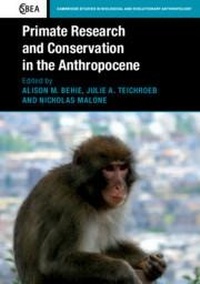
Primate Research and Conservation in the Anthropocene
Published on 31. January 2019
Book
Paperback/Softback
310 pages
978-1-316-61021-3 (ISBN)
Description
This book takes a new approach to understanding primate conservation research, adding a personal perspective to allow readers to learn what motivates those doing conservation work. When entering the field over a decade ago, many young primatologists were driven by evolutionary questions centered in behavioural ecology. However, given the current environment of cascading extinctions and increasing threats to primates we now need to ensure that primates remain in viable populations in the wild before we can simply engage in research in the context of pure behavioural ecology. This has changed the primary research aims of many primatologists and shifted our focus to conservation priorities, such as understanding the impacts of human activity, habitat conversion or climate change on primates. This book presents personal narratives alongside empirical research results and discussions of strategies used to stem the tide of extinction. It is a must-have for anyone interested in conservation research.
Reviews / Votes
'... this book gives good reason for cautious optimism, as it documents challenges that have been tackled and successes that have been celebrated to combat the decline of primates ...' Alexander Waller, The Biologist 'Primate Research and Conservation in the Anthropocene is predominantly a collection of research articles. I found the chapters on what is currently known about the effects of climate change on primates very illuminating. This volume is, therefore of particular interest for those studying or aspiring to study the impacts of climate change on primates.' Sian Waters, Primate EyeMore details
Series
Language
English
Place of publication
Cambridge
United Kingdom
Target group
Professional and scholarly
Product notice
Paperback (trade)
Illustrations
24 Tables, black and white; 36 Halftones, black and white; 28 Line drawings, black and white
Dimensions
Height: 247 mm
Width: 175 mm
Thickness: 17 mm
Weight
630 gr
ISBN-13
978-1-316-61021-3 (9781316610213)
Copyright in bibliographic data and cover images is held by Nielsen Book Services Limited or by the publishers or by their respective licensors: all rights reserved.
Schweitzer Classification
Other editions
Additional editions
Alison M. Behie | Julie A. Teichroeb | Nicholas Malone
Primate Research and Conservation in the Anthropocene
Book
01/2019
Cambridge University Press
€97.50
Shipment within 15-20 days
Persons
Alison M. Behie is the Head of Biological Anthropology at The Australian National University and an Australian Research Council DECRA fellow. Her research interests focus on understanding the impact of severe habitat change on populations of both human and non-human primates. Julie A. Teichroeb is an Assistant Professor of Evolutionary Anthropology at the University of Toronto Scarborough. Her primary research interests are understanding the evolution of primate social organization and individual and group decision-making processes. Nicholas Malone is a Senior Lecturer in Biological Anthropology at the University of Auckland. His research interests are broad, looking into the social and ecological lives of primates, especially those of apes and humans.
Content
1. Changing priorities for primate research and conservation in the Anthropocene Alison M. Behie, Julie A. Teichroeb and Nicholas Malone; 2. Struggling for socio-ecological resilience: a long-term study of Silvery Gibbons (Hylobates moloch) in the fragmented Sancang Forest Nature Reserve, West Java, Indonesia Nicholas Malone and Wedana Adi Putra; 3. Monitoring the Sanje Mangabey population in Tanzania while engaging the local community David Fernandez, Carolyn Erhardt and Grainne McCabe; 4. Uneasy neighbours: local perceptions of the Cross River Gorilla and Nigeria-Cameroon Chimpanzee in Cameroon Alison Wade, Nicholas Malone, Judith Littleton and Bruce Floyd; 5. Comanagment of primate hunting in Amazonian indigenous reserves: a case study from Guyana Christopher A. Shaffer, Marissa S. Milstein, Phillip Suse, Elisha Marawanaru and Charakura Yukuma; 6. The effects of selective logging on the habitat use of the Annamese Silvered Langur (Trachypithecus margarita) in Northeast Cambodia Alvaro Gonzalez-Monge and Alison M. Behie; 7. The immediate impact of selective logging on Angolan Colobus monkeys at Lake Nabugabo, Uganda Julie A. Teichroeb, Gregory R. Bridgett, Amelie Corriveau and Dennis Twinomugisha; 8. Threatened hosts, threatened parasites? Parasite diversity and distribution in red-listed primates Liesbeth Frias and Andrew J. J. MacIntosh; 9. Lemurs in fragmented forests: a conservation and research collaboration Sheila M. Holmes, Edward E. Louis, Jr and Steig E. Johnson; 10. Proboscis monkey conservation: beyond the science Stanislav Lhota, John C. M. Sha, Henry Bernard and Ikki Matsuda; 11. The effect of humans on the primate nutritional landscape Jessica Rothman and Margaret Bryer; 12. Using vegetation phenology and long-term demographic data to assess the impact of Cyclone Fanele on a lemur population in Madagascar Rebecca Lewis and Anne Axel; 13. Alas the storm has come again! The impact of frequent natural disasters on primate conservation Alison M. Behie, Mary S. M. Pavelka, Kayla Hartwell, Jane Champion and Hugh Notman; 14. The effect of climate change on the distribution of Colobus and Cercopithecus monkeys Amanda Korjstens; 15. Primate research(ers) and conservation(its) in the Anthropocene Nicholas Malone, Julie A. Teichroeb and Alison M. Behie.