

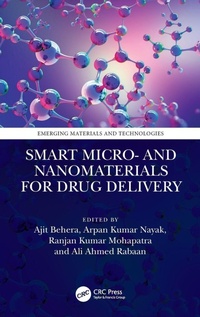
Smart Micro- and Nanomaterials for Drug Delivery
1st Edition
Published on 27. August 2024
Book
Hardback
422 pages
978-1-032-74260-1 (ISBN)
Description
Smart drug delivery at both the micro- and nanoscale is an evolving field with numerous potential applications. It has the potential to revolutionize drug therapy by making treatments more effective, reducing side effects, and improving patient outcomes.
This book presents a comprehensive review of the most recent studies on smart micro- and nanomaterials with a focus on their "smart" activity for formation of targeted and responsive drug-delivery carriers.
This volume:
Introduces readers to the fundamentals of these the micro- and nanoscale materials as well as approaches to smart drug delivery and drug delivery systems.
Covers polymers, metals, and composite materials as well as quantum dots and carbon nanotubes.
Describes of all possible stimulated systems for drug delivery such as enzyme-responsive, small molecules-responsive, thermo-responsive, pH-responsive, electric field-responsive, magnetic field-responsive, light-responsive, ultrasound-responsive, and reductive environment responsive.
Offers a critical perspective on the future scope of smart drug delivery systems.
This reference work is written to support researchers in the fields of materials engineering and biotechnology with the goal of improving the diagnosis and treatment of disease and patient quality of life.
This book presents a comprehensive review of the most recent studies on smart micro- and nanomaterials with a focus on their "smart" activity for formation of targeted and responsive drug-delivery carriers.
This volume:
Introduces readers to the fundamentals of these the micro- and nanoscale materials as well as approaches to smart drug delivery and drug delivery systems.
Covers polymers, metals, and composite materials as well as quantum dots and carbon nanotubes.
Describes of all possible stimulated systems for drug delivery such as enzyme-responsive, small molecules-responsive, thermo-responsive, pH-responsive, electric field-responsive, magnetic field-responsive, light-responsive, ultrasound-responsive, and reductive environment responsive.
Offers a critical perspective on the future scope of smart drug delivery systems.
This reference work is written to support researchers in the fields of materials engineering and biotechnology with the goal of improving the diagnosis and treatment of disease and patient quality of life.
More details
Series
Language
English
Place of publication
London
United Kingdom
Publishing group
Taylor & Francis Ltd
Target group
College/higher education
Postgraduate
Illustrations
78 s/w Abbildungen, 51 s/w Photographien bzw. Rasterbilder, 27 s/w Zeichnungen, 13 s/w Tabellen
13 Tables, black and white; 27 Line drawings, black and white; 51 Halftones, black and white; 78 Illustrations, black and white
Dimensions
Height: 240 mm
Width: 161 mm
Thickness: 28 mm
Weight
816 gr
ISBN-13
978-1-032-74260-1 (9781032742601)
Copyright in bibliographic data and cover images is held by Nielsen Book Services Limited or by the publishers or by their respective licensors: all rights reserved.
Schweitzer Classification
Other editions
Additional editions
Ajit Behera | Arpan Kumar Nayak | Ranjan Kumar Mohapatra
Smart Micro- and Nanomaterials for Drug Delivery
Book
approx. 07/2026
1st Edition
CRC Press
€66.00
Not yet published
Ajit Behera | Arpan Kumar Nayak | Ranjan Kumar Mohapatra
Smart Micro- and Nanomaterials for Drug Delivery
E-Book
08/2024
1st Edition
CRC Press
€218.99
Available for download
Ajit Behera | Arpan Kumar Nayak | Ranjan Kumar Mohapatra
Smart Micro- and Nanomaterials for Drug Delivery
E-Book
08/2024
1st Edition
CRC Press
€218.99
Available for download
Persons
Ajit Behera is an Assistant Professor in the Metallurgical & Materials Department at National Institute of Technology, Rourkela. He earned his PhD from IIT Kharagpur.
Arpan Kumar Nayak is Research Professor in the Department of Energy Engineering, Konkuk University, Republic of Korea. He earned his PhD from IIT Kharagpur.
Ranjan Kumar Mohapatra is Assistant Professor in Chemistry at Government College of Engineering, India. He earned PhD from Sambalpur University.
Ali Ahmed Rabaan is Head of the Molecular Diagnostic Lab at Johns Hopkins Aramco Healthcare Dhahran, Saudi Arabia, where he is also is a member of the Emerging Infectious Diseases task force. Dr. Rabaan is also adjunct Assistant Professor at the College of Medicine, Alfaisal University, Riyadh, Saudi Arabia. He earned his PhD in Molecular Microbiology from University of Sheffield, United Kingdom.
Arpan Kumar Nayak is Research Professor in the Department of Energy Engineering, Konkuk University, Republic of Korea. He earned his PhD from IIT Kharagpur.
Ranjan Kumar Mohapatra is Assistant Professor in Chemistry at Government College of Engineering, India. He earned PhD from Sambalpur University.
Ali Ahmed Rabaan is Head of the Molecular Diagnostic Lab at Johns Hopkins Aramco Healthcare Dhahran, Saudi Arabia, where he is also is a member of the Emerging Infectious Diseases task force. Dr. Rabaan is also adjunct Assistant Professor at the College of Medicine, Alfaisal University, Riyadh, Saudi Arabia. He earned his PhD in Molecular Microbiology from University of Sheffield, United Kingdom.
Content
1. Introduction to Smart Materials in Micro- and Nanoscale. 2. Current Approaches to Smart Drug Delivery. 3. Polymers for Smart Drug Delivery. 4. Metals for Smart Drug Delivery. 5. Composites for Smart Drug Delivery. 6. Micro- and Nanoscale Oral Drug Delivery Platforms. 7. Smart Nanocarriers. 8. Carbon Nanotubes (CNTs) and Their Smartness. 9. Quantum Dots (QDs) and Their Smartness. 10. Enzyme-Responsive Micro/Nano Drug Delivery. 11. Thermoresponsive Micro and Nano Drug Delivery. 12. Light-Triggered Micro/Nano Drug Delivery. 13. Electric Field Responsiveness of Nano Drug Delivery. 14. Magnetic Field-Responsive Micro/Nano Drug Delivery Systems. 15. pH-Responsive Micro/Nano Drug Delivery. 16. Smart Materials for Sustained and Controlled Drug Release. 17. MEMS-Based Drug Release. 18. Porous Nanocarriers for Targeted Drug Delivery and Theranostics. 19. Prospects and Future Scope of Smart Drug Delivery Systems: A Critical Perspective.