

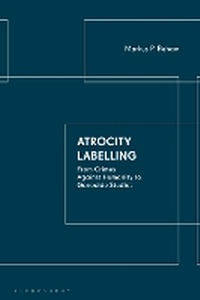
Atrocity Labelling
From Crimes Against Humanity to Genocide Studies
Published on 1. December 2022
Book
Hardback
216 pages
978-0-7556-1753-1 (ISBN)
Description
Atrocity. Genocide. War crime. Crime Against Humanity. Such atrocity labels have been popularized among international lawmakers but with little insight offered into how and when these terms are applied and to what effect. What constitutes an event to be termed a genocide or war crime and what role does this play in the application of legal proceedings?
Markus P. Beham, through an interdisciplinary and comparative approach, unpicks these terms to uncover their historical genesis and their implications for international criminal law initiatives concerned with atrocity. The book uniquely compares four specific case studies: Belgian colonial exploitation of the Congo, atrocities committed against the Herero and Nama in German South-West Africa, the Armenian genocide and the man-made Ukrainian famine of the 1930s. Encompassing international law, legal history, and discourse analysis, the concept of 'atrocity labelling' is used to capture the meaning underlying the work of international lawyers and prosecutors, historians and sociologists, agenda setters and policy makers.
Markus P. Beham, through an interdisciplinary and comparative approach, unpicks these terms to uncover their historical genesis and their implications for international criminal law initiatives concerned with atrocity. The book uniquely compares four specific case studies: Belgian colonial exploitation of the Congo, atrocities committed against the Herero and Nama in German South-West Africa, the Armenian genocide and the man-made Ukrainian famine of the 1930s. Encompassing international law, legal history, and discourse analysis, the concept of 'atrocity labelling' is used to capture the meaning underlying the work of international lawyers and prosecutors, historians and sociologists, agenda setters and policy makers.
Reviews / Votes
'This study is an insightful read and of great value for students and scholars of violence studies, modern history, and international law. The author breaks new ground by combining conceptual and legal history with in-depth analysis of genocide studies literature through four case studies of genocidal violence.' * Adamantios Th. Skordos, Leibniz Institute for the History and Culture of Eastern Europe * Atrocity Labelling is a strong addition to the literature on genocide and its application. * Choice *More details
Language
English
Place of publication
London
United Kingdom
Target group
Professional and scholarly
Dimensions
Height: 236 mm
Width: 164 mm
Thickness: 18 mm
Weight
480 gr
ISBN-13
978-0-7556-1753-1 (9780755617531)
Copyright in bibliographic data and cover images is held by Nielsen Book Services Limited or by the publishers or by their respective licensors: all rights reserved.
Schweitzer Classification
Other editions
Additional editions
E-Book
11/2022
1st Edition
I.B. Tauris & Co. Ltd.
€100.99
Available for download
E-Book
11/2022
1st Edition
I.B. Tauris & Co. Ltd.
€100.99
Available for download
Person
Markus P. Beham is Assistant Professor at the University of Passau, Germany.
Content
1. Introduction
2. From 'Crimes Against Humanity' to 'Genocide Studies'
3. Labelling Colonialism
4. Labelling Transformation
5. Conclusion
Index
2. From 'Crimes Against Humanity' to 'Genocide Studies'
3. Labelling Colonialism
4. Labelling Transformation
5. Conclusion
Index