

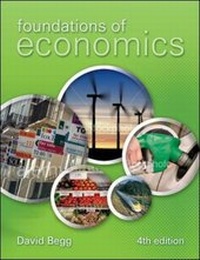
Foundations of Economics
4th Edition
Published on 16. March 2009
Book
Paperback/Softback
432 pages
978-0-07-712188-4 (ISBN)
Description
Foundations of Economics, fourth edition is ideal for students taking introductory economics modules as part of an interdisciplinary course. Building on the success of the second edition, the book provides accessible overviews of key economic topics, interweaving these with real-world examples and practical activities to equip students to think for themselves. Features of this edition include:Topical and up-to-date material, presented alongside real-world examples and policy problems Mini case studies taken from disciplines such as construction, sport and computing, to demonstrate the practical application of economics Increased microeconomic coverage; including separate chapters on supply, demand and markets, to provide students with a thorough grounding in these fundamental areas A revised structure to the macroeconomics section, beginning with growth, cycles, and issues, before introducing analysis and explanations Learning outcomes and recaps in each chapter, allowing students to track their progress and understanding through the text Key terms, clearly defined throughout each chapter Review questions and answers in each chapter, to test understanding and application of the topics covered An easy-to-navigate layout and design, with clearly signposted features and photos and figures to illustrate important conceptsSuccinctly offering the proven quality, consistency and clarity of the parent text Economics ('The Student Bible' BBC Radio 4), Foundations of Economics, forth edition is the essential text for today's non-specialist economics student.
More details
Edition
4th edition
Language
English
Place of publication
London
United States
Publishing group
McGraw-Hill Education - Europe
Target group
College/higher education
Illustrations
Illustrations
Dimensions
Height: 246 mm
Width: 191 mm
Thickness: 16 mm
Weight
710 gr
ISBN-13
978-0-07-712188-4 (9780077121884)
Copyright in bibliographic data and cover images is held by Nielsen Book Services Limited or by the publishers or by their respective licensors: all rights reserved.
Schweitzer Classification
Person
David Begg is Principal of the Tanaka Business School at Imperial College London. He has been a Research Fellow of the Centre for Economic Policy Research (a network of leading European economists) since its inception in 1984. David's research focuses mainly on monetary policy, exchange rates, monetary union, and economic transition. He is a Research Fellow of the Centre for Economic Policy Research. He co-authored several of the CEPR annual reports in the series he helped found: Monitoring the European Central Bank, and Monitoring European Integration. The 1997 MEI Report, EMU: Getting the Endgame Right, changed the policy that the European Union adopted to launch the euro in 1999. He was also founding Managing Editor of Economic Policy, now an official journal of the European Economic Association.
Content
1. What is Economics?
Appendix 1: Graph Methodology
Part 1: Microeconomics
2. Demand
3. Supply
4. Elasticity
5. Costs, Supply and Perfect Competition
6. Imperfect competition
7. Input markets: Labour
8. Other Input Markets and Income Distribution
Part 2: Macroeconomics
9. Governing the market
10. The income and output nations
11. Short-run fluctuations in income and output
12. Interest rates, money and inflation
13. Aggregate supply, inflation and unemployment
14. Exchange rates and the balance of payments
15. The global economy
16. European Integration
Appendix 1: Graph Methodology
Part 1: Microeconomics
2. Demand
3. Supply
4. Elasticity
5. Costs, Supply and Perfect Competition
6. Imperfect competition
7. Input markets: Labour
8. Other Input Markets and Income Distribution
Part 2: Macroeconomics
9. Governing the market
10. The income and output nations
11. Short-run fluctuations in income and output
12. Interest rates, money and inflation
13. Aggregate supply, inflation and unemployment
14. Exchange rates and the balance of payments
15. The global economy
16. European Integration