

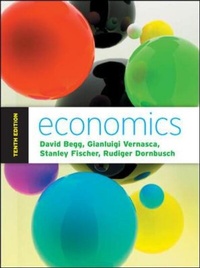
Economics
with Connect Plus card
10th Edition
Published on 16. January 2011
Book
Paperback/Softback
752 pages
978-0-07-712952-1 (ISBN)
Description
The combination of David Begg with new co-author Gianluigi Vernasca is one of the many reasons that the 10th edition of Economics stands out from the crowd.After extensive research, they have revised the structure of the book to make it more concise, perfected their rigorous yet accessible approach, updated data throughout and created over 80 new example boxes.The result is a textbook fully equipped with everything you need to master your economics principles course.
More details
Edition
10th edition
Language
English
Place of publication
London
United States
Publishing group
McGraw-Hill Education - Europe
Target group
College/higher education
Dimensions
Height: 263 mm
Width: 196 mm
Thickness: 30 mm
Weight
1 gr
ISBN-13
978-0-07-712952-1 (9780077129521)
Copyright in bibliographic data and cover images is held by Nielsen Book Services Limited or by the publishers or by their respective licensors: all rights reserved.
Schweitzer Classification
Other editions
New editions
David Begg | Gianluigi Vernasca | Eric Golson
Economics, 13e
Book
03/2025
13th Edition
McGraw-Hill Education (UK) Ltd
€77.03
Available immediately
Persons
David Begg is Principal of the Tanaka Business School at Imperial College London. He has been a Research Fellow of the Centre for Economic Policy Research (a network of leading European economists) since its inception in 1984. David's research focuses mainly on monetary policy, exchange rates, monetary union, and economic transition. He is a Research Fellow of the Centre for Economic Policy Research. He co-authored several of the CEPR annual reports in the series he helped found: Monitoring the European Central Bank, and Monitoring European Integration. The 1997 MEI Report, EMU: Getting the Endgame Right, changed the policy that the European Union adopted to launch the euro in 1999. He was also founding Managing Editor of Economic Policy, now an official journal of the European Economic Association.
Gianluigi Vernasca a Senior Lecturer of Economics at University of Essex.
Gianluigi Vernasca a Senior Lecturer of Economics at University of Essex.
Content
Part 1: Introduction
1. Economics and the Economy
2. Tools of Economic Analysis
3. Demand, Supply and the Market
Part 2: Positive Microeconomics
4. Elasticities of Demand and Supply
5. Consumer Choice and Demand Decisions
6. Introducing Supply Decisions
7. Cost and Supply
8. Perfect Competition and Pure Monopoly
9. Market Structure and Imperfect Competition
10. The Labour Market
11. Factor Markets and Income Distribution
12. Risk and Information
Part 3: Welfare Economics
13. Welfare Economics
14. Government Spending and Revenue
Part 4: Macroeconomics
15. Introduction to Macroeconomics
16. Output and Aggregate Demand
17. Fiscal Policy and Foreign Trade
18. Money and Banking
19. Interest Rates and Monetary Transmission
20. Monetary and Fiscal Policy
21. Aggregate Supply, Prices and Adjustment to Shocks
22. Inflation, Expectations and Credibility
23. Unemployment
24. Exchange Rates and the Balance of Payments
25. Open Economy Macroeconomics
26. Economic Growth
27. Business Cycles
Part 5: The World Economy
28. International Trade
29. Exchange Rate Regimes
1. Economics and the Economy
2. Tools of Economic Analysis
3. Demand, Supply and the Market
Part 2: Positive Microeconomics
4. Elasticities of Demand and Supply
5. Consumer Choice and Demand Decisions
6. Introducing Supply Decisions
7. Cost and Supply
8. Perfect Competition and Pure Monopoly
9. Market Structure and Imperfect Competition
10. The Labour Market
11. Factor Markets and Income Distribution
12. Risk and Information
Part 3: Welfare Economics
13. Welfare Economics
14. Government Spending and Revenue
Part 4: Macroeconomics
15. Introduction to Macroeconomics
16. Output and Aggregate Demand
17. Fiscal Policy and Foreign Trade
18. Money and Banking
19. Interest Rates and Monetary Transmission
20. Monetary and Fiscal Policy
21. Aggregate Supply, Prices and Adjustment to Shocks
22. Inflation, Expectations and Credibility
23. Unemployment
24. Exchange Rates and the Balance of Payments
25. Open Economy Macroeconomics
26. Economic Growth
27. Business Cycles
Part 5: The World Economy
28. International Trade
29. Exchange Rate Regimes