

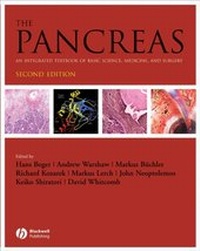
The Pancreas
An Integrated Textbook of Basic Science, Medicine and Surgery
2nd Edition
Published on 11. April 2008
Book
Hardback
1024 pages
978-1-4051-4664-7 (ISBN)
Description
The most encyclopedic book on the pancreas - providing clear guidance for practicing clinicians & surgeons
In the past decade, extraordinary developments in diagnostic and therapeutic radiology and endoscopy have been coupled with major advances in surgical techniques and basic sciences. As a result the management of pancreatic disorders is now handled by a multidisciplinary team.
This book shows you how to achieve superior patient management by taking the team approach to in-hospital care.
For all known pancreatic disorders, it details the latest knowledge on genetics and molecular biological background in terms of anatomy, physiology, pathology, and pathophysiology.
The Editor and author team are leading pancreatologists of high international repute and they present global best-practice using the newest diagnosis and treatment principles.
A timely section on early and late outcome data considers the benefits of management including chemotherapy and immune therapy. Carefully incorporating the latest evidence based data, the book also discusses early diagnosis, limited surgical treatment, oncology, treatment results and the option of transplantation.
This new edition contains more than 400 illustrations, line drawings and radiographs to provide a step-by-step approach to endoscopic techniques and surgical procedures. With The Pancreas, Second Edition, you can achieve a greater understanding of the principles of surgical treatment in one reference point.
In the past decade, extraordinary developments in diagnostic and therapeutic radiology and endoscopy have been coupled with major advances in surgical techniques and basic sciences. As a result the management of pancreatic disorders is now handled by a multidisciplinary team.
This book shows you how to achieve superior patient management by taking the team approach to in-hospital care.
For all known pancreatic disorders, it details the latest knowledge on genetics and molecular biological background in terms of anatomy, physiology, pathology, and pathophysiology.
The Editor and author team are leading pancreatologists of high international repute and they present global best-practice using the newest diagnosis and treatment principles.
A timely section on early and late outcome data considers the benefits of management including chemotherapy and immune therapy. Carefully incorporating the latest evidence based data, the book also discusses early diagnosis, limited surgical treatment, oncology, treatment results and the option of transplantation.
This new edition contains more than 400 illustrations, line drawings and radiographs to provide a step-by-step approach to endoscopic techniques and surgical procedures. With The Pancreas, Second Edition, you can achieve a greater understanding of the principles of surgical treatment in one reference point.
Reviews / Votes
"This textbook could easily serve as the most comprehensive written material on pancreatic diseases for laboratory scientists, gastroenterologists, gastrointestinal surgeons, and gastrointestinal or surgical fellows who work in the field." ( The New England Journal of Medicine )More details
Edition
2. Auflage
Language
English
Place of publication
Chicester
United Kingdom
Publishing group
John Wiley and Sons Ltd
Target group
Professional and scholarly
Gastroenterologists, including trainees and residentsEndoscopists, including trainees and residentsGI surgeons, including trainees and residentsGI pathologistsGastroenterology specialist nurses.
Edition type
New edition
Dimensions
Height: 28.6 cm
Width: 22.3 cm
Thickness: 6.3 cm
Weight
2912 gr
ISBN-13
978-1-4051-4664-7 (9781405146647)
Schweitzer Classification
Other editions
New editions
Hans G. Beger | Andrew L. Warshaw | Ralph H. Hruban
The Pancreas
An Integrated Textbook of Basic Science, Medicine, and Surgery
Book
04/2018
3rd Edition
Wiley
Unfortunately, price unknown
Article exhausted; check for reprint
Additional editions
Hans-Gunther Beger | Markus Buchler | Richard Kozarek
The Pancreas
An Integrated Textbook of Basic Science, Medicine, and Surgery
E-Book
01/2009
2nd Edition
Wiley-Blackwell
€449.99
Available for download
Persons
Professor Hans Beger MD FACS is Chairman and Head of the Department of Surgery, University of Ulm, Germany. He has published 675 papers and has served as an Editorial Board Member for 28 international surgery journals. He has also edited 21 books and delivered more than 250 international lectures. He also developed a surgical procedure for removing the head of the pancreas while preserving the duodenum: known as Beger's operation.
Professor Andrew L. Warshaw MD FACS is the W. Gerald Austen Professor of Surgery, surgeon-in-chief and chairman of the Department of Surgery at Massachusetts General Hospital. He has made important contributions to the diagnosis and treatment of pancreatic cancer and the pathogenesis and management of pancreatitis. A distinguished teacher, editor and prolific writer, he is Editor-in-chief of the journal Surgery. He has served on the editorial boards of 15 other major journals and as visiting professor at more than 50 major universities in the U.S. and around the world. He serves as a governor of the American College of Surgeons, and president-elect of the Halsted Society. He is past-president of the Society of Surgery of the Alimentary Tract and International Association of Pancreatology.
Professor David Whitcomb MD PhD, is Professor of Medicine, Cell Biology & Physiology, and Human Genetics, and Chief, Division of Gastroenterology, Hepatology and Nutrition, University of Pittsburgh, PA, USA (Pancreatologist). He founded and directs the Center for Genomic Sciences beginning in 1995. He has received numerous awards, including election to the prestigious American Society for Clinical Investigation ("Young Turk"). He conducts basic and translational research with a focus on pancreatic diseases. His laboratory group discovered the gene causing hereditary pancreatitis and other causes of pancreatic disease. In addition, he leads several research projects on alcoholic pancreatitis and pancreatic physiology. He has published over 100 manuscripts and recently co-edited two books on inherited diseases of the pancreas. He is a Counselor for the American Gastroenterology Association (AGA), the American Pancreas Association and the International Association of Pancreatology, and is Chairman of the Pancreatic Disorders Section of the AGA. He is an Associate Editor for Pancreas, Digestive Diseases and Sciences, and Pancreatology. He co-founded the Midwest Multicenter Pancreatic Study Group and serves on national and international committees for the major gastroenterology and pancreatic societies. He has just been elected President of the American Pancreas Association.
Professor Richard Kozarek, Chief of Gastroenterology, Virginia Mason Medical Center, and Clinical Professor of Medicine, University of Washington, Seattle, Washington
Professor Andrew L. Warshaw MD FACS is the W. Gerald Austen Professor of Surgery, surgeon-in-chief and chairman of the Department of Surgery at Massachusetts General Hospital. He has made important contributions to the diagnosis and treatment of pancreatic cancer and the pathogenesis and management of pancreatitis. A distinguished teacher, editor and prolific writer, he is Editor-in-chief of the journal Surgery. He has served on the editorial boards of 15 other major journals and as visiting professor at more than 50 major universities in the U.S. and around the world. He serves as a governor of the American College of Surgeons, and president-elect of the Halsted Society. He is past-president of the Society of Surgery of the Alimentary Tract and International Association of Pancreatology.
Professor David Whitcomb MD PhD, is Professor of Medicine, Cell Biology & Physiology, and Human Genetics, and Chief, Division of Gastroenterology, Hepatology and Nutrition, University of Pittsburgh, PA, USA (Pancreatologist). He founded and directs the Center for Genomic Sciences beginning in 1995. He has received numerous awards, including election to the prestigious American Society for Clinical Investigation ("Young Turk"). He conducts basic and translational research with a focus on pancreatic diseases. His laboratory group discovered the gene causing hereditary pancreatitis and other causes of pancreatic disease. In addition, he leads several research projects on alcoholic pancreatitis and pancreatic physiology. He has published over 100 manuscripts and recently co-edited two books on inherited diseases of the pancreas. He is a Counselor for the American Gastroenterology Association (AGA), the American Pancreas Association and the International Association of Pancreatology, and is Chairman of the Pancreatic Disorders Section of the AGA. He is an Associate Editor for Pancreas, Digestive Diseases and Sciences, and Pancreatology. He co-founded the Midwest Multicenter Pancreatic Study Group and serves on national and international committees for the major gastroenterology and pancreatic societies. He has just been elected President of the American Pancreas Association.
Professor Richard Kozarek, Chief of Gastroenterology, Virginia Mason Medical Center, and Clinical Professor of Medicine, University of Washington, Seattle, Washington
Author
Department of Surgery, University of Ulm
Department of General Surgery, University of Heidelberg
Department of Gastroenterology, Virginia Mason Medical Center, Seattle
University of Greifswald, Germany
Division of Surgery & Oncology, University of Liverpool
Department of Surgery, Massachusetts General Hospital, Boston
Department of Medicine, University of Pittsburgh
Department of Gastroenterology, Tokyo Women's Medical College
Content
Introduction: Definitions of Pancreatic Diseases and their Complications.
Section 1: Anatomy of the Pancreas.
Section 2: Physiology of Pancreatic Functions.
Section 3: Acute Pancreatitis.
Section 4: Chronic Pancreatitis.
Section 5: Neoplastic Lesions of Exocrine Tissue: Pancreatic Cancer.
Section 6: Endocrine Tumors of the Pancreas.
Section 7: Periampullary Tumors and others than Pancreatic Cancer.
Section 8: Other Tumors of the Pancreas.
Section 9: Transplantation of the Pancreas.
Section 1: Anatomy of the Pancreas.
Section 2: Physiology of Pancreatic Functions.
Section 3: Acute Pancreatitis.
Section 4: Chronic Pancreatitis.
Section 5: Neoplastic Lesions of Exocrine Tissue: Pancreatic Cancer.
Section 6: Endocrine Tumors of the Pancreas.
Section 7: Periampullary Tumors and others than Pancreatic Cancer.
Section 8: Other Tumors of the Pancreas.
Section 9: Transplantation of the Pancreas.