

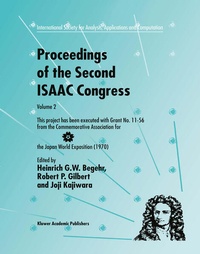
Proceedings of the Second ISAAC Congress
Volume 2: This project has been executed with Grant No. 11-56 from the Commemorative Association for the Japan World Exposition (1970)
Published on 15. September 2011
Book
Paperback/Softback
XIV, 821 pages
978-1-4613-7971-3 (ISBN)
Description
Let 8 be a Riemann surface of analytically finite type (9, n) with 29 - 2+n> O. Take two pointsP1, P2 E 8, and set 8 ,1>2= 8 \ {P1' P2}. Let PI Homeo+(8;P1,P2) be the group of all orientation preserving homeomor- phismsw: 8 -+ 8 fixingP1, P2 and isotopic to the identity on 8. Denote byHomeot(8;Pb P2) the set of all elements ofHomeo+(8;P1, P2) iso- topic to the identity on 8 ,P2' ThenHomeot(8;P1,P2) is a normal sub- pl group ofHomeo+(8;P1,P2). We setIsot(8;P1,P2) =Homeo+(8;P1,P2)/ Homeot(8;p1, P2). The purpose of this note is to announce a result on the Nielsen- Thurston-Bers type classification of an element [w] ofIsot+(8;P1,P2). We give a necessary and sufficient condition for thetypeto be hyperbolic. The condition is described in terms of properties of the pure braid [b ] w induced by [w]. Proofs will appear elsewhere. The problem considered in this note and the form ofthe solution are suggested by Kra's beautiful theorem in [6], where he treats self-maps of Riemann surfaces with one specified point. 2 TheclassificationduetoBers Let us recall the classification of elements of the mapping class group due to Bers (see Bers [1]).
LetT(R) be the Teichmiiller space of a Riemann surfaceR, andMod(R) be the Teichmtiller modular group of R. Note that an orientation preserving homeomorphism w: R -+ R induces canonically an element (w) EMod(R). Denote by&.r(R)(*,.) the Teichmiiller distance onT(R). For an elementXEMod(R), we define a(x)= inf &.r(R)(r,x(r)).
LetT(R) be the Teichmiiller space of a Riemann surfaceR, andMod(R) be the Teichmtiller modular group of R. Note that an orientation preserving homeomorphism w: R -+ R induces canonically an element (w) EMod(R). Denote by&.r(R)(*,.) the Teichmiiller distance onT(R). For an elementXEMod(R), we define a(x)= inf &.r(R)(r,x(r)).
More details
Series
Edition
Softcover reprint of the original 1st ed. 2000
Language
English
Place of publication
New York
United States
Target group
Professional and scholarly
Research
Product notice
Paperback (trade)
Unsewn / adhesive bound
Illustrations
XIV, 821 p.
Dimensions
Height: 240 mm
Width: 160 mm
Thickness: 45 mm
Weight
1314 gr
ISBN-13
978-1-4613-7971-3 (9781461379713)
DOI
10.1007/978-1-4613-0271-1
Schweitzer Classification
Other editions
Additional editions
Heinrich G.W. Begehr | R.P. Gilbert | Joji Kajiwara
Proceedings of the Second ISAAC Congress
Volume 2: This project has been executed with Grant No. 11-56 from the Commemorative Association for the Japan World Exposition (1970)
Book
12/2000
Kluwer Academic Publishers
€213.99
Shipment within 15-20 days
Content
Volume 1: Preface. 1. A central limit theorem for the Simple random walk on a crystal lattice; M. Kotani, T. Sunada. 2. Level Statistics for Quantum Hamiltonians - Some Preliminary Ideas toward Mathematical Justification of the Theory of Berry and Tabor; N. Minami. 3. Fermion process and Fredholm determinant; T. Shirai, Y. Takahashi. 4. Strong type estimation from weak type estimates for some integral operators; N. Fujii. 5. Conjugate Fourier Series and Integrals of Several Variables in the l - 1 Sense; Z. Li. 6. Admissible wavelets and Siegel domains; H. Liu. 7. Some results on a class of oscillatory Integrals; S. Lu. 8. Weighted Hardy spaces on a domain; A. Miyachi. 9. Commutators of singular integral operators on Morrey spaces with some growth functions; T. Mizuhara. 10. On generalized fractional integrals in the Orlicz spaces; E. Nakai. 11. Weak (1,1) estimates for Littlewood-Paley functions with rough kernels; S. Sato. 12. A Note on average densities of Brownian intersection measures; N.-R. Shieh. 13. Problem of integral geometry on paraboloids with perturbation; A.H. Begmatov. 14. The connection between discrete and continuous realisations of least squares method; Y.V. Chebrakov, V.V. Shmagin. 15. An Eigenvalue Problem for Analytic Functions; D.Q. Dai, M.S. Liu. 16. On quadrature formulae of hypersingular integrals; J.Y. Du, J.C. Hu. 17. Theoretical and numerical analysis of inversion of satellite remote sensing; S.-x. Huang, J. Li. 18. Optimization of vector-valued integral equations for a class; C.G. Hu, L.X. Ma. 19. Nonlinear Riemann-Hilbert problems of first order quasi-linear elliptic system; M.Z. Li. 20. The algorithm implementation of Cauchy singular integral in Daubechies wavelets on the interval; W. Lin, Q. Li. 21. Closed form solution for a hypersingular integral equation of order n + 1; X. Li. 22. Cyclically symmetric crack problems of different media II; J. Lu. 23. Linear conjugate boundary value problems for first order ordinary system of linear differential equations with singular or super singular coefficients; N. Rajabov. 24. Initial-mixed boundary value problems for parabolic equations of second order with measurable coeeficients in a higher dimensional domain; G.C. Wen. 25. Stability estimates in states-estimation for a heat process; D. Xu, M. Yamamoto. 26. Plastic zone and opening displacement for an asymmetrical fast propagating semi-infinite crack in a strip; X.-C. Yang, T.-Y. Fan. 27. Certain class of hyperanalytic Haseman boundary value problems; Y.S. Zeng. 28. On compound boundary value problems for non linear elliptic systems of first order; C. Zhao. 29. On the integral of Cauchy type and the generalized Harnack theorem for bianalytic functions; Z. Zhao. 30. The growth of spirallike mappings; H. Hamada, G. Kohr. 31. Subordination principle to functions of several complex variables; K.H. Shon, G.M. Son. 32. ρ-adic Nevanlinna Theory and Functional Equations; A. Boutabaa, A. Escassut. 33. Unique range sets in p-adic and complex analys