

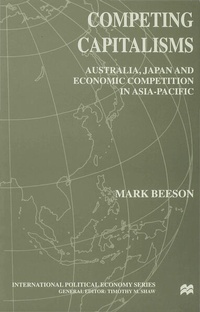
Competing Capitalisms
Australia, Japan and Economic Competition in the Asia Pacific
Published on 13. July 1999
Book
Hardback
XII, 232 pages
978-0-333-74774-2 (ISBN)
Description
Since the end of the Cold War capitalism has become the dominant form of economic and political organization across the globe. This does not mean, however, that all forms of capitalism are the same. Competing Capitalisms explains why some countries have developed very different forms of capitalism and what happens when they interact. The book considers the distinctive experiences of Australia's market-based, and Japan's state-led forms of capitalism and explains what this means for future international economic competition.
More details
Series
Edition
1999 edition
Language
English
Place of publication
London
United Kingdom
Target group
Professional and scholarly
Product notice
sewn/stitched
Cloth over boards
Illustrations
XII, 232 p.
Dimensions
Height: 216 mm
Width: 140 mm
Thickness: 18 mm
Weight
463 gr
ISBN-13
978-0-333-74774-2 (9780333747742)
DOI
10.1057/9780230287150
Schweitzer Classification
Other editions
Additional editions
E-Book
07/1999
Palgrave Macmillan
€96.29
Available for download
Person
MARK BEESON is Lecturer in the School of Modern Asian Studies, Griffith University. He has published extensively on Australia-Japan relations in particular and the political economy of the Asia Pacific more generally.
Content
List of Tables and Figures List of Abbreviations Acknowledgements Introduction Power, Institutions, and Political Rationalities Competing Capitalisms: Australia Competing Capitalisms: Japan The Regional Context Japanese Investment in Australia Japan and Australia: The Trade Relationship Competing Capitalisms: Theoretical and Policy Implications Conclusion: Competing Capitalisms in the Asia Pacific Bibliography Index