

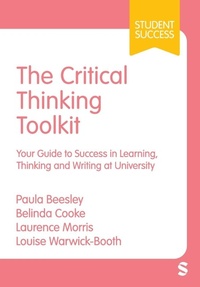
The Critical Thinking Toolkit
Your Guide to Success in Learning, Thinking and Writing at University
1st Edition
Will be published approx. on 13. December 2025
Book
Paperback/Softback
240 pages
978-1-5296-8318-9 (ISBN)
Description
We hear a lot about critical thinking at university but what does it really look like? This book has the answer.
Whether you're writing essays, prepping for exams, or navigating lectures, seminars and placements, this book helps you build the thinking skills that make university life easier and your work stronger.
Inside, you'll find:
Real examples and exercises that show how critical thinking works in everyday study situations.
Step-by-step support to help you sharpen your reasoning and make confident decisions.
Flexible tools-like action plans and activities-you can adapt to your own goals and pace.
Smart guidance on AI and how to use it ethically and effectively in your work.
This book covers critical thinking from every angle, with practical advice to actually help you do it. Whether you're just starting out or want to level up, it's time to say goodbye to feedback that calls for stronger arguments and hello to better marks.
Student Success is a series of essential guides for students of all levels. From how to think critically and write great essays to boosting your employability and managing your wellbeing, the Student Success series helps you study smarter and get the best from your time at university.
Whether you're writing essays, prepping for exams, or navigating lectures, seminars and placements, this book helps you build the thinking skills that make university life easier and your work stronger.
Inside, you'll find:
Real examples and exercises that show how critical thinking works in everyday study situations.
Step-by-step support to help you sharpen your reasoning and make confident decisions.
Flexible tools-like action plans and activities-you can adapt to your own goals and pace.
Smart guidance on AI and how to use it ethically and effectively in your work.
This book covers critical thinking from every angle, with practical advice to actually help you do it. Whether you're just starting out or want to level up, it's time to say goodbye to feedback that calls for stronger arguments and hello to better marks.
Student Success is a series of essential guides for students of all levels. From how to think critically and write great essays to boosting your employability and managing your wellbeing, the Student Success series helps you study smarter and get the best from your time at university.
More details
Series
Edition
First
Language
English
Place of publication
London
United Kingdom
Target group
College/higher education
Dimensions
Height: 244 mm
Width: 170 mm
Thickness: 13 mm
Weight
425 gr
ISBN-13
978-1-5296-8318-9 (9781529683189)
Copyright in bibliographic data and cover images is held by Nielsen Book Services Limited or by the publishers or by their respective licensors: all rights reserved.
Schweitzer Classification
Other editions
Additional editions
Paula Beesley | Belinda Cooke | Laurence Morris
The Critical Thinking Toolkit
Your Guide to Success in Learning, Thinking and Writing at University
Book
approx. 12/2025
1st Edition
SAGE Publications Ltd
€43.50
Not yet published
Paula Beesley | Belinda Cooke | Laurence Morris
The Critical Thinking Toolkit
Your Guide to Success in Learning, Thinking and Writing at University
E-Book
11/2025
Sage Publications Ltd (Digital)
€20.49
Available for download
Paula Beesley | Belinda Cooke | Laurence Morris
The Critical Thinking Toolkit
Your Guide to Success in Learning, Thinking and Writing at University
E-Book
11/2025
Sage Publications Ltd (Digital)
€20.49
Available for download
Persons
Paula Beesley is a Senior Lecturer in Social Work at Leeds Beckett University, with interests in communication skill development and practice placements. She holds the Practice Teacher Award, and has been a practice teacher for 20 years both as a child protection social worker and as an independent off-site practice educator working with a wide range of placements and students. She is currently undertaking a PhD into communication in social work student supervision on placement.
Louise is a sociologist with specific interests in health policy and social policy. She is a Reader located in The Centre for Health Promotion Research, which she has co-directed since 2013. Louise joined the University in September 2005 and has taught on a wide range of modules including sociology, health policy, research, community and global policy and health care. She also manages a range of research projects and a team of research staff.
Louise's research projects are diverse and include a commissioned evaluation of the Way Forward Programme, a project to develop resilience in vulnerable young women with unmet need, the evaluation of a Department of Health Eatwell and Livewell Project to tackle malnutrition amongst the elderly, and the project management of the Sunderland Health Champion Programme.
Louise has recently conducted a range of research with vulnerable young women, drawing upon feminist participatory approaches to data collection in order to give young women voice. Her research has been used in practice to improve interventions during their delivery and in securing future funding for further work in this area. Her other evaluation research is used in practice similarly to further develop interventions, and to capture the voice of service users.
Louise is a sociologist with specific interests in health policy and social policy. She is a Reader located in The Centre for Health Promotion Research, which she has co-directed since 2013. Louise joined the University in September 2005 and has taught on a wide range of modules including sociology, health policy, research, community and global policy and health care. She also manages a range of research projects and a team of research staff.
Louise's research projects are diverse and include a commissioned evaluation of the Way Forward Programme, a project to develop resilience in vulnerable young women with unmet need, the evaluation of a Department of Health Eatwell and Livewell Project to tackle malnutrition amongst the elderly, and the project management of the Sunderland Health Champion Programme.
Louise has recently conducted a range of research with vulnerable young women, drawing upon feminist participatory approaches to data collection in order to give young women voice. Her research has been used in practice to improve interventions during their delivery and in securing future funding for further work in this area. Her other evaluation research is used in practice similarly to further develop interventions, and to capture the voice of service users.
Content
PART I: CRITICAL THINKING FOR STUDENTS
Chapter 1: What is critical thinking?
Chapter 2: Why critical thinking matters at university
Chapter 3: Becoming a critical thinker
PART II: CRITICAL THINKING IN LECTURES AND SEMINARS
Chapter 4: Critical thinking before lectures and seminars
Chapter 5: Critical thinking during lecturers
Chapter 6: Critical thinking during seminars
Chapter 7: Critical thinking after lectures and seminars
PART III: CRITICAL THINKING IN ASSESSED WORK
Chapter 8: Critical thinking and critical writing
Chapter 9: Critical thinking in essays
Chapter 10: Critical thinking in presentations
Chapter 11: Critical thinking in exams
Chapter 12: Critical thinking in practice learning and practical assessments: skills practice, role plays, experiments, placements, volunteering hours, apprenticeships
Chapter 13: Critical thinking and responding to feedback
Chapter 1: What is critical thinking?
Chapter 2: Why critical thinking matters at university
Chapter 3: Becoming a critical thinker
PART II: CRITICAL THINKING IN LECTURES AND SEMINARS
Chapter 4: Critical thinking before lectures and seminars
Chapter 5: Critical thinking during lecturers
Chapter 6: Critical thinking during seminars
Chapter 7: Critical thinking after lectures and seminars
PART III: CRITICAL THINKING IN ASSESSED WORK
Chapter 8: Critical thinking and critical writing
Chapter 9: Critical thinking in essays
Chapter 10: Critical thinking in presentations
Chapter 11: Critical thinking in exams
Chapter 12: Critical thinking in practice learning and practical assessments: skills practice, role plays, experiments, placements, volunteering hours, apprenticeships
Chapter 13: Critical thinking and responding to feedback