

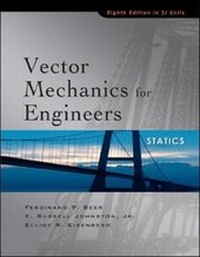
Vector Mechanics for Engineers: Statics (SI units)
8th Edition
Published on 16. July 2007
Book
Paperback/Softback
644 pages
978-0-07-125765-7 (ISBN)
Description
Vector Mechanics for Engineers: Statics and its companion volume, Vector Mechanics for Engineers: Dynamics, are designed to develop in first-year engineering students the ability to analyze any problem in a simple and logical manner, and to apply basic engineering principles to its solution. Each chapter begins with an introduction and a set of learning objectives, and ends with a chapter review and summary. The body of the text is divided into units, each consisting of one or several theory sections, one or several sample problems, and a large number of problems to be assigned during the class or as homework. The sample problems serve the double purpose of amplifying the text and demonstrating the type of neat, orderly work that students should cultivate in their own solutions. This allows students to organize in their minds the theories and solution methods learnt before they tackle the assigned problems. Each unit corresponds to a well-defined topic and can generally be covered in one lesson.
More details
Other editions
New editions
Ferdinand Beer | Jr., E. Russell Johnston | David Mazurek
Vector Mechanics for Engineers: Statics (Asia Adaptation)
Book
10/2010
9th Edition
McGraw Hill Higher Education
€59.41
Article is exhausted; no reprint
Persons
Author
Born in France and educated in France and Switzerland, Ferdinand Beer held an M.S. degree from the Sorbonne and an Sc.D. degree in theoretical mechanics from the University of Geneva. He came to the United States after serving in the French army during the early part of World War II and taught for four years at Williams College in the Williams-MIT joint arts and engineering program. Following his service at Williams College, Beer joined the faculty of Lehigh University, where he taught for thirty-seven years. He held several positions, including the University Distinguished Professors Chair and Chairman of the Mechanical Engineering and Mechanics Department. In 1995, Beer was awarded an honorary Doctor of Engineering degree by Lehigh University.
Born in Philadelphia, Russ holds a B.S. degree in civil engineering from the University of Delaware and an Sc.D. degree in the field of structural engineering from The Massachusetts Institute of Technology (MIT). He taught at Lehigh University and Worchester Polytechnic Institute (WPI) before joining the faculty of the University of Connecticut where he held the position of Chairman of the Civil Engineering Department and taught for twenty-six years. In 1991 Russ received the Outstanding Civil Engineer Award from the Connecticut Section of the American Society of Civil Engineers.
Elliot holds a B.S. degree in engineering and an M.E. degree, both from Cornell University. He has focused his scholarly activities on professional service and teaching, and he was recognized for this work in 1992 when the American Society of Mechanical Engineers (ASME) awarded him the Ben C. Sparks Medal for his contributions to mechanical engineering and mechanical engineering technology education and for service to the American Society for Engineering Education (ASEE). Elliot taught for thirty-two years, including twenty-nine years at Penn State where he was recognized with awards for both teaching and advising.
Content
Contents
Preface
List of Symbols
1. Introduction
2. Statics of Particles
Forces in a Plane
Forces in Space
3. Rigid Bodies: Equivalent Systems of Forces
4. Equilibrium of Rigid Bodies
Equilibrium in Two Dimensions
Equilibrium in Three Dimensions
5. Distributed Forces: Centroids and Centers of Gravity
Areas and Lines
Volumes
6. Analysis of Structures
Trusses
Frames and Machines
7. Forces in Beams and Cables
Beams
Cables
8. Friction
9. Distributed Forces: Moments of Inertia
Moments of Inertia of Areas
Moments of Inertia of Masses
10. Method of Virtual Work
Appendix
Photo Credits
Index
Answers to Problems
Preface
List of Symbols
1. Introduction
2. Statics of Particles
Forces in a Plane
Forces in Space
3. Rigid Bodies: Equivalent Systems of Forces
4. Equilibrium of Rigid Bodies
Equilibrium in Two Dimensions
Equilibrium in Three Dimensions
5. Distributed Forces: Centroids and Centers of Gravity
Areas and Lines
Volumes
6. Analysis of Structures
Trusses
Frames and Machines
7. Forces in Beams and Cables
Beams
Cables
8. Friction
9. Distributed Forces: Moments of Inertia
Moments of Inertia of Areas
Moments of Inertia of Masses
10. Method of Virtual Work
Appendix
Photo Credits
Index
Answers to Problems