

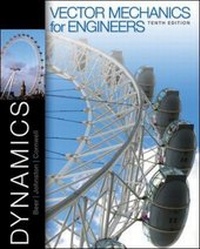
Vector Mechanics for Engineers: Dynamics
10th Edition
Published on 1. February 2012
Book
Hardback
832 pages
978-0-07-740232-7 (ISBN)
Description
Continuing in the spirit of its successful previous editions, the tenth edition of Beer, Johnston, Mazurek, and Cornwell's Vector Mechanics for Engineers provides conceptually accurate and thorough coverage together with a significant refreshment of the exercise sets and online delivery of homework problems to your students. Nearly forty percent of the problems in the text are changed from the previous edition.
The Beer/Johnston textbooks introduced significant pedagogical innovations into engineering mechanics teaching. The consistent, accurate problem-solving methodology gives your students the best opportunity to learn statics and dynamics. At the same time, the careful presentation of content, unmatched levels of accuracy, and attention to detail have made these texts the standard for excellence.
The Beer/Johnston textbooks introduced significant pedagogical innovations into engineering mechanics teaching. The consistent, accurate problem-solving methodology gives your students the best opportunity to learn statics and dynamics. At the same time, the careful presentation of content, unmatched levels of accuracy, and attention to detail have made these texts the standard for excellence.
More details
Persons
Born in France and educated in France and Switzerland, Ferd held an M.S. degree from the Sorbonne and an Sc.D. degree in theoretical mechanics from the University of Geneva. He came to the United States after serving in the French army during the early part of World War II and had taught for four years at Williams College in the Williams-MIT joint arts and engineering program. Following his service at Williams College, Ferd joined the faculty of Lehigh University where he taught for thirty-seven years. He held several positions, including the University Distinguished Professors Chair and Chairman of the Mechanical Engineering and Mechanics Department, and in 1995 Ferd was awarded an honorary Doctor of Engineering degree by Lehigh University.
Born in Philadelphia, Russ holds a B.S. degree in civil engineering from the University of Delaware and an Sc.D. degree in the field of structural engineering from The Massachusetts Institute of Technology (MIT). He taught at Lehigh University and Worchester Polytechnic Institute (WPI) before joining the faculty of the University of Connecticut where he held the position of Chairman of the Civil Engineering Department and taught for twenty-six years. In 1991 Russ received the Outstanding Civil Engineer Award from the Connecticut Section of the American Society of Civil Engineers.
Phillip J. Cornwell.
Phil holds a B.S. degree in mechanical engineering
from Texas Tech University and M.A. and Ph.D. degrees in mechanical and
aerospace engineering from Princeton University. He is currently a professor of
mechanical engineering at Rose-Hulman Institute of Technology where he has
taught since 1989. His present interests include structural dynamics, structural
health monitoring, and undergraduate engineering education. Phil spends his
summers working at Los Alamos National Laboratory where he is a mentor in the
Los Alamos Dynamics Summer School and he does research in the area of structural
health monitoring. Phil received an SAE Ralph R. Teetor Educational Award in
1992, the Dean's Outstanding Scholar Award at Rose-Hulman in 2000, and the Board
of Trustees Outstanding Scholar Award at Rose-Hulman in 2001.
Born in Philadelphia, Russ holds a B.S. degree in civil engineering from the University of Delaware and an Sc.D. degree in the field of structural engineering from The Massachusetts Institute of Technology (MIT). He taught at Lehigh University and Worchester Polytechnic Institute (WPI) before joining the faculty of the University of Connecticut where he held the position of Chairman of the Civil Engineering Department and taught for twenty-six years. In 1991 Russ received the Outstanding Civil Engineer Award from the Connecticut Section of the American Society of Civil Engineers.
Phillip J. Cornwell.
Phil holds a B.S. degree in mechanical engineering
from Texas Tech University and M.A. and Ph.D. degrees in mechanical and
aerospace engineering from Princeton University. He is currently a professor of
mechanical engineering at Rose-Hulman Institute of Technology where he has
taught since 1989. His present interests include structural dynamics, structural
health monitoring, and undergraduate engineering education. Phil spends his
summers working at Los Alamos National Laboratory where he is a mentor in the
Los Alamos Dynamics Summer School and he does research in the area of structural
health monitoring. Phil received an SAE Ralph R. Teetor Educational Award in
1992, the Dean's Outstanding Scholar Award at Rose-Hulman in 2000, and the Board
of Trustees Outstanding Scholar Award at Rose-Hulman in 2001.
Content
11 Kinematics of Particles
12 Kinetics of Particles: Newton's Second Law
13 Kinetics of Particles: Energy and Momentum Methods
14 Systems of Particles
15 Kinematics of Rigid Bodies
16 Plane Motion of Rigid Bodies: Forces and Accelerations
17 Plane Motion of Rigid Bodies: Energy and Momentum Methods
18 Kinetics of Rigid Bodies in Three Dimensions
19 Mechanical Vibrations
Appendix A Some Useful Definitions and Properties of Vector Algebra
Appendix B Moments of Inertia of Masses
Appendix C Fundamentals of Engineering Examination
12 Kinetics of Particles: Newton's Second Law
13 Kinetics of Particles: Energy and Momentum Methods
14 Systems of Particles
15 Kinematics of Rigid Bodies
16 Plane Motion of Rigid Bodies: Forces and Accelerations
17 Plane Motion of Rigid Bodies: Energy and Momentum Methods
18 Kinetics of Rigid Bodies in Three Dimensions
19 Mechanical Vibrations
Appendix A Some Useful Definitions and Properties of Vector Algebra
Appendix B Moments of Inertia of Masses
Appendix C Fundamentals of Engineering Examination