

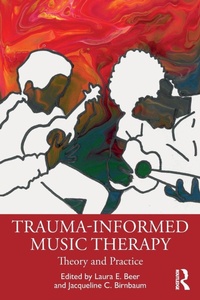
Trauma-Informed Music Therapy
Theory and Practice
1st Edition
Published on 30. August 2022
Book
Paperback/Softback
164 pages
978-1-032-06126-9 (ISBN)
Description
Trauma-Informed Music Therapy is a timely volume that combines theoretical perspectives on trauma-informed practice with real-life applications in music therapy practice.
Board-certified music therapists are in a unique position to provide comfort, create a sense of safety, and empower people to find their voice during and after traumatic experiences. In this book, the theory behind trauma-informed practice (TIP) is explored and expanded through stories of clinical implementation, social justice practices, and music therapy theories. Spanning topics such as grief and loss, adverse childhood experiences and their intergenerational effects, domestic abuse, urban trauma, polyvagal theory, and psychological first aid, this book addresses music therapy as the emerging therapeutic treatment modality for adults, children, and teenagers alike.
This book will be of interest to practicing music therapists and music therapy students who are learning how to bring music therapy to victims and survivors of trauma.
Board-certified music therapists are in a unique position to provide comfort, create a sense of safety, and empower people to find their voice during and after traumatic experiences. In this book, the theory behind trauma-informed practice (TIP) is explored and expanded through stories of clinical implementation, social justice practices, and music therapy theories. Spanning topics such as grief and loss, adverse childhood experiences and their intergenerational effects, domestic abuse, urban trauma, polyvagal theory, and psychological first aid, this book addresses music therapy as the emerging therapeutic treatment modality for adults, children, and teenagers alike.
This book will be of interest to practicing music therapists and music therapy students who are learning how to bring music therapy to victims and survivors of trauma.
Reviews / Votes
"Trauma can be caused by various origins, not only by natural disasters but also violence, social oppression, and so on. This book covers such a wide range of populations who are affected by various origins of trauma, as well as overarching trauma theories. As someone who experienced the Great East Japan earthquake and nuclear disaster in 2011, I know how important and effective the trauma work can be. This book will be a valuable resource for students and professionals who wish to work with such populations. I highly recommend this book."Yuji Igari, M. S., Associate Professor of Music Therapy, Nagoya College of Music, Japan
"This book includes chapters by a stellar group of international contributors, many of whom are recognized as authorities in their areas of expertise. The topics covered are highly relevant in the contemporary world, including natural disaster trauma, cultural issues including race and gender/sexual preference identity, and sexual and intimate partner violence, in addition to the more traditional focuses of psychiatry and oncology. Contemporary approaches are used to develop broad-based theory that is relevant across specific clinical areas and music therapy treatment models. This book is an essential resource for music therapists working within psychotherapy contexts."
Kenneth Aigen, Director of Music Therapy, New York University, USA
"This book offers an essential introduction to principles of trauma-informed practice in music therapy. The editors bring together a collection of voices that demonstrate the potential for music to assist in the healing process in the aftermath of difficult events that shape our lives. It will be an incredibly valuable resource to both students and experienced practitioners across the creative arts therapies."
Prof. Nisha Sajnani, Director, Program in Drama Therapy, New York University, USA
"Trauma can affect people in many ways. This book discusses trauma-informed practice (TIP), laying a theoretical framework and drawing together some of the ways of working with trauma. The authors come from a variety of backgrounds and clinical settings, thus presenting various perspectives on this work. An awareness of the power dynamics that may intersect with experiences of trauma runs through a number of the chapters. I expect that music therapists and others will be stimulated by the contents and excited to read about new approaches to trauma-informed practice in music therapy."
Barbara L. Wheeler, PhD, MT-BC, Professor Emeritus, Montclair State University, USA
More details
Language
English
Place of publication
London
United Kingdom
Publishing group
Taylor & Francis Ltd
Target group
College/higher education
Professional and scholarly
Academic, Postgraduate, and Professional Practice & Development
Illustrations
2 s/w Abbildungen, 2 s/w Zeichnungen, 1 s/w Tabelle
1 Tables, black and white; 2 Line drawings, black and white; 2 Illustrations, black and white
Dimensions
Height: 229 mm
Width: 152 mm
Thickness: 11 mm
Weight
276 gr
ISBN-13
978-1-032-06126-9 (9781032061269)
Copyright in bibliographic data and cover images is held by Nielsen Book Services Limited or by the publishers or by their respective licensors: all rights reserved.
Schweitzer Classification
Other editions
Additional editions
E-Book
08/2022
1st Edition
Routledge
€45.99
Available for download
E-Book
08/2022
1st Edition
Routledge
€45.99
Available for download
Book
08/2022
1st Edition
Routledge
€195.80
Shipment within 10-20 days
Persons
Laura E. Beer, PhD, is an Associate Professor of Music Therapy at Colorado State University and the Editor for Music Therapy Perspectives. She has extensive clinical experience as a music therapist, researcher, author, and educator. Her most recent clinical experience includes working in the neonatal intensive care unit (NICU) and with children who have multiple developmental challenges.
Jacqueline C. Birnbaum, MSEd, is the administrative coordinator and senior clinician at the Nordoff-Robbins Center for Music Therapy at New York University. She is a musician and composer and has presented internationally on the use of Creative Music Therapy. Jacqueline has served as Chair of the Certification Board for Music Therapists and currently is on the editorial board of the journal Music Therapy Perspectives.
Jacqueline C. Birnbaum, MSEd, is the administrative coordinator and senior clinician at the Nordoff-Robbins Center for Music Therapy at New York University. She is a musician and composer and has presented internationally on the use of Creative Music Therapy. Jacqueline has served as Chair of the Certification Board for Music Therapists and currently is on the editorial board of the journal Music Therapy Perspectives.
Content
1. Introduction, Part I: Theories and Perspectives, 2. The Resilience Framework for Trauma-Informed Music Therapy, 3. Global Trends in Music Therapy for Disaster Preparedness, Response, and Recovery, 4. Cultural Humility in Music Therapy Practice, 5. Questioning the Promise of Safety in Trauma-Informed Music Therapy Practice, Part II: Children and Adolescents, 6. I Am Safe and I Am Strong: Understanding Adverse Childhood Experiences and Building Resilience Through Trauma-Informed Music Therapy, 7. Changing the Narrative: Exploring how Music Therapy can Assist Adolescents Dealing with Race-Based Traumatic Stress, 8. Music Therapy with Children in the Aftermath of a Natural Disaster, 9. Clinical Songwriting for Children with Cancer and Sickle Cell Disease, Part III: Adults, 10. Music Therapy for Survivors of Sexual Violence and Intimate Partner Violence, 11. Group Work with Adults in Short-Term Inpatient Psychiatric Treatment and Recovery, 12. Trauma-Informed Music Psychotherapy in Radiation Oncology: Implementation of the Trauma, Resilience, Safety Model, 13. Finding One's Voice: Working Through Developmental Trauma with Vocal Psychotherapy, 14. Music Therapy in the Treatment of Complex Trauma in Adult Mental Health, 15. "I Hear You": The Potency of Play in Music Psychotherapy for Treating Trauma in Musicians, 16. Bent Pitch: Trauma, the LGBTQAI+ Community, and Music Psychotherapy, 17. Mechanisms of Change in Music Therapy when Treating Adults Coping with Trauma, 18. Conclusion