

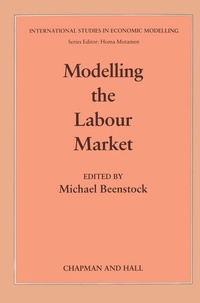
Modelling the Labour Market
Published on 30. October 2011
Book
Paperback/Softback
XII, 206 pages
978-94-010-7035-5 (ISBN)
Description
It is generally agreed that the operation of the labour market lies at the heart of macroeconomic activity. Following Keynes' attack on the postulates of the classics in The General Theory a number of labour market paradigms have been proposed including the Phillips curve, new classical and union bargaining models. These paradigms usually form the centrepiece of any good text on macroeconomic theory. Our purpose in this volume is not to restate these paradigms but to explore the extent to which they might be empirically modelled. To this end the volume includes a set of econometric models of the UK labour market where each contribution relates very closely to one of the principal paradigms. The purpose of this collection is threefold. First and foremost we wanted to present an integrated set of case studies in applied econometrics with reference to labour market modelling. In doing so we hope the volume will appeal to third year undergraduates and postgraduate students studying applied econometrics and labour economics. Secondly, the contributions have been carefully selected to illustrate the main paradigms since each contribution is intellectually self contained. It is arguable that this may be disadvantageous as far as the truth is concerned if eclecticism is preferable. On the other hand it has pedagogic advantages in drawing sharp distinctions between the various approaches.
More details
Series
Edition
Softcover reprint of the original 1st ed. 1988
Language
English
Place of publication
Dordrecht
Netherlands
Target group
Professional and scholarly
Research
Illustrations
XII, 206 p.
Dimensions
Height: 235 mm
Width: 155 mm
Thickness: 13 mm
Weight
347 gr
ISBN-13
978-94-010-7035-5 (9789401070355)
DOI
10.1007/978-94-009-1203-8
Other editions
Additional editions

Michael Beenstock
Modelling the Labour Market
Book
06/1988
Chapman and Hall
€89.13
Article exhausted; check different version
Content
1 The labour market: theory and experience.- 1.1 The concept of the labour market.- 1.2 The supply and demand for labour.- 1.3 Models of unemployment.- 1.4 Macroeconomics and the labour market.- 1.5 The Phillips curve and the NAIRU.- 1.6 Some features of the data.- References.- 2 Some formal models of the aggregate labour market.- 2.1 Introduction.- 2.2 Labour demand.- 2.3 Some formal models.- Appendix A.- References.- 3 The disequilibrium approach to modelling the labour market.- 3.1 Introduction.- 3.2 The multimarket non-clearing model.- 3.3 The labour market in disequilibrium.- 3.4 Empirical results.- 3.5 Policy implications.- 3.6 Conclusions.- References.- 4 A neoclassical model of the UK labour market.- 4.1 Introduction.- 4.2 Theory.- 4.3 Econometric results.- 4.4 Simulations.- Appendix A.- References.- 5 A new classical model of the labour marketg.- 5.1 The model in outline.- 5.2 The labour market in detail.- 5.3 The demand for labour.- 5.4 Responses to critics.- 5.5 Conclusions.- Acknowledgement.- References.- 6 Imperfect competition and the labour market.- 6.1 Introduction.- 6.2 Price and employment behaviour.- 6.3 Wage determination.- 6.4 The labour market in a macromodel.- 6.5 Empirical analysis of the British labour market.- 6.6 Summary and conclusions.- References.- 7 An international perspective.- 7.1 Introduction.- 7.2 Multi-country studies: some comments.- 7.3 Selected applications of labour market models.- 7.4 Multi-country studies: some examples.- 7.5 Institutional characteristics.- 7.6 Concluding comments.- Acknowledgements.- References.