

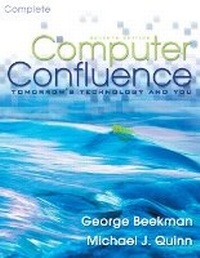
Computer Confluence Complete
United States Edition
7th Edition
Published on 24. March 2005
Book
Paperback/Softback
688 pages
978-0-13-152531-3 (ISBN)
Description
For introductory courses in computer concepts often including instruction in Microsoft Office.
Integrates three information sources-an illustrated textbook, a multimedia CD, and a Companion Website-with a lively writing style to explore the promises and challenges of information technology, its effect on businesses, people, society, and the future.
Integrates three information sources-an illustrated textbook, a multimedia CD, and a Companion Website-with a lively writing style to explore the promises and challenges of information technology, its effect on businesses, people, society, and the future.
More details
Edition
7th edition
Language
English
Place of publication
United States
Publishing group
Pearson Education (US)
Target group
Professional and scholarly
Weight
1000 gr
ISBN-13
978-0-13-152531-3 (9780131525313)
Copyright in bibliographic data and cover images is held by Nielsen Book Services Limited or by the publishers or by their respective licensors: all rights reserved.
Schweitzer Classification
Other editions
Previous edition
Book
05/2004
6th Edition
Prentice Hall
€60.82
Article exhausted; check for reprint
Persons
George Beekman is the author of more than 20 books and 100 articles and reviews on computers, information technology, and multimedia. He has taught courses in multimedia, computer literacy and computer ethics at Oregon State University for more than two decades.
Michael J. Quinn is a Professor in the School of Electrical Engineering and Computer Science at Oregon State University. He is the author of more than 70 publications, including five books on subjects ranging from computer ethics to parallel computing.
Michael J. Quinn is a Professor in the School of Electrical Engineering and Computer Science at Oregon State University. He is the author of more than 70 publications, including five books on subjects ranging from computer ethics to parallel computing.
Content
Basics.
I. APPROACHING COMPUTERS.
Chapter 1. Computer Currents and Internet Waves: The Long View.
Chapter 2. Hardware Basics: Inside the Box.
Chapter 3. Hardware Basics: Peripherals.
Chapter 4. Software Basics: The Ghost in the Machine.
II. USING SOFTWARE.
Chapter 5. Basic Productivity Applications.
Chapter 6. Graphics, Digital Media, and Multimedia.
Chapter 7. Database Applications and Implications.
III. EXPLORING WITH COMPUTERS: NETWORKING AND THE INTERNET.
Chapter 8. Networking and Telecommunication.
Chapter 9. Inside the Internet and the World Wide Web.
IV. LIVING WITH COMPUTERS: ISSUES AND IMPLICATIONS.
Chapter 10. Computer Security and Risks.
Chapter 11. Computers at Work, School, and Home.
V. MANAGING COMPUTERS: INFORMATION SYSTEMS AT WORK.
Chapter 12. Information Systems in Business.
Chapter 13. Electronic Commerce and E-Business.
VI. MASTERING COMPUTERS.
Chapter 14. Is Artificial Intelligence Real?
Appendix: Code of Ethics and Professional Conduct.
Glossary.
Credits.
Index.
I. APPROACHING COMPUTERS.
Chapter 1. Computer Currents and Internet Waves: The Long View.
Chapter 2. Hardware Basics: Inside the Box.
Chapter 3. Hardware Basics: Peripherals.
Chapter 4. Software Basics: The Ghost in the Machine.
II. USING SOFTWARE.
Chapter 5. Basic Productivity Applications.
Chapter 6. Graphics, Digital Media, and Multimedia.
Chapter 7. Database Applications and Implications.
III. EXPLORING WITH COMPUTERS: NETWORKING AND THE INTERNET.
Chapter 8. Networking and Telecommunication.
Chapter 9. Inside the Internet and the World Wide Web.
IV. LIVING WITH COMPUTERS: ISSUES AND IMPLICATIONS.
Chapter 10. Computer Security and Risks.
Chapter 11. Computers at Work, School, and Home.
V. MANAGING COMPUTERS: INFORMATION SYSTEMS AT WORK.
Chapter 12. Information Systems in Business.
Chapter 13. Electronic Commerce and E-Business.
VI. MASTERING COMPUTERS.
Chapter 14. Is Artificial Intelligence Real?
Appendix: Code of Ethics and Professional Conduct.
Glossary.
Credits.
Index.