

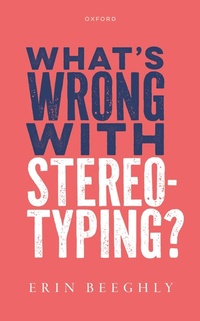
What's Wrong with Stereotyping?
Published on 22. April 2025
Book
Hardback
272 pages
978-0-19-882966-9 (ISBN)
Description
What's Wrong with Stereotyping? offers a refreshing and accessibly written philosophical take on the ethics of stereotyping. Stereotyping is woven into every aspect of human experience: conversation, psychology, algorithmic systems, and culture. It relates to generalization and induction, core aspects of rationality. But when and why it is morally wrong to stereotype? This book tackles this deep and enduring puzzle. To solve it, Erin Beeghly delves into the relationship between stereotyping and another phenomenon, discrimination. Not only does stereotyping cause discriminatory treatment, she argues, stereotyping can itself be discriminatory. This insight-that to stereotype is to discriminate-enables a novel philosophical methodology, which builds towards a theory of wrongful stereotyping by analyzing the lived experiences of marginalized groups and existing theories of wrongful discrimination.
Core chapters evaluate important ethical wrongs: the failure to treat persons as individuals, disrespect, harm, prejudice, threats to freedoms, and the failure to treat persons as equals. One finds that there is no "essence" of wrongful stereotyping, a single property or set of properties that all problematic cases share in common. Nor are the wrongs of stereotyping reducible to an elegant number, two or three. Instead, wrongful stereotyping is a messy normative kind characterized by clusters of wrong-making properties, including all the ones noted here (and perhaps more). Readers will come away with a radically pluralistic, open-ended theory of wrongful stereotyping that they can use to identify wrongful stereotyping in their own lives and our contemporary world. Filled with thought-provoking examples and models for social change, this book emphasizes the messiness of moral reality and the importance of looking to the past in order to understand the ethical perils of stereotyping.
Core chapters evaluate important ethical wrongs: the failure to treat persons as individuals, disrespect, harm, prejudice, threats to freedoms, and the failure to treat persons as equals. One finds that there is no "essence" of wrongful stereotyping, a single property or set of properties that all problematic cases share in common. Nor are the wrongs of stereotyping reducible to an elegant number, two or three. Instead, wrongful stereotyping is a messy normative kind characterized by clusters of wrong-making properties, including all the ones noted here (and perhaps more). Readers will come away with a radically pluralistic, open-ended theory of wrongful stereotyping that they can use to identify wrongful stereotyping in their own lives and our contemporary world. Filled with thought-provoking examples and models for social change, this book emphasizes the messiness of moral reality and the importance of looking to the past in order to understand the ethical perils of stereotyping.
Reviews / Votes
Stereotypes are related to another interesting phenomenon, namely discrimination. Stereotypes result in discrimination when people articulate stereotypes in speech and follow them up in action. For example, a statement by a security official stating the characteristics of a "potential terrorist" or the characteristics of a radical figure, then the media spreads those characteristics without any criticism at all. So, any official and any means that support/spread the stereotypical speech can be categorized as an attempt to discriminate. An attempt to eliminate people or groups in society who are considered a "threat". * Rosdiansyah, RMOLJATIM *More details
Language
English
Place of publication
Oxford
United Kingdom
Target group
Professional and scholarly
Dimensions
Height: 219 mm
Width: 140 mm
Thickness: 24 mm
Weight
460 gr
ISBN-13
978-0-19-882966-9 (9780198829669)
Copyright in bibliographic data and cover images is held by Nielsen Book Services Limited or by the publishers or by their respective licensors: all rights reserved.
Schweitzer Classification
Person
Erin Beeghly is Associate Professor of Philosophy at the University of Utah. Her research lies at the intersection of ethics, social epistemology, feminist philosophy, and moral psychology. She and Alex Madva are co-editors of the first philosophical introduction to implicit bias: An Introduction to Implicit Bias: Knowledge, Justice, and the Social Mind (Routledge, 2020). Beeghly's research has been supported by the NEH, ACLS, National Humanities Center, the AAUW, and Townsend Center for Humanities at Berkeley. Beeghly received a PhD from UC Berkeley in 2014, a BA in PPE from the University of Oxford in 2006, and a BA in History from UC Berkeley in 2004.
Content
Introduction
1: A Starting Point for Theorizing: What is a Stereotype? What is Stereotyping?
2: To Stereotype Is to Discriminate
3: Lived Experience and the Wrongs of Stereotyping
4: Failing to Treat Persons as Individuals
5: Prejudice and the Problem of Statistical Stereotyping
6: Disrespect and Harm
7: Freedom and Failing to Treat Persons as Equals
8: Radical Pluralism A New Theory of Wrongful Stereotyping
1: A Starting Point for Theorizing: What is a Stereotype? What is Stereotyping?
2: To Stereotype Is to Discriminate
3: Lived Experience and the Wrongs of Stereotyping
4: Failing to Treat Persons as Individuals
5: Prejudice and the Problem of Statistical Stereotyping
6: Disrespect and Harm
7: Freedom and Failing to Treat Persons as Equals
8: Radical Pluralism A New Theory of Wrongful Stereotyping