

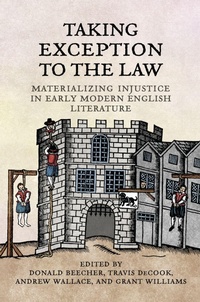
Taking Exception to the Law
Materializing Injustice in Early Modern English Literature
Published on 29. January 2015
Book
Hardback
288 pages
978-1-4426-4201-0 (ISBN)
Description
Taking Exception to the Law explores how a range of early modern English writings responded to injustices perpetrated by legal procedures, discourses, and institutions. From canonical poems and plays to crime pamphlets and educational treatises, the essays engage with the relevance and wide appeal of legal questions in order to understand how literature operated in the early modern period.
Justice in its many forms - legal, poetic, divine, natural, and customary - is examined through insightful and innovative analyses of a number of texts, including The Merchant of Venice, The Faerie Queene, and Paradise Lost. A major contribution to the growing field of law and literature, this collection offers cultural contexts, interpretive insights, and formal implications for the entire field of English Renaissance culture.
Justice in its many forms - legal, poetic, divine, natural, and customary - is examined through insightful and innovative analyses of a number of texts, including The Merchant of Venice, The Faerie Queene, and Paradise Lost. A major contribution to the growing field of law and literature, this collection offers cultural contexts, interpretive insights, and formal implications for the entire field of English Renaissance culture.
Reviews / Votes
'Highly recommended'- J.D. Sharpe (Choice Magazine, vol 52:12:2015) 'The volume takes its place among lively and rapidly expanding scholarship on early modern law and literature... Such a survey can do little, of course, to give a full sense of the richness of the volume but perhaps can tantalize readers with the variety of texts and breadth of concepts the authors tackle.'
- Karen Cunningham (Renaissance Quarterly vol 69:02:2016) 'The editors gather an admirable selection of essays from a range of scholars....Taking Exception to the Law provokes stimulating conversation between legal and literary sources.'
- Larissa Tracy (Sixteenth Century Studies vol 47:02:2016) 'Taking Exception to the Law certainly illuminates the networks of literary actors, both non-human and human, that exert power in early modern English law.'
- Marissa Greenberg (English Studies in Canada vol 42:3-4:2016)
More details
Language
English
Place of publication
Toronto
Canada
Target group
College/higher education
Professional and scholarly
Product notice
sewn/stitched
Cloth over boards
With dust jacket
Dimensions
Height: 234 mm
Width: 155 mm
Thickness: 33 mm
Weight
617 gr
ISBN-13
978-1-4426-4201-0 (9781442642010)
Copyright in bibliographic data and cover images is held by Nielsen Book Services Limited or by the publishers or by their respective licensors: all rights reserved.
Schweitzer Classification
Persons
Donald Beecher is a professor in the Department of English at Carleton University.
Travis DeCook is an associate professor in the Department of English at Carleton University.
Andrew Wallace is an associate professor in the Department of English at Carleton University.
Grant Williams is an associate professor in the Department of English at Carleton University.
Travis DeCook is an associate professor in the Department of English at Carleton University.
Andrew Wallace is an associate professor in the Department of English at Carleton University.
Grant Williams is an associate professor in the Department of English at Carleton University.
Content
1. Law and the Production of Literature: An Introductory Perspective (Grant Williams)
2. Paper Justice, Parchment Justice: Shakespeare, Hamlet, and the Life of Legal Documents (Bradin Cormack)
3. Conditional Promises and Legal Instruments in The Merchant of Venice (Tim Stretton)
4. The "Snared Subject" and the General Pardon Statute in Late Elizabethan Coterie Literature (Virginia Lee Strain)
5. The Prison Diaries of Archbishop Laud (Debora Shuger)
6. Criminal Biography in Early Modern News Pamphlets (David Stymeist)
7. Two-Sided Legal Narratives: Slander, Evidence, Proof, and Turnarounds in Much Ado About Nothing (Barbara Kreps)
8. No Boy Left Behind: Education and Distributive Justice in Early Modern England (Elizabeth Hanson)
9. Warding off Injustice in Book Five of The Faerie Queene (Judith Owens)
10. Torture and the Tyrant's Injustice from Foxe to King Lear (John D. Staines)
11. The Literatures of Toleration and Civil Religion in Post-Revolutionary England (Elliott Visconsi)
12. Obnoxious Satan: Milton, Neo-Roman Justice, and the Burden of Grace (Paul Stevens)
2. Paper Justice, Parchment Justice: Shakespeare, Hamlet, and the Life of Legal Documents (Bradin Cormack)
3. Conditional Promises and Legal Instruments in The Merchant of Venice (Tim Stretton)
4. The "Snared Subject" and the General Pardon Statute in Late Elizabethan Coterie Literature (Virginia Lee Strain)
5. The Prison Diaries of Archbishop Laud (Debora Shuger)
6. Criminal Biography in Early Modern News Pamphlets (David Stymeist)
7. Two-Sided Legal Narratives: Slander, Evidence, Proof, and Turnarounds in Much Ado About Nothing (Barbara Kreps)
8. No Boy Left Behind: Education and Distributive Justice in Early Modern England (Elizabeth Hanson)
9. Warding off Injustice in Book Five of The Faerie Queene (Judith Owens)
10. Torture and the Tyrant's Injustice from Foxe to King Lear (John D. Staines)
11. The Literatures of Toleration and Civil Religion in Post-Revolutionary England (Elliott Visconsi)
12. Obnoxious Satan: Milton, Neo-Roman Justice, and the Burden of Grace (Paul Stevens)