

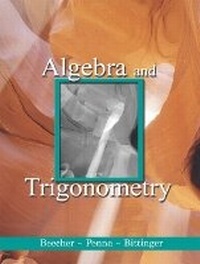
Algebra and Trigonometry
Published on 16. May 2002
Book
Hardback
880 pages
978-0-201-74141-4 (ISBN)
Description
The BPB team has created a book where the use of the graphing calculator is optional but visualizing the mathematics is not. By creating algebraic-visual side-by-sides, the authors show students the relationship of the algebraic solution with the visual, often graphical solution.
In addition to helping students visualize the math with the side-by-sides, the authors focus on helping students make the connection between x-intercepts, zeros and solutions, both visually and algebraically.
In addition to helping students visualize the math with the side-by-sides, the authors focus on helping students make the connection between x-intercepts, zeros and solutions, both visually and algebraically.
More details
Language
English
Place of publication
United States
Publishing group
Pearson Education (US)
Target group
Professional and scholarly
Dimensions
Height: 261 mm
Width: 210 mm
Thickness: 32 mm
Weight
1723 gr
ISBN-13
978-0-201-74141-4 (9780201741414)
Copyright in bibliographic data and cover images is held by Nielsen Book Services Limited or by the publishers or by their respective licensors: all rights reserved.
Schweitzer Classification
Other editions
New editions
Judith A. Beecher | Judith A. Penna | Marvin L. Bittinger
Algebra and Trigonometry
Book
06/2004
2nd Edition
Pearson
€100.27
Article exhausted; check for reprint
Content
R. Basic Concepts of Algebra.
The Real-Number System.
Integer Exponents, Scientific Notation, and Order of Operations.
Addition, Subtraction, and Multiplication of Polynomials.
Factoring.
Rational Expressions.
Radical Notation and Rational Exponents.
1. Graphs, Functions, and Models.
Introduction to Graphing.
Functions and Graphs.
Linear Functions, Slope, and Applications.
Equations of Lines and Modeling.
More on Functions.
Symmetry and Transformations.
2. Functions, Equations, and Inequalities.
Linear Equations, Functions, and Models.
The Complex Numbers.
Quadratic Equations, Functions, and Models.
Analyzing Graphs of Quadratic Equations.
More Equation Solving.
Solving Linear Inequalities.
3. Polynomial and Rational Functions.
Polynomial Functions and Models.
Polynomial Division; The Remainder and Factor Theorems.
Theorems about Zeros of Polynomial Functions.
Rational Functions.
Polynomial and Rational Inequalities.
Variation and Applications.
4. Exponential and Logarithmic Functions.
Composite and Inverse Functions.
Exponential Functions and Graphs.
Logarithmic Functions and Graphs.
Properties of Logarithmic Functions.
Solving Exponential and Logarithmic Equations.
Applications and Models: Growth and Decay.
5. The Trigonometric Functions.
Trigonometric Functions of Acute Angles.
Applications of Right Triangles.
Trigonometric Functions of Any Angle.
Radians, Arc Length, and Angular Speed.
Circular Functions: Graphs and Properties.
Graphs of Transformed Sine and Cosine Functions.
6. Trigonometric Identities, Inverse Functions, and Equations.
Identities: Pythagorean and Sum and Difference.
Identities: Cofunction, Double-Angle, and Half-Angle.
Proving Trigonometric Identities.
Inverses of the Trigonometric Functions.
Solving Trigonometric Equations.
7. Applications of Trigonometry.
The Law of Sines.
The Law of Cosines.
Complex Numbers: Trigonometric Form.
Polar Coordinates and Graphs.
Vectors and Applications.
Vector Operations.
8. Systems of Equations and Matrices.
Systems of Equations in Two Variables.
Systems of Equations in Three Variables.
Matrices and Systems of Equations.
Matrix Operations.
Inverses of Matrices.
Determinants and Cramer's Rule.
Systems of Inequalities and Linear Programming.
Partial Fractions.
9. Conic Sections.
The Parabola.
The Circle and the Ellipse.
The Hyperbola.
Nonlinear Systems of Equations.
10. Sequences, Series, and Combinatorics.
Sequences and Series.
Arithmetic Sequences and Series.
Geometric Sequences and Series.
Mathematical Induction.
Combinatorics: Permutations.
Combinatorics: Combinations.
The Binomial Theorem.
Probability.
The Real-Number System.
Integer Exponents, Scientific Notation, and Order of Operations.
Addition, Subtraction, and Multiplication of Polynomials.
Factoring.
Rational Expressions.
Radical Notation and Rational Exponents.
1. Graphs, Functions, and Models.
Introduction to Graphing.
Functions and Graphs.
Linear Functions, Slope, and Applications.
Equations of Lines and Modeling.
More on Functions.
Symmetry and Transformations.
2. Functions, Equations, and Inequalities.
Linear Equations, Functions, and Models.
The Complex Numbers.
Quadratic Equations, Functions, and Models.
Analyzing Graphs of Quadratic Equations.
More Equation Solving.
Solving Linear Inequalities.
3. Polynomial and Rational Functions.
Polynomial Functions and Models.
Polynomial Division; The Remainder and Factor Theorems.
Theorems about Zeros of Polynomial Functions.
Rational Functions.
Polynomial and Rational Inequalities.
Variation and Applications.
4. Exponential and Logarithmic Functions.
Composite and Inverse Functions.
Exponential Functions and Graphs.
Logarithmic Functions and Graphs.
Properties of Logarithmic Functions.
Solving Exponential and Logarithmic Equations.
Applications and Models: Growth and Decay.
5. The Trigonometric Functions.
Trigonometric Functions of Acute Angles.
Applications of Right Triangles.
Trigonometric Functions of Any Angle.
Radians, Arc Length, and Angular Speed.
Circular Functions: Graphs and Properties.
Graphs of Transformed Sine and Cosine Functions.
6. Trigonometric Identities, Inverse Functions, and Equations.
Identities: Pythagorean and Sum and Difference.
Identities: Cofunction, Double-Angle, and Half-Angle.
Proving Trigonometric Identities.
Inverses of the Trigonometric Functions.
Solving Trigonometric Equations.
7. Applications of Trigonometry.
The Law of Sines.
The Law of Cosines.
Complex Numbers: Trigonometric Form.
Polar Coordinates and Graphs.
Vectors and Applications.
Vector Operations.
8. Systems of Equations and Matrices.
Systems of Equations in Two Variables.
Systems of Equations in Three Variables.
Matrices and Systems of Equations.
Matrix Operations.
Inverses of Matrices.
Determinants and Cramer's Rule.
Systems of Inequalities and Linear Programming.
Partial Fractions.
9. Conic Sections.
The Parabola.
The Circle and the Ellipse.
The Hyperbola.
Nonlinear Systems of Equations.
10. Sequences, Series, and Combinatorics.
Sequences and Series.
Arithmetic Sequences and Series.
Geometric Sequences and Series.
Mathematical Induction.
Combinatorics: Permutations.
Combinatorics: Combinations.
The Binomial Theorem.
Probability.