

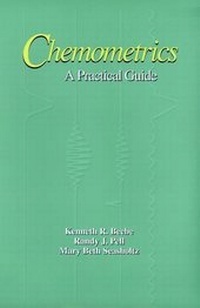
Chemometrics
A Practical Guide
Published on 16. April 1998
Book
Hardback
XII, 348 pages
978-0-471-12451-1 (ISBN)
Description
An outstanding practical guide to the most common chemometric methods in use today
Chemometrics explains how to apply the most widely used pattern recognition and multivariate calibration techniques to solve data analysis problems. This practical guide describes all key methods in terms of processes and applications in order to help the reader easily identify the best technique for a given situation.
Drawing on years of industrial experience with chemometric tools, the authors share their six basic steps, or "habits," for achieving reliable chemometric results, and cover key areas such as:
* Defining and understanding the problem
* Experimental planning and design
* Preprocessing of samples and variables
* Supervised and unsupervised pattern recognition
* Classical and inverse methods of multivariate calibration
Complete with helpful chapter-end summaries, technical references, and more, this book is an invaluable hands-on resource for analytical chemists and laboratory scientists who use chemometrics in their work.
Reviews / Votes
"...probably the best introductory text that I have read on the subject...I would recommend this book for an introductory course...whithout the slightest hesitation." (Microchemical Journal, Vol. 69, 2001)More details
Series
Edition
1. Auflage
Language
English
Place of publication
United States
Publishing group
John Wiley & Sons Inc
Target group
College/higher education
Professional and scholarly
Product notice
sewn/stitched
Cloth over boards
Dimensions
Height: 240 mm
Width: 161 mm
Thickness: 24 mm
Weight
712 gr
ISBN-13
978-0-471-12451-1 (9780471124511)
Schweitzer Classification
Persons
KENNETH R. BEEBE is a global technical manager with The Dow Chemical Company in Freeport, Texas.
RANDY J. PELL and MARY BETH SEASHOLTZ are chemometricians in the Process Analytical Research and Development group with The Dow Chemical Company in Midland, Michigan.
Content
The Six Habits of an Effective Chemometrician.
Defining the Problem.
Preprocessing.
Pattern Recognition.
Multivariate Calibration and Prediction.
References.
Index.