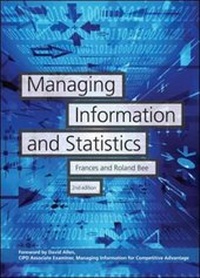
In an age where organisations handle significant volumes of data on a daily basis, it is vital that effective information management systems are put in place to manage them and use them to their full potential. <b><i>Managing Information and Statistics</i></b> provides the information needed for a sound understanding of the concepts that underpin this key area that is now a feature of every aspect of organisational life. The first part deals with information systems generally, whilst the second looks at how numerical data can be used to develop strategy. Topics addressed include how to utilise information systems for planning and organisation, and storing data; how to design, develop and implement an information systems; data security and human resources information system; how to exploit statistics to sample, forecast and make informed decisions.
Fully revised and restructured to cater for CIPD students taking the Managing Information for Competitive Advantage module, as part of the Leadership and Management standards, <b><i>Managing Information and Statistics</i></b> is also essential reading for HR and business practitioners looking to further their professional development and manage effectively, as well as students studying information management as part of wider HR and business degrees. This fully revised edition includes case studies, examples, chapter objectives, exercises, chapter conclusions and further reading suggestions to aid student learning, as well as new chapters on Knowledge Management and the E-organisation. With a strategic approach and accessible style, this is your step-by-step guide to developing, managing and utilising information and statistics in a business context.
Edition
Language
Place of publication
Target group
Edition type
Product notice
Dimensions
Height: 247 mm
Width: 148 mm
Thickness: 18 mm
Weight
ISBN-13
978-0-85292-995-7 (9780852929957)
Schweitzer Classification
<b>Roland and Frances Bee</b> are Managing Consultants with Time for People, a learning consultancy specialising in information management, learning needs analysis and evaluation. They have worked with a wide variety of public and private sector organisations and are authors of several books published by the CIPD. Their practical experience as statisticians, HR professionals, finance and line managers gives them a unique perspective on the area.
<ul style='padding-top:0;padding-left:0;list-style:none;'><li>Section - ONE: Introduction to Information Systems;</li><li><ul style='padding-top:0;list-style:none;'><li>Chapter - 01: The Philosophy of Managing Information;</li><li>Chapter - 02: Information Systems Concepts;</li><li>Chapter - 03: Information Systems for Planning and Organising;</li><li>Chapter - 04: Information Systems for Review and Control;</li><li>Chapter - 05: Storing Data;</li><li>Chapter - 06: The E-Organisation;</li><li>Chapter - 07: Designing, Developing and Maintaining Your Information System;</li><li>Chapter - 08: Data Security;</li><li>Chapter - 09: Information Systems for HR Applications;</li><li>Chapter - 10: Knowledge Management Systems;</li><li>Chapter - 11: Looking Ahead;</li></ul></li><li>Section - TWO: Introduction to Statistics;</li><li><ul style='padding-top:0;list-style:none;'><li>Chapter - 12: Tabulations;</li><li>Chapter - 13: Diagrammatic Methods;</li><li>Chapter - 14: Numerical Methods;</li><li>Chapter - 15: Introduction to Probability and Probability Distributions;</li><li>Chapter - 16: Sampling, Estimation and Inference;</li><li>Chapter - 17: Hypothesis Testing;</li><li>Chapter - 18: Regression and Correlation;</li><li>Chapter - 19: Forecasting and Time Series;</li><li>Chapter - 20: Index Numbers, Published Indices and Sources of Data;</li><li>Chapter - 21: Decision Theory;</li><li>Chapter - 22: Using the Computer</li></ul></li></ul>