

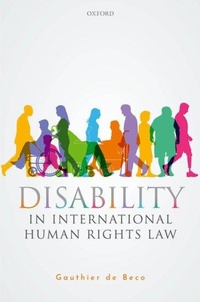
Disability in International Human Rights Law
Published on 12. August 2021
Book
Hardback
234 pages
978-0-19-882450-3 (ISBN)
Description
This book examines what international human rights law has gained from the new elements in the UN Convention on the Rights of Persons with Disabilities (CRPD). It explores how the CRPD is intricately bound up with other international instruments by studying the relationship between the Convention rights and those protected by other human rights treaties, as well as the overall objectives of the UN. Using a social model lens on disability, the book shows how the Convention sheds new light on the very notion of human rights.
The book provides a theoretical framework which explicitly integrates disability into international human rights law. It explains how the CRPD challenges the legal subject by drawing attention to distinct forms of embodiment, before introducing the idea of the 'dis-abled subject', which stems from a recognition that all individuals encounter disability-related issues during their lives. The book also shows how to apply this theoretical framework to several rights and highlights the consequences for the implementation of human rights treaties as a whole. It builds upon the literature of disability studies and legal and political theory, as well as drawing upon the recommendations of treaty bodies and reports of UN agencies and disabled people's organisations. This book thereby provides an agenda-setting analysis for all human rights experts, by showing the benefits of placing disabled people at the heart of international human rights law.
The book provides a theoretical framework which explicitly integrates disability into international human rights law. It explains how the CRPD challenges the legal subject by drawing attention to distinct forms of embodiment, before introducing the idea of the 'dis-abled subject', which stems from a recognition that all individuals encounter disability-related issues during their lives. The book also shows how to apply this theoretical framework to several rights and highlights the consequences for the implementation of human rights treaties as a whole. It builds upon the literature of disability studies and legal and political theory, as well as drawing upon the recommendations of treaty bodies and reports of UN agencies and disabled people's organisations. This book thereby provides an agenda-setting analysis for all human rights experts, by showing the benefits of placing disabled people at the heart of international human rights law.
Reviews / Votes
This book is an excellent introduction not only to the CRPD, but also to broader philosophical questions about how we ought to view rights-holders at all. * Francesca Parente, Law and Politics Book Review *More details
Language
English
Place of publication
Oxford
United Kingdom
Target group
Professional and scholarly
Product notice
sewn/stitched
Cloth over boards
Dimensions
Height: 240 mm
Width: 167 mm
Thickness: 20 mm
Weight
519 gr
ISBN-13
978-0-19-882450-3 (9780198824503)
Copyright in bibliographic data and cover images is held by Nielsen Book Services Limited or by the publishers or by their respective licensors: all rights reserved.
Schweitzer Classification
Other editions
Additional editions
Gauthier de Beco
Disability in International Human Rights Law
E-Book
08/2021
1st Edition
OUP eBook
€67.49
Available for download
Gauthier de Beco
Disability in International Human Rights Law
E-Book
08/2021
1st Edition
OUP eBook
€67.49
Available for download
Person
Gauthier de Beco (J.D., KU Leuven; LL.M. University of Nottingham; Ph.D. in Law, University of Louvain) is Reader in Law at the University of Huddersfield, having previously taught at University College London, KU Leuven, and the University of Leeds. He has widely published in the field of international human rights law, including two monographs, four edited collections, and many articles in peer-reviewed journals. He regularly provides advice on the CRPD to international organisations, such as the OHCHR and the European Commission, as well as to civil society organisations, and is involved in a number of research projects relating to disability.
Content
Introduction
1: Historical Background: Towards a Human Rights Treaty for Disabled People
2: Conceptual Background: Disability in the Field of International Human Rights Law
3: Theoretical Background: The Inclusion of Disabled People
4: Normative Background: The Dis-abled Subject in International Human Rights Law
5: Legal Capacity: A Challenging Priority
6: Inclusive Education: A Hidden Priority
7: Work: A Needed Priority
8: Political Participation: An Ultimate Priority
9: Participation: 'Nothing About Us Without Us'
10: Monitoring: The Role of Independent Mechanisms
11: Conclusion: From the Margins to the Centre
1: Historical Background: Towards a Human Rights Treaty for Disabled People
2: Conceptual Background: Disability in the Field of International Human Rights Law
3: Theoretical Background: The Inclusion of Disabled People
4: Normative Background: The Dis-abled Subject in International Human Rights Law
5: Legal Capacity: A Challenging Priority
6: Inclusive Education: A Hidden Priority
7: Work: A Needed Priority
8: Political Participation: An Ultimate Priority
9: Participation: 'Nothing About Us Without Us'
10: Monitoring: The Role of Independent Mechanisms
11: Conclusion: From the Margins to the Centre