

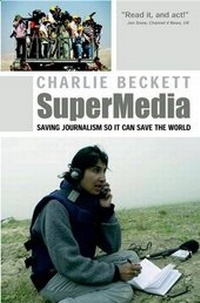
SuperMedia
Saving Journalism So It Can Save the World
Published on 16. May 2008
Book
Paperback/Softback
216 pages
978-1-4051-7923-2 (ISBN)
Unfortunately, price unknown
Article exhausted; check different version
Description
Journalism matters. We live in a much more interconnected world where information is ever-more critical to our lives. Authorities the world over agree that it is a profession under siege. Yet, it is journalism that conveys that information and allows us to debate its significance. At this crucial time, journalism is undergoing profound changes for social, economic and technological reasons. Some of these changes, however, offer an opportunity for journalism not only to survive, but to do much more than it has in the past. Despite the barrage of social, political, cultural and commercial threats, the potential is there for a whole new type of journalism.
There are fewer hotter topics in media than the fate of journalism and the new media in our rapidly changing world. Smart and controversial, Beckett's timely book makes the case that journalism could be the catalyst for change needed to solve many of the world's problems. Drawing on his credentials as a first class broadcast journalist, Beckett provides a practical roadmap for identifying the issues and solutions that will ensure an open and reliable news media for generations to come.
A lively, engaging and refreshingly-opinionated text offering informed discussion on the importance and future of liberal journalism as a healthy part of a flourishing society.
Reviews / Votes
Beckett (London School of Economics) sees the growth of new media and technologies as an opportunity for, rather than a threat to, the traditional practices of journalism. However, he observes, those practices will need to change and adjust to take advantage of the opportunities offered by what he calls networking journalism. He believes that the many sources and voices competing, particularly on the Web, can and do produce better journalism in traditional media as well as on the Web--a contention he illustrates with case studies. Unfortunately, Beckett's idealism does not address the major problem of false information that infects the public sphere: as the 2008 presidential election demonstrated, too many people repeated lies that they had "read somewhere." Truth seldom travels as quickly as lies. What remains in question is what would happen to thoughtful, investigative, long-piece journalism in Beckett's scheme. The author provides brief bibliographies for each of the five chapters and helpful endnotes. Summing Up: Recommended. Professionals and general readers. -- P. E. Kane, emeritus, SUNY College at Brockport (Choice, February 2009) "This is a strongly argued, well-sourced, knowledgeable piece of work, informed by Beckett's time working on news and current affairs programmes at both the BBC and Channel 4 television. It is the most sustained and enthusiastic endorsement of citizen journalism I have read, displaying a faith in the power of journalism allied to that of an active citizenry." (Financial Times)"Consider this a hearty recommendation ... British broadcast journalist Charlie Beckett stays on point in 170 pages of well-reasoned argument about exactly how journalism has already changed - and how today's journalists and journalism educators need to understand that so they can go forward, and not sit inert as their world collapses on their heads ... It's a positive book with clear, real-world examples from real journalism. It does not waste words and it doesn't lose itself in philosophical boilerplate. I think all journalists and journalism educators should read this book." (Teaching Online Journalism (blog))
More details
Edition
1. Auflage
Language
English
Place of publication
Hoboken
United Kingdom
Publishing group
John Wiley and Sons Ltd
Target group
Professional and scholarly
Undergraduates, graduate students and faculty studying journalism, broadcasting and media, journalists, policy makers and general readers.
Dimensions
Height: 22.9 cm
Width: 15.6 cm
Thickness: 1.2 cm
Weight
322 gr
ISBN-13
978-1-4051-7923-2 (9781405179232)
Schweitzer Classification
Other editions
Additional editions
E-Book
09/2011
Wiley-Blackwell
€23.99
Available for download
Book
05/2008
Wiley
€89.90
Shipment within 3-4 weeks
Person
Charlie Beckett is the founding Director of POLIS, the forum for research and debate into journalism and society at the London School of Economics. For 20 years he has worked for some of the best news and current affairs programmes at the BBC and Channel 4 News, ITN as an award-winning producer and programme editor. He was a Reuters Fellow at Oxford University. He currently writes and broadcasts internationally about global journalism as well as teaching and researching at the LSE and the University of the Arts of London. As an experienced journalist who has covered events around the world and now as a think-tank director, Charlie Beckett has a unique vantage point on global news. POLIS engages with its international network of news media practitioners who take part in all aspects of its forum and study work centred on the LSE. And because POLIS works with governments, organisations and the public in different parts of the world, Charlie Beckett has a rare understanding of the impact of journalism beyond the newsroom.
Content
Introduction.
1. Terror, Values and Community.
2. The new media landscape.
3. Networked journalism..
4. Politics and networked journalism.
5. Editorial diversity..
Media Literacy..
Conclusion.