

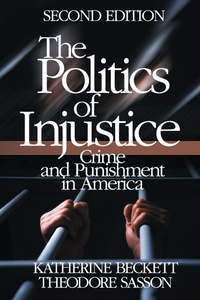
The Politics of Injustice
Crime and Punishment in America
2nd Edition
Published on 2. December 2003
Book
Paperback/Softback
272 pages
978-0-7619-2994-9 (ISBN)
Description
The U.S. crime rate has dropped steadily for more than a decade, yet the rate of incarceration continues to skyrocket. Today, more than 2 million Americans are locked in prisons and jails with devastating consequences for poor families and communities, overcrowded institutions and overburdened taxpayers. How did the U.S. become the world's leader in incarceration? Why have the numbers of women, juveniles, and people of color increased especially rapidly among the imprisoned?
The Politics of Injustice: Crime and Punishment in America, Second Edition is the first book to make widely accessible the new research on crime as a political and cultural issue. Katherine Beckett and Theodore Sasson provide readers with a robust analysis of the roles of crime, politics, media imagery and citizen activism in the making of criminal justice policy in the age of mass incarceration.
Features of this text:
Critical Approach. Debunks myths about crime in the U.S., challenges many current anticrime policies that became harsher in the 1990s, and illuminates the political implications of crime and punishment.
Contemporary. Updated throughout with particular attention to Chapter 5, "Crime in the Media," including research and analyses of crime in the news, crime as entertainment, and the interplay of news media, entertainment, and crime.
Comprehensive Research. Draws on a wide range of scholarship, including research on crime's representation in political discourse and the mass media, public opinion, crime-related activism, and public policy.
Consistent and Accessible. A great source to communicate new research to both non-specialists and specialists in accessible language with riveting, real-life examples.
Intended as a supplement for use in any criminal justice or criminology course, especially in the punishment, corrections and policy areas, The Politics of Injustice, Second Edition will appeal to those who take a critical approach to crime issues.
The Politics of Injustice: Crime and Punishment in America, Second Edition is the first book to make widely accessible the new research on crime as a political and cultural issue. Katherine Beckett and Theodore Sasson provide readers with a robust analysis of the roles of crime, politics, media imagery and citizen activism in the making of criminal justice policy in the age of mass incarceration.
Features of this text:
Critical Approach. Debunks myths about crime in the U.S., challenges many current anticrime policies that became harsher in the 1990s, and illuminates the political implications of crime and punishment.
Contemporary. Updated throughout with particular attention to Chapter 5, "Crime in the Media," including research and analyses of crime in the news, crime as entertainment, and the interplay of news media, entertainment, and crime.
Comprehensive Research. Draws on a wide range of scholarship, including research on crime's representation in political discourse and the mass media, public opinion, crime-related activism, and public policy.
Consistent and Accessible. A great source to communicate new research to both non-specialists and specialists in accessible language with riveting, real-life examples.
Intended as a supplement for use in any criminal justice or criminology course, especially in the punishment, corrections and policy areas, The Politics of Injustice, Second Edition will appeal to those who take a critical approach to crime issues.
More details
Edition
2nd Revised edition
Language
English
Place of publication
Thousand Oaks
United States
Target group
College/higher education
Edition type
Revised edition
Dimensions
Height: 229 mm
Width: 152 mm
Thickness: 15 mm
Weight
399 gr
ISBN-13
978-0-7619-2994-9 (9780761929949)
Copyright in bibliographic data and cover images is held by Nielsen Book Services Limited or by the publishers or by their respective licensors: all rights reserved.
Schweitzer Classification
Other editions
Previous edition
Book
10/1999
1st Edition
SAGE Publications Inc
€49.71
Article exhausted; check for reprint
Persons
Katherine Beckett, Ph.D., is Associate Professor in the Department of Sociology and in the Law, Societies and Justice Program at the University of Washington in Seattle. She teaches courses on law, culture, drugs, social control, and terrorism. She is the author of Making Crime Pay: Law and Order in Contemporary American Politics (1997), as well as numerous articles and chapters, including "How Unregulated Is the U.S. Labor Market? The Dynamics of Jobs and Jails, 1980-1995," with Bruce Western (American Journal of Sociology, 1999).
Theodore Sasson, Ph.D., is Chair and Associate Professor of Sociology, Middlebury College, where he teaches courses in criminology, political sociology, social theory, and media studies. He has also taught sociology and criminology at Northeastern University, Boston College, and the University of Southern Maine. He is the author of Crime Talk: How Citizens Construct a Social Problem (1995), as well as numerous journal articles and book chapters.
Theodore Sasson, Ph.D., is Chair and Associate Professor of Sociology, Middlebury College, where he teaches courses in criminology, political sociology, social theory, and media studies. He has also taught sociology and criminology at Northeastern University, Boston College, and the University of Southern Maine. He is the author of Crime Talk: How Citizens Construct a Social Problem (1995), as well as numerous journal articles and book chapters.
Content
Preface
Acknowledgments
Chapter 1. Criminal Justice Expansion
Explaining the Expansion of the Penal System
Outline of the Book
Chapter 2. Crime in the United States
Crime in Historical Perspective
Crime in Comparative Perspective
Conclusion
Chapter 3. Murder, American Style
Popular Explanations of Violence
Guns
Inequality and Homicide
Conclusion
Chapter 4. The Politics of Crime
The Origins of the Discourse of Law and Order
From the War on Poverty to the War on Crime
From the War on Crime to the War on Drugs
Conclusion
Chapter 5. Crime in the Media
Crime in the News
Crime as Entertainment
The Police Drama
The Crime Film
The "Reality-Based" Cop Show
Media Imagery and Public Opinion
Conclusion
Chapter 6. Crime and Public Opinion
Fear of Crime
Crime as a Social Problem
Popular Punitiveness
Understanding Popular Punitiveness
Alternatives to Punitiveness
Minority Dissent
Conclusion
Chapter 7. Activism and the Politics of Crime
Community-Based Crime Prevention Efforts
The Victim Rights Movement
Adverasarial Activism: Human Rights Campaigns Against Police Brutality, Capital Punishment, and the War on Drugs
Conclusion
Chapter 8. Crime and Public Policy
Drug Policing
Punitive Sentencing
Return of Capital Punishment
Retreat From Juvenile Justice
Prisoner Warehousing
The Surveillance Society
Criminal Justice and Democracy
Conclusion
Chapter 9. Alternatives
Social Investment
Harm Reduction
Alternative Sentencing
Rehabilitating Reintegration
Toward Disarmament
Community Policing
Conclusion
Notes
References
Index
Acknowledgments
Chapter 1. Criminal Justice Expansion
Explaining the Expansion of the Penal System
Outline of the Book
Chapter 2. Crime in the United States
Crime in Historical Perspective
Crime in Comparative Perspective
Conclusion
Chapter 3. Murder, American Style
Popular Explanations of Violence
Guns
Inequality and Homicide
Conclusion
Chapter 4. The Politics of Crime
The Origins of the Discourse of Law and Order
From the War on Poverty to the War on Crime
From the War on Crime to the War on Drugs
Conclusion
Chapter 5. Crime in the Media
Crime in the News
Crime as Entertainment
The Police Drama
The Crime Film
The "Reality-Based" Cop Show
Media Imagery and Public Opinion
Conclusion
Chapter 6. Crime and Public Opinion
Fear of Crime
Crime as a Social Problem
Popular Punitiveness
Understanding Popular Punitiveness
Alternatives to Punitiveness
Minority Dissent
Conclusion
Chapter 7. Activism and the Politics of Crime
Community-Based Crime Prevention Efforts
The Victim Rights Movement
Adverasarial Activism: Human Rights Campaigns Against Police Brutality, Capital Punishment, and the War on Drugs
Conclusion
Chapter 8. Crime and Public Policy
Drug Policing
Punitive Sentencing
Return of Capital Punishment
Retreat From Juvenile Justice
Prisoner Warehousing
The Surveillance Society
Criminal Justice and Democracy
Conclusion
Chapter 9. Alternatives
Social Investment
Harm Reduction
Alternative Sentencing
Rehabilitating Reintegration
Toward Disarmament
Community Policing
Conclusion
Notes
References
Index