

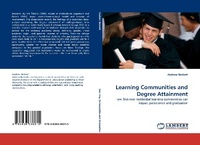
Learning Communities and Degree Attainment
How first-year residential learning communities can impact persistence and graduation
Published on 12. January 2010
Book
Paperback/Softback
108 pages
978-3-8383-3601-5 (ISBN)
Description
Informed by the Tinto''s (1993) model of institutional departure and Astin''s (1993) input- environment-output model and concept of involvement, this dissertation reports the findings of a secondary data-analysis examining the degree attainment of undergraduates who participated in a residentially-based Freshman Interest Group (FIG) at a selective research institution in the Midwest. Using logistic regression to control for the entering academic ability, ethnicity, gender, initial academic major, and parental income of entering first-time college students, the researcher found that students who participated in a FIG were more likely to earn a baccalaureate degree and graduate within 4 years. Furthermore, the effect size associated with FIG participation was significantly greater for lower income and lower ability students compared to the general population. Based on these findings, the researcher suggested that institutions would be well-served to create similar learning environments for students who have historically been considered "at-risk."
More details
Language
English
Place of publication
Germany
Product notice
Paperback (trade)
Unsewn / adhesive bound
Dimensions
Height: 220 mm
Width: 150 mm
Thickness: 7 mm
Weight
179 gr
ISBN-13
978-3-8383-3601-5 (9783838336015)
Copyright in bibliographic data and cover images is held by Nielsen Book Services Limited or by the publishers or by their respective licensors: all rights reserved.
Schweitzer Classification
Person
Andrew Beckett es actualmente el Decano Asociado de Estudiantes y profesor adjunto del Departamento de Liderazgo Educativo de la Universidad de Miami. Trabaja con una variedad de programas de transición de primer y segundo año que incluyen asesoramiento académico, orientación y comunidades de aprendizaje en vivo.