


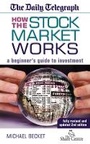
How the Stock Market Works
A Beginner's Guide to Wise Investment
Published on 1. October 2001
Book
Paperback/Softback
160 pages
978-0-7494-2817-4 (ISBN)
Description
There is no one fixed stock exchange, just as there is no one place for buying and selling houses. Increasingly, the stock exchange is dispersing and multiplying, with the number of markets proliferating. It is now possible for an investor to deal on Nasdaq in New York, on the Frankfurt stock exchange or to go to an online broker. With such complexity it becomes increasingly difficult to see exactly what and where the market is. It may be easier and cheaper to trade, but is less easy to trade successfully. This book arms the investor with all-important knowledge. It sets out the ground rules and the ways that systems operate - it tells you what is being traded, how it is traded, who does the trading and and lets you in on how to evaluate both the shares and the proponents' claims. In his acclaimed lucid style, Michael Becket cuts through the investment hype and answers questions such as, What are shares and gilts? What are futures and options? How much money does it take to own shares? What does it cost to deal in shares? Where and how can you buy shares? What do newspapers' financial pages mean? How do you pick a share to buy? When should you buy or sell?
Whose advice can you trust? There is money to be made and it does not require genius to make a fortune, but you do need care, commonsense, lots of luck and expert advice.
Whose advice can you trust? There is money to be made and it does not require genius to make a fortune, but you do need care, commonsense, lots of luck and expert advice.
More details
Series
Language
English
Place of publication
London
United Kingdom
Illustrations
illustrations
Dimensions
Height: 216 mm
Width: 135 mm
Weight
320 gr
ISBN-13
978-0-7494-2817-4 (9780749428174)
Copyright in bibliographic data is held by Nielsen Book Services Limited or its licensors: all rights reserved.
Schweitzer Classification
Other editions
New editions
Book
06/2004
2nd Edition
Kogan Page Ltd
€32.37
Article exhausted; check for reprint
Content
What the book is about. Part 1 What are shares?: Quoted shares; Returns Stock markets. Part 2 Are there other types of paper?: Loan stock and debentures; Warrants; Preference shares; Convertibles. Part 3 What are gilts? Part 4 What are derivatives?: Futures; Forward contracts; Options. Part 5 What about overseas shares? Part 6 How do shares compare with investment/unit trusts?: Investment trusts; Unit trust; Tracker funds; OIECs; Advantages. Part 7 What is the point of owning shares?: Long term; Short term; Perks. Part 8 How much money does it take?: Investment clubs. Part 9. What does it cost to deal in shares?: Brokers' commission; The spread; Advice; Portfolio management; Tax. Part 10 Where and how can you buy shares?: Finding a stockbroker; The Internet; Trading. Part 11 How do you find out the cost of a share?: Newspapers; Online; The spread; Why at that price? Part 12 What do the newspaper financial pages mean?: Prices pages - during the week; Mondays; Indices; Editorial. Part 13 How do you pick a share to buy?: Pet systems; Setting criteria; Market theories; Share analysis; Personal priorities; Building a portfolio; Sources of information. Part 14 What do you look for in company accounts?: Annual report; Using the accounts; Other information from thecompany. Part 15 Do the various ratios and formulae help?. Part 16 Whose advice can you trust? Part 17 Can you recognize high-risk shares? Part 18 When do you buy shares?: Charts; Sentiment indicators; Other theories. Part 19 What is a stock market? Part 20 Other UK markets: The Alternative Investment Market; Techmark; Ofex; Tradepoint; Jiway. Part 21 Other markets: Nasdaq; Easdaq; Internet; Emerging markets. Part 22 Do shareholders have any rights or duties?: Specific rights; Regulated markets; Codes of conduct. Part 23 What are rights and scrip issues?: Rights; Scrip issues. Part 24 What do you do at take-overs? Part 25 What if the company goes bust? Part 26 When do you sell a share?: Some theories; Cashing profits; Reducing losses. Part 27: Tax; ISAs; Dividends; Capital profits; Share schemes; Tax incentives to risk; Tax rates; Useful addresses.