

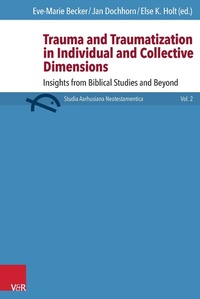
Trauma and Traumatization in Individual and Collective Dimensions
Insights from Biblical Studies and Beyond
1st Edition
Published on 1. October 2014
Book
Hardback
314 pages
978-3-525-53616-2 (ISBN)
Description
The contributors of this volume demonstrate how a highly developed expertise in interpreting Biblical and cognate literature is a substantial part of the overall discourse on the historical, literary, social, political, and religious dimensions of trauma in past and present. This idea is based on the assumption that trauma is not only a modern concept which derives from 20th century psychiatry: It is an ancient phenomenon already which predates modern discourses. Trauma studies will thus profit from how Theology - specifically Biblical exegesis - and the Humanities deal with trauma in terms of religion, history, sociology, and politics.
More details
Other editions
Additional editions
Eve-Marie Becker | Jan Dochhorn
Trauma and Traumatization in Individual and Collective Dimensions
Insights from Biblical Studies and Beyond. EBook
E-Book
10/2014
1st Edition
Vandenhoeck & Ruprecht
€110.00
Available for download
Persons
Editor
Dr. theol. Eve-Marie Becker ist Professorin für Neues Testament an der Evangelisch-Theologischen Fakultät der WWU Münster.
ISNI:
ISNI:
Dr. theol. Jan Dochhorn is Lector / Associate Professor for New Testament Studies at Aarhus University.
Else Holt is Associate Professor in Old Testament Studies at Aarhus University.
Contributions
Dr. Jan Dietrich ist Professor für Literatur- und Religionsgeschichte des Alten Testaments an der Evangelisch-Theologischen Fakultät der Rheinischen Friedrich-Wilhelms-Universität Bonn.
Content
The contributors of this volume demonstrate how a highly developed expertise in interpreting Biblical and cognate literature is a substantial part of the overall discourse on the historical, literary, social, political, and religious dimensions of trauma in past and present. This idea is based on the assumption that trauma is not only a modern concept which derives from 20th century psychiatry: It is an ancient phenomenon already which predates modern discourses. Trauma studies will thus profit from how Theology - specifically Biblical exegesis - and the Humanities deal with trauma in terms of religion, history, sociology, and politics.>