

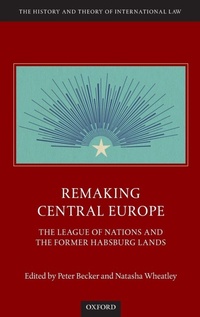
Remaking Central Europe
The League of Nations and the Former Habsburg Lands
Published on 29. December 2020
Book
Hardback
416 pages
978-0-19-885468-5 (ISBN)
Description
Over the last two decades, the "new international order" of 1919 has grown into an expansive new area of research across multiple disciplines. With the League of Nations at its heart, the interwar settlement's innovations in international organizations, international law, and many other areas shaped the world we know today.
This book presents the first study of the relationship between this new international order and the new regional order in Central and Eastern Europe after the collapse of the Habsburg empire. An analysis of the co-implication of these two orders is grounded in four key scholarly interventions: understanding the legacies of empire in international organizations; examining regionalism in the work of interwar international institutions; creating an integrated history of the interwar order in Europe; and testing recent claims of the conceptual connection between nationalism and internationalism.
With chapters covering international health, international financial oversight, human trafficking, minority rights, scientific networks, technical expertise, passports, commercial treaties, borders and citizenship, and international policing, this book pioneers a regional approach to international order, and explores the origins of today's global governance in the wake of imperial collapse.
This book presents the first study of the relationship between this new international order and the new regional order in Central and Eastern Europe after the collapse of the Habsburg empire. An analysis of the co-implication of these two orders is grounded in four key scholarly interventions: understanding the legacies of empire in international organizations; examining regionalism in the work of interwar international institutions; creating an integrated history of the interwar order in Europe; and testing recent claims of the conceptual connection between nationalism and internationalism.
With chapters covering international health, international financial oversight, human trafficking, minority rights, scientific networks, technical expertise, passports, commercial treaties, borders and citizenship, and international policing, this book pioneers a regional approach to international order, and explores the origins of today's global governance in the wake of imperial collapse.
Reviews / Votes
The volume begins with an evaluation of Habsburg histories of internationalism (Glenda Sluga), devotes six chapters to "remaking actors and networks", and seven to "remaking territories and borders". A fine Epilogue (Patricia Clavin) sums up the relationship between the League and Central Europe as "foundational" for that institution, the region, and the world. * William E. Butler, Jus Gentium * This is a fine collection of historical scholarship in which contributions are always original, well-informed, thoughtful, and well worth reading. * Martyn Housden, Austrian History Yearbook * Remaking Central Europe, in that sense, might seem to be a (thought-provoking) reversion to a Europocentric interpretation of the League (and international law in general). * Omer Aloni, Journal of the History of International Law * The volume certainly leaves a lot more nuance in our understanding of the dynamic relationship between the League and the ex-Habsburg lands. * Matthew Stibbe, Slavonic and East European Review * Had the COVID-19 pandemic of 2020/21 not occurred, Remaking Central Europe would have been an important addition to the canon that has reassessed the League of Nations due to its geographical focus. But its publication at the height of the pandemic adds a poignancy to many of these the chapters and lends a relevance to the book that it would otherwise lack ... a valuable source for anyone interested in the Habsburg Monarchy or the League of Nations. * Benjamin J. Whitlock, European Review of History * Through 16 essays the reader is able to explore the effects of the collapse of the Habsburg Monarchy and how the international community was compelled to deal with the fallout, developing new techniques in crisis management and specialized international organizations ... a valuable source for anyone interested in the Habsburg Monarchy or the League of Nations. * Benjamin J. Whitlock, University of Aberdeen, European History Review *More details
Series
Language
English
Place of publication
Oxford
United Kingdom
Target group
Professional and scholarly
Dimensions
Height: 240 mm
Width: 161 mm
Thickness: 27 mm
Weight
784 gr
ISBN-13
978-0-19-885468-5 (9780198854685)
Copyright in bibliographic data and cover images is held by Nielsen Book Services Limited or by the publishers or by their respective licensors: all rights reserved.
Schweitzer Classification
Other editions
Additional editions
Peter Becker | Natasha Wheatley
Remaking Central Europe
The League of Nations and the Former Habsburg Lands
E-Book
12/2020
1st Edition
OUP eBook
€87.99
Available for download
Peter Becker | Natasha Wheatley
Remaking Central Europe
The League of Nations and the Former Habsburg Lands
E-Book
12/2020
1st Edition
OUP eBook
€74.99
Available for download
Persons
Peter Becker is Professor of Austrian History in the Department of History at the University of Vienna. Before moving to Vienna, he held a professorship at the European University Institute in Florence, where he started his research on the history of modern state and governance especially of the Habsburg monarchy and on the cultural history of public administration.
Natasha Wheatley is an Assistant Professor in the Department of History at Princeton University. Prior to joining the Princeton faculty, she completed her PhD at Columbia University and was an ARC Postdoctoral Research Fellow at the University of Sydney.
Natasha Wheatley is an Assistant Professor in the Department of History at Princeton University. Prior to joining the Princeton faculty, she completed her PhD at Columbia University and was an ARC Postdoctoral Research Fellow at the University of Sydney.
Content
Peter Becker and Natasha Wheatley: Introduction: Central Europe and the New International Order of 1919
1: Glenda Sluga: Habsburg Histories of Internationalism
Part One: Remaking Actors and Networks
2: Michael Burri: Clemens Pirquet: Early Twentieth-Century Scientific Networks, the Austrian Hunger Crisis, and the Making of the International Food Expert
3: Sara Silverstein: Reinventing International Health in East Central Europe: The League of Nations, State Sovereignty, and Universal Health
4: Katja Naumann: The Polycentric Remaking of International Participation after World War I: (Post-)Imperial Agents from Eastern Europe in and around the League of Nations' Secretariat
5: Nathan Marcus: Austria, the League of Nations, and the Birth of Multilateral Financial Control
6: Zoltan Peterecz: Hungary and the League of Nations: A Forced Marriage
7: Johannes Feichtinger: On the Fraught Internationalism of Intellectuals: Alfons Dopsch, Austria, and the League's Intellectual Cooperation Program
Part Two: Remaking Territories and Borders
8: Peter Becker: Remaking Mobility: International Conferences and the Emergence of the Modern Passport System
9: Madeleine Lynch Dungy: International Commerce in the Wake of Empire: Central European Economic Integration between National and Imperial Sovereignty
10: David Petruccelli: Fighting the Scourge of International Crime: The Internationalisation of Policing and Criminal Law in Interwar Europe
11: Martina Steer: Nation, Internationalism, and the Policies against Trafficking in Girls and Women after the Fall of the Habsburg Empire
12: Antal Berkes: The League of Nations and the Optants Disputes of the Hungarian Borderlands: Romania, Yugoslavia, and Czechoslovakia
13: Boerries Kuzmany: Non-Territorial Autonomy in Interwar European Minority Protection and Its Habsburg Legacies
14: Sarah Lemmen: Beyond the League of Nations: Public Debates on International Relations in Czechoslovakia during the Interwar Period
Patricia Clavin: An Epilogue to the Making and Unmaking of Central Europe and Global Order
1: Glenda Sluga: Habsburg Histories of Internationalism
Part One: Remaking Actors and Networks
2: Michael Burri: Clemens Pirquet: Early Twentieth-Century Scientific Networks, the Austrian Hunger Crisis, and the Making of the International Food Expert
3: Sara Silverstein: Reinventing International Health in East Central Europe: The League of Nations, State Sovereignty, and Universal Health
4: Katja Naumann: The Polycentric Remaking of International Participation after World War I: (Post-)Imperial Agents from Eastern Europe in and around the League of Nations' Secretariat
5: Nathan Marcus: Austria, the League of Nations, and the Birth of Multilateral Financial Control
6: Zoltan Peterecz: Hungary and the League of Nations: A Forced Marriage
7: Johannes Feichtinger: On the Fraught Internationalism of Intellectuals: Alfons Dopsch, Austria, and the League's Intellectual Cooperation Program
Part Two: Remaking Territories and Borders
8: Peter Becker: Remaking Mobility: International Conferences and the Emergence of the Modern Passport System
9: Madeleine Lynch Dungy: International Commerce in the Wake of Empire: Central European Economic Integration between National and Imperial Sovereignty
10: David Petruccelli: Fighting the Scourge of International Crime: The Internationalisation of Policing and Criminal Law in Interwar Europe
11: Martina Steer: Nation, Internationalism, and the Policies against Trafficking in Girls and Women after the Fall of the Habsburg Empire
12: Antal Berkes: The League of Nations and the Optants Disputes of the Hungarian Borderlands: Romania, Yugoslavia, and Czechoslovakia
13: Boerries Kuzmany: Non-Territorial Autonomy in Interwar European Minority Protection and Its Habsburg Legacies
14: Sarah Lemmen: Beyond the League of Nations: Public Debates on International Relations in Czechoslovakia during the Interwar Period
Patricia Clavin: An Epilogue to the Making and Unmaking of Central Europe and Global Order