

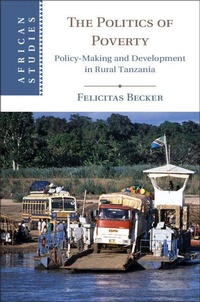
The Politics of Poverty
Policy-Making and Development in Rural Tanzania
Published on 28. May 2019
Book
Hardback
378 pages
978-1-108-49693-3 (ISBN)
Description
How is it that rural poverty in southern Tanzania appears both easy to explain and yet also mystifying? Why is it that 'development' is such a touchstone, when actual attempts at fostering development have been largely ephemeral and/or unpopular for decades? In this book, Felicitas Becker traces dynamics of rural poverty based on the exportation of foodstuffs rather than the better-known problems connected to exportation of migrant labour, and examines what has kept the development industry going despite its failure to break these dynamics. Becker argues that development planners often exaggerated their prospects to secure funding, repackaged old strategies as new to maintain their promise, and shifted blame onto rural Africans for failing to meet the expectations they had raised. But the rural poor, too, pursued conversations on the causes and morality of poverty and wealth. Despite their dependence and deprivation, officials found repeatedly that they could not take them for granted.
Reviews / Votes
'The Politics of Poverty thus complements the existing literature on development and poverty in Tanzania, offering another historical account that is anthropologically informed, environmentally minded, and attuned to political-economic dynamics ... Practitioners and scholars of development, particularly those with an interest in Tanzania and rural areas more generally, will find this book a useful addition to their libraries.' Jessica Pouchet, International Journal of African Historical Studies 'The Politics of Poverty successfully provides a detailed historical account of a relatively understudied region - Southeast Tanzania - and at the same time a balanced reflection on development relevant to broader histories of colonial and post-colonial Africa ... [It] undoubtedly constitutes an excellent endeavour and will contribute greatly to Africanist and development historiography.' Michele Sollai, Connections 'It will be of interest to any scholar wanting a more intimate and complicated portrayal of the developmentalist machine that endures in the twenty-first century in regions across the global South.' Muey Ching Saeteurn, Agricultural HistoryMore details
Series
Language
English
Place of publication
Cambridge
United Kingdom
Target group
Professional and scholarly
Illustrations
Worked examples or Exercises; 1 Maps; 11 Halftones, black and white
Dimensions
Height: 235 mm
Width: 157 mm
Thickness: 25 mm
Weight
703 gr
ISBN-13
978-1-108-49693-3 (9781108496933)
Copyright in bibliographic data and cover images is held by Nielsen Book Services Limited or by the publishers or by their respective licensors: all rights reserved.
Schweitzer Classification
Other editions
Additional editions
Book
09/2020
Cambridge University Press
€55.30
Shipment within 15-20 days
E-Book
06/2019
Cambridge University Press
€24.49
Available for download
E-Book
06/2019
Cambridge University Press
€45.49
Available for download
Person
Felicitas Becker is Professor of African history at Ghent University, and has previously taught at School of Oriental and African Studies, University of London, Simon Fraser University, Vancouver, and the University of Cambridge. Her Ph.D. thesis from the University of Cambridge won the Ellen MacArthur Prize in economic history, and her first book, Becoming Muslim in Mainland Tanzania, 1890-2000 (2008), obtained a British Academy postdoctoral fellowship publication award. She is currently working on the interaction between notions of progress used in development discourse and those deployed by religious reformers in East Africa.
Content
Introduction; 1. The end of slavery, famine and food aid in Tunduru; 2. Changing configurations of poverty in the colonial Southeast and the myth of communalism; 3. The struggle to trade; 4. Independence and the rhetoric of feasibility; 5. Villagisation and the pursuit of market access; 6. The politics of development in the era of liberalisation; 7. Performing and pursuing development in Kineng'ene; Conclusion; Bibliography.