

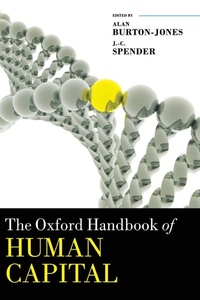
The Oxford Handbook of Human Capital
Published on 10. February 2011
Book
Hardback
718 pages
978-0-19-953216-2 (ISBN)
Description
Macroeconomic research on human capital - the stock of human capabilities and knowledge - has been extensively published but to date the literature has lacked a comprehensive analysis of human capital within the organization. The Oxford Handbook of Human Capital has been designed to fill that gap, providing an authoritative, inter-disciplinary, and up to date survey of relevant concepts, research areas, and applications. Specially commissioned contributions from over 40 authors reveal the importance of human capital for contemporary organizations, exploring its conceptual underpinnings, relevance to theories of the firm, implications for organizational effectiveness, interdependencies with other resources, and role in the future economy. Unlike neoclassical macroeconomic concepts of human capital, human capital in organizations is shown to be dynamic and heterogeneous, requiring new theories and management frameworks. The systemic role of human capital is explored, revealing it as the lynchpin of social, structural and other forms of intangible and tangible capital. Connections between human capital and organizational performance are investigated from HR management, procurement, alignment, value appropriation, and accounting perspectives. Links between micro and macro perspectives are provided through analyses of inter firm human capital mobility, national and regional human capital formation regimes and industry employment relations practices.
This Handbook is designed for scholars and graduate students of organization and management theory, strategy, entrepreneurship, knowledge and intellectual capital, accounting, IT, HR, IR, economic sociology and cultural studies. For policy makers and practitioners it should provide an up to date guide to the nature and role of human capital in contemporary organizations and the roles that government, industry and other extra firm institutions can play in facilitating its development.
This Handbook is designed for scholars and graduate students of organization and management theory, strategy, entrepreneurship, knowledge and intellectual capital, accounting, IT, HR, IR, economic sociology and cultural studies. For policy makers and practitioners it should provide an up to date guide to the nature and role of human capital in contemporary organizations and the roles that government, industry and other extra firm institutions can play in facilitating its development.
More details
Series
Language
English
Place of publication
Oxford
United Kingdom
Target group
College/higher education
Professional and scholarly
Illustrations
Numerous tables and figures
Dimensions
Height: 260 mm
Width: 183 mm
Thickness: 43 mm
Weight
1522 gr
ISBN-13
978-0-19-953216-2 (9780199532162)
Copyright in bibliographic data and cover images is held by Nielsen Book Services Limited or by the publishers or by their respective licensors: all rights reserved.
Schweitzer Classification
Other editions
Additional editions
Alan Burton-Jones | J.-C. Spender
The Oxford Handbook of Human Capital
Book
05/2012
1st Edition
Oxford University Press
€75.40
Shipment within 15-20 days
Alan Burton-Jones | J. -C. Spender
The Oxford Handbook of Human Capital
E-Book
05/2012
1st Edition
OUP eBook
€39.49
Available for download
Alan Burton-Jones | J. -C. Spender
The Oxford Handbook of Human Capital
E-Book
05/2012
1st Edition
OUP eBook
€39.49
Available for download
Persons
Alan Burton-Jones heads an international management consultancy practice headquartered in Australia and is a senior visiting lecturer at New South Wales, Griffith and Bond Universities. His academic research focuses on the role of knowledge in organizations and the links between strategy, intellectual resources and organizational effectiveness. He is the author of Knowledge Capitalism: Business, Work and Learning in the New Economy (Oxford University Press, (1999) (Nikkei 2002) and his writings have also been published in a number of leading international journals. He contributed to the Australian government report on the knowledge-based economy in APEC countries (DISR 2000) ,the first national Knowledge Management Framework published by Standards Australia and the establishment of the Asia-Pacific Learning and Knowledge Management Council (pan-Pacific industry forum).
J.-C. Spender served in experimental submarines in the Royal Navy, then studied engineering at Oxford (Balliol), worked as a nuclear submarine reactor engineer with Rolls-Royce & Associates, a sales manager with IBM (UK), a consultant with Decision Technology International (Boston), and an investment banker with Slater-Walker Securities. His PhD thesis (Manchester Business School) won the Academy of Management's 1980 A.T. Kearney PhD Research Prize, later published as Industry Recipes (Blackwell, 1989). He served on the faculty at City University, London, York University, Toronto, UCLA, and Rutgers. He was Dean of the School of Business and Technology at SUNY/FIT before retiring in 2003. He now researches, writes, and lectures on organization theory, strategy and knowledge management in the USA, Canada, and Europe, with Visiting Professor appointments at Lund University, ESADE, Cranfield, Leeds, and Open Universities.
J.-C. Spender served in experimental submarines in the Royal Navy, then studied engineering at Oxford (Balliol), worked as a nuclear submarine reactor engineer with Rolls-Royce & Associates, a sales manager with IBM (UK), a consultant with Decision Technology International (Boston), and an investment banker with Slater-Walker Securities. His PhD thesis (Manchester Business School) won the Academy of Management's 1980 A.T. Kearney PhD Research Prize, later published as Industry Recipes (Blackwell, 1989). He served on the faculty at City University, London, York University, Toronto, UCLA, and Rutgers. He was Dean of the School of Business and Technology at SUNY/FIT before retiring in 2003. He now researches, writes, and lectures on organization theory, strategy and knowledge management in the USA, Canada, and Europe, with Visiting Professor appointments at Lund University, ESADE, Cranfield, Leeds, and Open Universities.
Content
PART I: THE NATURE OF HUMAN CAPITAL; PART II: HUMAN CAPITAL AND THE FIRM; PART III: HUMAN CAPITAL AND ORGANIZATIONAL EFFECTIVENESS; PART IV: HUMAN CAPITAL INTERDEPENDENCIES; PART V: HUMAN CAPITAL IN THE FUTURE ECONOMY