

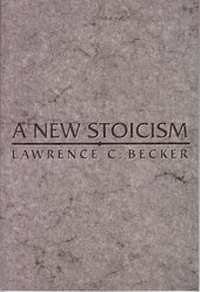
A New Stoicism
A New Stoicism
Published on 21. July 1999
Book
Paperback/Softback
272 pages
978-0-691-00964-3 (ISBN)
Description
What would stoic ethics be like today if stoicism had survived as a systematic approach to ethical theory, if it had coped successfully with the challenges of modern philosophy and experimental science? A New Stoicism proposes an answer to that question, offered from within the stoic tradition but without the metaphysical and psychological assumptions that modern philosophy and science have abandoned. Lawrence Becker argues that a secular version of the stoic ethical project, based on contemporary cosmology and developmental psychology, provides the basis for a sophisticated form of ethical naturalism, in which virtually all the hard doctrines of the ancient Stoics can be clearly restated and defended. Becker argues, in keeping with the ancients, that virtue is one thing, not many; that it, and not happiness, is the proper end of all activity; that it alone is good, all other things being merely rank-ordered relative to each other for the sake of the good; and that virtue is sufficient for happiness. Moreover, he rejects the popular caricature of the stoic as a grave figure, emotionally detached and capable mainly of endurance, resignation, and coping with pain.
To the contrary, he holds that while stoic sages are able to endure the extremes of human suffering, they do not have to sacrifice joy to have that ability, and he seeks to turn our attention from the familiar, therapeutic part of stoic moral training to a reconsideration of its theoretical foundations.
To the contrary, he holds that while stoic sages are able to endure the extremes of human suffering, they do not have to sacrifice joy to have that ability, and he seeks to turn our attention from the familiar, therapeutic part of stoic moral training to a reconsideration of its theoretical foundations.
Reviews / Votes
"From the beginning to the end of this compact but lucid book, Becker skillfully brings to life both the arguments and the intuitive appeal of stoicism... In its essentials [the new stoicism] is recognizable, with its particularly astringent rational charm enhanced by Becker's focused and self-disciplined argumentation. Zeno, I suspect, would be pleased."--Brad Inwood, Apeiron "A stimulating discussion of ethics that is free of the jejune or overly technical attitudes characteristic of much current writing on the subject."--Joseph Shea, n.b.: new from The Reader's CatalogMore details
Language
English
Place of publication
New Jersey
United States
Target group
Professional and scholarly
College/higher education
Product notice
Paperback (trade)
Dimensions
Height: 229 mm
Width: 152 mm
Weight
340 gr
ISBN-13
978-0-691-00964-3 (9780691009643)
Copyright in bibliographic data and cover images is held by Nielsen Book Services Limited or by the publishers or by their respective licensors: all rights reserved.
Schweitzer Classification
Other editions
New editions
Book
08/2017
Princeton University Press
€26.50
Shipment within 10-20 days
Additional editions
Lawrence C. Becker
A New Stoicism
E-Book
06/2015
1st Edition
Princeton University Press
€33.99
Available for download
Person
Lawrence C. Becker is William R. Kenan, Jr., Professor in the Humanities and Professor of Philosophy at the College of William and Mary. He is the author of several books, including Reciprocity and Property Rights: Philosophic Foundations. He is the coeditor, with Charlotte B. Becker, of the Encyclopedia of Ethics.
Content
Acknowledgments ix PART ONE: THE WAY THINGS STAND 1 1. The Conceit 3 2. A New Agenda for Stoic Ethics 5 3. The Ruins of Doctrine 8 Science, Logic, and Ethics 8 Norms and Moral Training 14 Virtue and Happiness 20 Commentary 22 Acknowledgments 30 PART TWO: THE WAY THINGS MIGHT GO 33 4. Normative Logic 35 Norms and Normative Propositions 36 Normative Constructs 39 Axioms of Stoic Normative Logic 42 5. Following the Facts 43 Impossibilities 44 A Posteriori Normative Propositions 46 Motivated Norms 52 Heteronomous Endeavors, Autonomous Agency, and Freedom 59 Commentary 69 Acknowledgments 80 6. Virtue 81 The Development of Virtue as the Perfection of Agency 81 THE STRUCTURE OF AGENCY 82 AGENCY CONSTRUCTED AND PERFECTED 103 VIRTUE AS IDEAL AGENCY 112 The Argument for Virtue as the Perfection of Agency 114 Exalted Virtue 119 Commentary 123 Acknowledgments 137 7. Happiness 138 A Complete Life 138 A Controlled Life 142 Life on the Rack 146 Joy 148 Commentary 150 Acknowledgments 158 Appendix A Calculus for Normative Logic 159 Notation and Interpretation 159 Basic Definitions, Rules, and Axioms 163 Normative Constructs 167 Axioms of Stoic Normative Logic 181 Immediate Inferences 182 Commentary 185 Acknowledgments 191 Bibliography 193 Index 201