

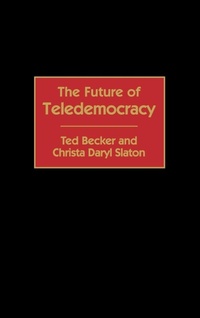
The Future of Teledemocracy
Published on 30. June 2000
Book
Hardback
248 pages
978-0-275-96632-4 (ISBN)
Description
Drawing on the new physics as the scientific foundation of transformational politics, Becker and Slaton write compellingly about teledemocracy, social energy, and democratic quanta. They outline their quantum political theory in rich detail, demonstrating how we have entered a phase of highly charged, erratic, and sometimes self-contradictory packets of social political energy that appears to occur with a rough regularity but with differing levels of velocity and force.
Becker and Slaton explore the current state and future of televoting, electronic town meetings, and other initiatives designed to put the public back into public affairs. This book will prove to be a fascinating read for scholars, students, researchers, and policymakers interested in new political paradigms, politics, and public administration.
Becker and Slaton explore the current state and future of televoting, electronic town meetings, and other initiatives designed to put the public back into public affairs. This book will prove to be a fascinating read for scholars, students, researchers, and policymakers interested in new political paradigms, politics, and public administration.
More details
Language
English
Place of publication
United States
Publishing group
Bloomsbury Publishing Plc
Target group
College/higher education
Professional and scholarly
Dimensions
Height: 235 mm
Width: 157 mm
Thickness: 19 mm
Weight
552 gr
ISBN-13
978-0-275-96632-4 (9780275966324)
Copyright in bibliographic data and cover images is held by Nielsen Book Services Limited or by the publishers or by their respective licensors: all rights reserved.
Schweitzer Classification
Persons
TED BECKER is Professor of Political Science at Auburn University. The author of eleven earlier books, including Quantum Politics (Praeger, 1991), he is also a political activist, trying to link teledemocracy, direct democracy, and environmental sustainability.
CHRISTA DARYL SLATON is Director of the Masters in Public Administration program and Professor of Political Science at Auburn University. Among her earlier publications is Televote: Expanding Citizen Participation in the Quantum Age (Praeger, 1991).
CHRISTA DARYL SLATON is Director of the Masters in Public Administration program and Professor of Political Science at Auburn University. Among her earlier publications is Televote: Expanding Citizen Participation in the Quantum Age (Praeger, 1991).
Content
Introduction Introduction to the New Physics and New Democratic Paradigm The Emergence and Components of the New Democratic Paradigm: Historical Surges and Visions of the Future The New Physics as the Scientific Foundation for the New Democratic Paradigm Synergizing Teledemocracy: Scientific Deliberative Polling + Electronic Town Meetings + the Internet = Critical Mass Empowering Citizens by Televoting: Experiments in Scientific Deliberative Polling The Untapped Potential of Interactive TV Town Meetings and Public Hearings The First Step Toward Synergy: Collaborative Designs for Advanced, Genuine Electronic Town Meetings Beyond ETMs: Synergizing Future Teledemocracies via Computers The New Democratic Paradigm in the 21st Century The Future of Teledemocracy: Entering the Post-Hierarchical Age Bibliography Index