

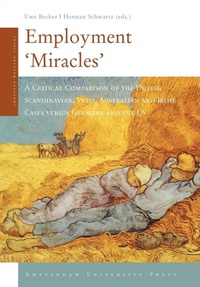
Employment 'Miracles'
A Critical Comparison of the Dutch, Scandinavian, Swiss, Australian and Irish Cases versus Germany and the US
Published on 4. April 2005
Book
Paperback/Softback
288 pages
978-90-5356-755-5 (ISBN)
Description
Why did some economies experience a boom in the 1990s? Employment 'Miracles' comparatively analyses select miracle economies. The contributors to the volume critically analyze how the small size and institutional structure of seven countries like the Netherlands, Denmark and Ireland accounted for their success and status as economic models. Comparisons with the American and German markets reveal how differing policies - liberal versus corporatist/social democratic - determine job growth and levels of income inequality and poverty. The book also stresses the explanatory relevance of lucky circumstances such as the housing price bubble. Employment 'Miracles' is an important resource for political scientists and economists in their study of employment development. A critical scrutiny of the 'miracle economies' of the 1990s, analysing the role of the relatively small size of the national economies in question, and of accidental external circumstances which contributed to favourable developments.
Reviews / Votes
Employment "miracles" challenges the conventional wisdom that full employment and good overall economic performance is a function of a particular recipe of policies and institutions. To the extent that deliberate policies have played a role in recent success stories, they are embedded in nationally specific social, economic, and political institutions, which cannot be easily emulated. The book therefore offers a stern warning against the temptation, so rarely resisted, to draw sweeping generalizations from particular national "models." But while there is no magic bullet, the book is optimistic about the capacity of countries with very different institutions to be successful in a fiercely competitive global economy. There is no necessary tradeoff between competitiveness and a large redistributive welfare state, and success is not synonymous with US-style deregulation. This is a point that is brought out in a nuanced and insightful fashion by the individual country chapters. Anyone interested in understanding the relationship between the economy, public policy, and economic performance is well-advised to read this important and timely new book. Torben Iversen Professor of Government Center for European Studies Harvard UniversityMore details
Series
Language
English
Place of publication
Amsterdam
Netherlands
Target group
Professional and scholarly
Academic
Dimensions
Height: 244 mm
Width: 170 mm
Thickness: 16 mm
Weight
502 gr
ISBN-13
978-90-5356-755-5 (9789053567555)
DOI
10.5117/9789053567555
Copyright in bibliographic data and cover images is held by Nielsen Book Services Limited or by the publishers or by their respective licensors: all rights reserved.
Schweitzer Classification
Other editions
Additional editions
Uwe Becker | Herman Schwartz
Employment 'Miracles'
A Critical Comparison of the Dutch, Scandinavian, Swiss, Australian and Irish Cases versus Germany and the US
E-Book
10/2025
Routledge
€61.99
Available for download
Uwe Becker | Herman Schwartz
Employment 'Miracles'
A Critical Comparison of the Dutch, Scandinavian, Swiss, Australian and Irish Cases versus Germany and the US
E-Book
10/2025
Routledge
€61.99
Available for download
Persons
Uwe Becker is Associate Professor of Political Science at the University of Amsterdam and co-ordinator of an international research project on the socio-economic develop[1]ment of European corporatist countries.
Herman Schwartz is Professor of Political Science at the University of Virginia, Charlottesville and director of the Graduate Studies Department of Politics.
Herman Schwartz is Professor of Political Science at the University of Virginia, Charlottesville and director of the Graduate Studies Department of Politics.
Content
Preface, 1 Introduction: Miracles, Mirages and Markets, Introduction, Luck, pluck and stuck in the employment miracles, Globalisation and the miracles, A specific (corporatist) variety of capitalism? What the chapters say, 2 The Dutch Model: Magic in a Flat Landscape? Introduction,40 Labour market performance, Economic performance, Social outcomes, Policies, the model and the results, Conclusion: luck, pluck or stuck? 3 Employment and Unemployment in Denmark and Sweden: Success or Failure for the Universal Welfare Model? Introduction Employment and unemployment: what happened? Unemployment and employment policies, Policies and outcome - Is there a link? Conclusions 4 The Evolution of the Finnish Model in the 1990s : From Depression to High-Tech Boom, Introduction, The background of the Finnish miracle: the economic crisis of the 1990s, Political response to the crisis,94 The recovery and the Finnish 'miracle', Structural issues: welfare state and labour market institutions, The Nordic welfare state: Good to economic growth? Labour market institutions and corporatism, Conclusion, 5 The Swiss Miracle: Low growth and high employment, Introduction, Corporatism in a fragmented polity, A coordinated market economy? Recent developments, Economic and labour market development, Disentangling the Swiss 'miracle', An expanding welfare system, Conclusion, 6 Recasting the Story of Ireland's Miracle: Policy, Politics or Profit? The constituents of economic growth and development, Possible explanations, The costs: sustainability? The significance of the Irish case, 7 The Australian Miracle: Luck, Pluck or Being Stuck Down Under? Introduction, Exports and the current account balance,166 Employment and collective bargaining, Fiscal balance, Conclusion, 8 Last Year's Model? Reflections on the American Model of Employment Growth, Introduction, An American success story The American model, Limits to the liberal market economy model, Conclusion, 9 The German Contrast. On Bad Comparisons, Special Circumstances, Luck and Policies That Turned Out to Be Wrong, 'Germany isn't working', The German economy in comparison, A bad employment record because of labour market and welfare rigidities? Accidental circumstances: housing bubble versus unification, On strong German regions, Prospects and possible lessons from the 'model cases', 10 Conclusion: The Importance of Lucky Circumstances, and Still the Liberal-Social Democratic Divide, In sum, Recent developments and prospects, What is to be learned? 'Competitive Corporatism'? Still the liberal-social democratic divide, Contributors, Index, Bibliography.