

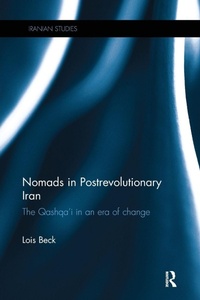
Nomads in Postrevolutionary Iran
The Qashqa'i in an Era of Change
1st Edition
Published on 24. May 2017
Book
Paperback/Softback
404 pages
978-1-138-09972-2 (ISBN)
Description
Examining the rapid transition in Iran from a modernizing, westernizing, secularizing monarchy (1941-79) to a hard-line, conservative, clergy-run Islamic republic (1979-), this book focuses on the ways this process has impacted the Qashqa'i-a rural, nomadic, tribally organized, Turkish-speaking, ethnic minority of a million and a half people who are dispersed across the southern Zagros Mountains.
Analysing the relationship between the tribal polity and each of the two regimes, the book goes on to explain the resilience of the people's tribal organizations, kinship networks, and politicized ethnolinguistic identities to demonstrate how these structures and ideologies offered the Qashqa'i a way to confront the pressures emanating from the two central governments.
Existing scholarly works on politics in Iran rarely consider Iranian society outside the capital of Tehran and beyond the reach of the details of national politics. Local-level studies on Iran-accounts of the ways people actually lived-are now rare, especially after the revolution. Based on long-term anthropological research, Nomads in Postrevolutionary Iran provides a unique insight into how national-level issues relate to the local level and will be of interest to scholars and researchers in Anthropolgy, Iranian Studies and Middle Eastern Studies.
Analysing the relationship between the tribal polity and each of the two regimes, the book goes on to explain the resilience of the people's tribal organizations, kinship networks, and politicized ethnolinguistic identities to demonstrate how these structures and ideologies offered the Qashqa'i a way to confront the pressures emanating from the two central governments.
Existing scholarly works on politics in Iran rarely consider Iranian society outside the capital of Tehran and beyond the reach of the details of national politics. Local-level studies on Iran-accounts of the ways people actually lived-are now rare, especially after the revolution. Based on long-term anthropological research, Nomads in Postrevolutionary Iran provides a unique insight into how national-level issues relate to the local level and will be of interest to scholars and researchers in Anthropolgy, Iranian Studies and Middle Eastern Studies.
Reviews / Votes
"Beck's account of Qashqa'i nomads in postrevolutionary Iran is a unique achievement and an outstanding complement to her many other publications on this populationaEUR"for example, Nomad (CH, Jan'93, 30-2751). In the present volume, Beck (anthropology, Washington Univ., St. Louis) focuses on cultural and political events involving the Qermezi subtribe since 1979, making valuable connections with her previous historical and ethnographic studies. No other anthropologist can offer more rich social and political information and longitudinal analysis concerning nomadic populations in Iran during the last four decades. In addition, few Euro-American researchers of any discipline have been able to continue to conduct field research in Iran in the years since 1979 revolution. Beck's long-term research and integrated cultural understanding make it possible for her to discuss both continuities and changes in Qashqa'i practices, and she provides otherwise unavailable details about Qashqa'i reactions and resistance to the officials and policies of the Iranian central government and its ideological orientation. She presents her research primarily in the form of narrative descriptions, with minimal jargon but also limited ethnological comparison or anthropological theory. Beck's knowledge of Iran is unparalleled in many ways, and this is an indispensable volume for those interested in Iran and nomadism. Summing Up: Highly recommended. Upper-division undergraduates through faculty."-B. Tavakolian, Denison University, CHOICE
Chosen as an Outstanding Academic Title (OATs) by CHOICE Magazine for 2015
On the basis of extensive fieldwork in the same Qermesi camp for over 44 years...Beck constructs a narrative of life in the nomad camps, with more detailed analytic material inserted into the text at appropriate places. This has produced a highly readable and informative... account of the evolution of nomadic pastoralism in an area where it has long been a mainstay of the rural economy. Beck's book advances our understanding of nomadic pastoral societies in significant ways.
- Jeremy Swift, University of Sussex, for NOMADIC PEOPLES, vol.21 no.1 2016
More details
Series
Language
English
Place of publication
London
United Kingdom
Publishing group
Taylor & Francis Ltd
Target group
College/higher education
Dimensions
Height: 234 mm
Width: 156 mm
Thickness: 23 mm
Weight
652 gr
ISBN-13
978-1-138-09972-2 (9781138099722)
Copyright in bibliographic data and cover images is held by Nielsen Book Services Limited or by the publishers or by their respective licensors: all rights reserved.
Schweitzer Classification
Other editions
Additional editions
E-Book
09/2014
1st Edition
Routledge
€67.49
Available for download
E-Book
09/2014
1st Edition
Routledge
€67.49
Available for download
Book
09/2014
1st Edition
Routledge
€244.60
Shipment within 10-20 days
Person
Lois Beck is Professor of Anthropology at Washington University in Saint Louis. She has conducted anthropological research in Iran since 1969. Her books include; The Qashqa'i of Iran; Nomad: A Year in the Life of a Qashqa'i Tribesman in Iran; Women in the Muslim World (coedited); Women in Iran from the Rise of Islam to 1800 (coedited), and Women in Iran from 1800 to the Islamic Republic (coedited).
Content
1 Introduction 2 Past and present: Forty-Four Years of Transformation 3 The Revolution and the Islamic Republic 4 Reclaiming Culture: The Politics of Resistance and Defiance 5 The Hope of Spring 6 Death and Memory: The End of the Life of a Qashqa'i Tribesman in Iran 7 Life Moves On 8 Decisions and Consequences 9 Facing the Future Conclusion