

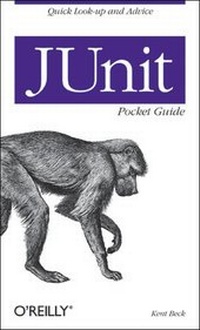
JUnit Pocket Guide
1st Edition
Will be published approx. on 2. November 2004
Book
Paperback/Softback
96 pages
978-0-596-00743-0 (ISBN)
Description
JUnit, created by Kent Beck and Erich Gamma, is an open source framework for test-driven development in any Java-based code. JUnit automates unit testing and reduces the effort required to frequently test code while developing it. While there are lots of bits of documentation all over the place, there isn't a go-to-manual that serves as a quick reference for JUnit. This Pocket Guide meets the need, bringing together all the bits of hard to remember information, syntax, and rules for working with JUnit, as well as delivering the insight and sage advice that can only come from a technology's creator. Any programmer who has written, or is writing, Java Code will find this book valuable. Specifically it will appeal to programmers and developers of any level that use JUnit to do their unit testing in test-driven development under agile methodologies such as Extreme Programming (XP) [another Beck creation].
More details
Other editions
Additional editions
E-Book
09/2004
1st Edition
O'Reilly
€7.99
Available for download
E-Book
09/2004
1st Edition
O'Reilly
€6.49
Available for download
Person
Kent Beck is the founder and director of Three Rivers Institute (TRI). He has pioneered patterns for software development, the XUnit family of test frameworks, the HotDraw drawing editor framework, CRC cards, refactoring, and most recently eXtreme Programming (XP). He is the author of Extreme Programming Explained, Planning Extreme Programming, and The Smalltalk Best Practice Patterns. He lives on 20 acres in rural southern Oregon with his wife, five children, four dogs, two sheep, and a variable number of domestic fowl.
Content
Chapter 1: JUnit Pocket Guide;
1.1 Automating Tests;
1.2 Why Test?;
1.3 JUnit's Goals;
1.4 Fixtures;
1.5 Testing Exceptions;
1.6 JUnit's Implementation;
1.7 JUnit API;
1.8 Test-First Programming;
1.9 Stubs;
1.10 Other Uses for Tests;
1.11 Story of JUnit;
1.12 Extending JUnit;
1.13 JUnit and Ant;
1.14 Running JUnit Standalone;
1.15 JUnit and IDEs;
1.16 Test Infection;
1.17 Bibliography;
1.18 Acknowledgments;