

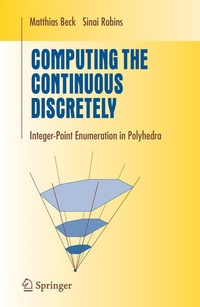
Computing the Continuous Discretely
Integer-point Enumeration in Polyhedra
Published on 23. November 2010
Book
Paperback/Softback
XVIII, 226 pages
978-1-4419-2119-2 (ISBN)
Description
The world is continuous, but the mind is discrete. David Mumford We seek to bridge some critical gaps between various ?elds of mathematics by studying the interplay between the continuous volume and the discrete v- ume of polytopes. Examples of polytopes in three dimensions include crystals, boxes, tetrahedra, and any convex object whose faces are all ?at. It is amusing to see how many problems in combinatorics, number theory, and many other mathematical areas can be recast in the language of polytopes that exist in some Euclidean space. Conversely, the versatile structure of polytopes gives us number-theoretic and combinatorial information that ?ows naturally from their geometry. Fig. 0. 1. Continuous and discrete volume. The discrete volume of a body P can be described intuitively as the number of grid points that lie inside P, given a ?xed grid in Euclidean space. The continuous volume of P has the usual intuitive meaning of volume that we attach to everyday objects we see in the real world. VIII Preface Indeed, the di?erence between the two realizations of volume can be thought of in physical terms as follows. On the one hand, the quant- level grid imposed by the molecular structure of reality gives us a discrete notion of space and hence discrete volume. On the other hand, the N- tonian notion of continuous space gives us the continuous volume.
Reviews / Votes
From the reviews:"You owe it to yourself to pick up a copy . to read about a number of interesting problems in geometry, number theory, and combinatorics . . Even people who are familiar with the material would almost certainly learn something from the clear and engaging exposition . . It contains a large number of exercises . . Each chapter also ends with a series of relevant open problems . . it is also full of mathematics that is self-contained and worth reading on its own." (Darren Glass, MathDL, February, 2007)"This beautiful book presents, at a level suitable for advanced undergraduates, a fairly complete introduction to the problem of counting lattice points inside a convex polyhedron. . Most importantly the book gives a complete presentation of the use of generating functions of various kinds to enumerate lattice points, as well as an introduction to the theory of Erhart quasipolynomials. . This book provides many well-crafted exercises, and even a list of open problems in each chapter." (Jesús A. De Loera, Mathematical Reviews, Issue 2007 h)"All mathematics majors study the topics they will need to know, should they want to go to graduate school. But most will not, and many departments recognize the need for capstone courses in which graduating students can see the tools they have acquired come together in some satisfying way. Beck (San Francisco State Univ.) and Robins (Temple Univ.) have written the perfect text for such a course. . Summing Up: Highly recommended. General readers; lower-division undergraduates through faculty." (D. V. Feldman, CHOICE, Vol. 45 (2), 2007)"This book is concerned with the mathematics of that connection between the discrete and the continuous, with significance for geometry, number theory and combinatorics. . The book is written as an accessible and engaging textbook, with many examples, historical notes, pithy quotes, commentary integrating the material, exercises, open problems and an extensive bibliography." (Margaret M. Bayer, Zentralblatt MATH, Vol. 1114 (16), 2007)"The main topic of the book is initiated by a theorem of Ehrhart . . This is a wonderful book for various readerships. Students, researchers, lecturers in enumeration, geometry and number theory all find it very pleasing and useful. The presentation is accessible for mature undergraduates. . it is a clear introduction to graduate students and researchers with many exercises and with a list of open problems at the end of each chapter." (Péter Hajnal, Acta Scientiarum Mathematicarum, Vol. 75, 2009)"The theme of this textbook . is the relation between the continuous and the discrete, namely, the interplay between the volume of a polytope and the number of grid points contained in it. . The text contains many exercises, some of which present material needed later (for these exercises hints are provided), and lists also many open research problems. - The book can be recommended both for its style and for its interesting . content." (P. Schmitt, Monatshefte für Mathematik, Vol. 155 (2), October, 2008)More details
Series
Edition
1st ed. Softcover of orig. ed. 2007
Language
English
Place of publication
New York
United States
Target group
Lower undergraduate
Illustrations
XVIII, 226 p.
Dimensions
Height: 235 mm
Width: 155 mm
Thickness: 14 mm
Weight
376 gr
ISBN-13
978-1-4419-2119-2 (9781441921192)
DOI
10.1007/978-0-387-46112-0
Schweitzer Classification
Other editions
New editions
Matthias Beck | Sinai Robins
Computing the Continuous Discretely
Integer-Point Enumeration in Polyhedra
Book
11/2015
2nd Edition
Springer
€64.19
Shipment within 15-20 days
Additional editions
Matthias Beck | Sinai Robins
Computing the Continuous Discretely
Integer-point Enumeration in Polyhedra
E-Book
11/2007
1st Edition
Springer
€48.14
Available for download
Matthias Beck | Sinai Robins
Computing the Continuous Discretely
Integer-point Enumeration in Polyhedra
Book
11/2007
Springer
€42.75
Article exhausted; check for reprint
Persons
Matthias Beck received his initial training in mathematics in Würzburg, Germany, received his Ph.D. in mathematics from Temple University, and is now associate professor of mathematics at San Francisco State University. He is the recipient of the 2013 MAA Haimo Award for Distinguished College or University Teaching of Mathematics. He is the author of a previously published Springer book, Computing the Continuous Discretely (with Sinai Robins).
Ross Geoghegan received his initial training in mathematics in Dublin, Ireland, received his Ph.D. in mathematics from Cornell University, and is now professor of mathematics at the State University of New York at Binghamton. He is the author of a previously published Springer book, Topological Methods in Group Theory.
Content
The Essentials of Discrete Volume Computations.- The Coin-Exchange Problem of Frobenius.- A Gallery of Discrete Volumes.- Counting Lattice Points in Polytopes:The Ehrhart Theory.- Reciprocity.- Face Numbers and the Dehn-Sommerville Relations in Ehrhartian Terms.- Magic Squares.- Beyond the Basics.- Finite Fourier Analysis.- Dedekind Sums, the Building Blocks of Lattice-point Enumeration.- The Decomposition of a Polytope into Its Cones.- Euler-Maclaurin Summation in ?d.- Solid Angles.- A Discrete Version of Green's Theorem Using Elliptic Functions.