

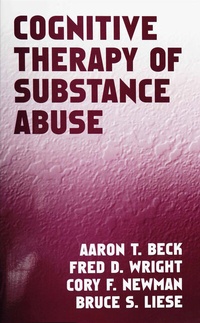
Cognitive Therapy of Substance Abuse
1st Edition
Published on 15. March 2001
Book
Paperback/Softback
354 pages
978-1-57230-659-2 (ISBN)
Description
This book is out of print. SeeCognitive-Behavioral Therapy of Addictive Disorders, ISBN 978-1-4625-4884-2.
Reviews / Votes
. - [This] textbook explicates and expands on Aaron Beck's applications of cognitive therapy to the addictions with lucid, useful integration and a wide explanation of theory and practice....The techniques used are clearly described and can be used for treatment outcome research to validate the cognitive approach versus other approaches, and to look for subpopulations in which cognitive therapy makes special sense. --General Hospital Psychiatry, 1/18/2001?? I will refer to and recommend this book as a bountiful clinical guide....Bolstered by outcome data, this wise and hopeful book will greatly advance integration of cognitive therapy into addiction treatment programs. --Contemporary Psychology, 1/18/2001??In Cognitive Theory of Substance Abuse, Beck and his colleagues...help us to understand the way the addicts' subjective interpretations of intrinsic and extrinsic stimuli lead to addictive behavior. They offer a carefully developed theoretical model, a sizable number of carefully structured therapeutic techniques, and illustrative examples of therapist-patient exchanges....One important aspect of this cognitive format is that its techniques can be combined with other therapeutic approaches to addiction, such as the use of AA, family supports, and social network supports....Practitioners of these modalities would do well to adapt the cognitive approach in their work. Such applications will indeed be of great value to an emerging body of substance abuse practitioners, whose techniques will inevitably be eclectic in nature.--American Journal of Psychiatry, 1/18/2001?? The strength of the authors' approach is exemplified by the clarity and concision of their writing, and by the operationalization of their constructs....Constitutes a 'gold standard' for the field. --Journal of Cognitive Psychotherapy, 1/18/2001?? Dr. Beck's stamp is most definitely on this book. He brings a certain clarity to a direct, in-depth discussion of the use of cognitive therapy to treat substance abuse. This is a rich, utilitarian book for clinicians. --Journal of Psychoactive Drugs, 1/18/2001More details
Language
English
Place of publication
New York
United States
Target group
College/higher education
Professional and scholarly
Professional and Professional Practice & Development
Dimensions
Height: 229 mm
Width: 152 mm
Weight
520 gr
ISBN-13
978-1-57230-659-2 (9781572306592)
Copyright in bibliographic data and cover images is held by Nielsen Book Services Limited or by the publishers or by their respective licensors: all rights reserved.
Schweitzer Classification
Other editions
Additional editions
Aaron T. Beck | Fred D. Wright | Cory F. Newman
Cognitive Therapy of Substance Abuse
Book
09/1993
1st Edition
Guilford Publications
€110.36
Article exhausted; check different version
Persons
Aaron T. Beck, MD, until his death in 2021, was Professor Emeritus of Psychiatry at the University of Pennsylvania and President Emeritus of the Beck Institute for Cognitive Behavior Therapy. Internationally recognized as the founder of cognitive therapy, Dr. Beck has been credited with shaping the face of American psychiatry and was cited by American Psychologist as "one of the five most influential psychotherapists of all time." Dr. Beck was the recipient of awards including the Albert Lasker Clinical Medical Research Award, the Lifetime Achievement Award from the American Psychological Association, the Distinguished Service Award from the American Psychiatric Association, the James McKeen Cattell Fellow Award in Applied Psychology from the Association for Psychological Science, and the Sarnat International Prize in Mental Health and Gustav O. Lienhard Award from the Institute of Medicine. He authored or edited numerous books for professionals and the general public.
Content
1. Overview of Substance Abuse
2. Cognitive Model of Addiction
3. Theory and Therapy of Addiction
4. The Therapeutic Relationship and Its Problems
5. Formulation of the Case
6. Structure of the Therapy Session
7. Educating Patients in the Cognitive Model
8. Setting Goals
9. Techniques of Cognitive Therapy
10. Dealing with Craving/Urges
11. Focus on Beliefs
12. Managing General Life Problems
13. Crisis Intervention
14. Therapy of Depression in Addicted Individuals
15. Anger and Anxiety
16. Concomitant Personality Disorders
17. Relapse Prevention in the Cognitive Therapy of Substance Abuse
Appendices
2. Cognitive Model of Addiction
3. Theory and Therapy of Addiction
4. The Therapeutic Relationship and Its Problems
5. Formulation of the Case
6. Structure of the Therapy Session
7. Educating Patients in the Cognitive Model
8. Setting Goals
9. Techniques of Cognitive Therapy
10. Dealing with Craving/Urges
11. Focus on Beliefs
12. Managing General Life Problems
13. Crisis Intervention
14. Therapy of Depression in Addicted Individuals
15. Anger and Anxiety
16. Concomitant Personality Disorders
17. Relapse Prevention in the Cognitive Therapy of Substance Abuse
Appendices