

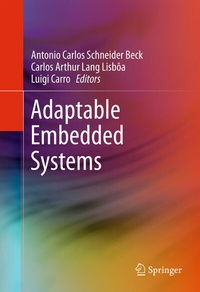
Adaptable Embedded Systems
Published on 21. November 2012
Book
Hardback
XIV, 314 pages
978-1-4614-1745-3 (ISBN)
Description
As embedded systems become more complex, designers face a number of challenges at different levels: they need to boost performance, while keeping energy consumption as low as possible, they need to reuse existent software code, and at the same time they need to take advantage of the extra logic available in the chip, represented by multiple processors working together. This book describes several strategies to achieve such different and interrelated goals, by the use of adaptability. Coverage includes reconfigurable systems, dynamic optimization techniques such as binary translation and trace reuse, new memory architectures including homogeneous and heterogeneous multiprocessor systems, communication issues and NOCs, fault tolerance against fabrication defects and soft errors, and finally, how one can combine several of these techniques together to achieve higher levels of performance and adaptability. The discussion also includes how to employ specialized software to improve this new adaptive system, and how this new kind of software must be designed and programmed.
More details
Edition
2012
Language
English
Place of publication
New York
United States
Target group
Professional and scholarly
Research
Illustrations
XIV, 314 p.
Dimensions
Height: 241 mm
Width: 160 mm
Thickness: 23 mm
Weight
658 gr
ISBN-13
978-1-4614-1745-3 (9781461417453)
DOI
10.1007/978-1-4614-1746-0
Schweitzer Classification
Other editions
Additional editions
Antonio Carlos Schneider Beck | Carlos Arthur Lang Lisbôa | Luigi Carro
Adaptable Embedded Systems
Book
12/2014
Springer
€129.98
Shipment within 15-20 days
Antonio Carlos Schneider Beck | Carlos Arthur Lang Lisbôa | Luigi Carro
Adaptable Embedded Systems
E-Book
11/2012
1st Edition
Springer
€96.29
Available for download
Content
Adaptability: The Key for Future Embedded Systems.- Heterogeneous Behavior of Applications and Systems.- Reconfigurable Systems.- Reconfigurable Memories.- Reconfigurable Intercommunication Infrastructure - NoCs.- Dynamic Optimization Techniques.- Fault Tolerance.- Multicore Platforms: Processors, Communication, and Memories.- Adaptive Software.- Conclusions.