

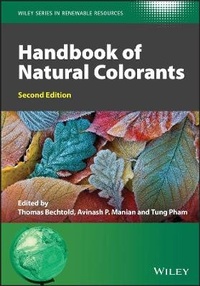
Handbook of Natural Colorants, 2nd Edition
Description
Colorants describe a wide range of materials such as dyes, pigments, inks, paint, or chemicals, which are used in small quantities but play an important role in many products such as textiles, polymers, food, and cosmetics. As the effects of climate change begin to be felt, there has been a shift in focus in the field to renewable resources and sustainability, and an interest in the replacement of oil-based products with greener substitutions. As the push to adopt natural resources grows, there have been significant developments in the research and application of natural colorants as a step in the transition to a bio-based economy.
The second edition of this popular textbook, Handbook of Natural Colorants provides a detailed introduction to natural colorants in a marriage of theory and practice, from seed of plant to consumer demand. Presenting a wide range of viewpoints, the book briefly discusses the history of coloration technology and the current position of natural colorants before highlighting detailed information on regional plant source availability, colorant production and properties, as well as analytical methods for isolation, identification, and toxicity aspects. It also presents key applications in technical use and consumer products, including the use of natural colorants in textiles, hair dyeing, printing, and packaging. Finally, the text considers environmental and economic aspects of natural colorants.
Handbook of Natural Colorants readers will also find:
Revised and updated content throughout to reflect developments in research and applications over the past decade
New content on biotechnology in natural colorant production, natural colorants for mass coloration polymers, natural colorants in printing/packaging, and plant-based pigments
Strategies for scale up, including consideration of energy, waste, and effluents
Handbook of Natural Colorants is a useful reference for dyers, textile producers, and researchers in the evolving field of sustainable chemistry, environmental sciences, agricultural sciences, and polymer sciences.
<b>A detailed survey of a variety of natural colorants and their different applications including textiles, polymers, and cosmetics</b>
Colorants describe a wide range of materials such as dyes, pigments, inks, paint, or chemicals, which are used in small quantities but play an important role in many products such as textiles, polymers, food, and cosmetics. As the effects of climate change begin to be felt, there has been a shift in focus in the field to renewable resources and sustainability, and an interest in the replacement of oil-based products with greener substitutions. As the push to adopt natural resources grows, there have been significant developments in the research and application of natural colorants as a step in the transition to a bio-based economy.
The second edition of this popular textbook, <i>Handbook of Natural Colorants</i> provides a detailed introduction to natural colorants in a marriage of theory and practice, from seed of plant to consumer demand. Presenting a wide range of viewpoints, the book briefly discusses the history of coloration technology and the current position of natural colorants before highlighting detailed information on regional plant source availability, colorant production and properties, as well as analytical methods for isolation, identification, and toxicity aspects. It also presents key applications in technical use and consumer products, including the use of natural colorants in textiles, hair dyeing, printing, and packaging. Finally, the text considers environmental and economic aspects of natural colorants.
<i>Handbook of Natural Colorants </i>readers will also find:
<ul><li>Revised and updated content throughout to reflect developments in research and applications over the past decade</li><li>New content on biotechnology in natural colorant production, natural colorants for mass coloration polymers, natural colorants in printing/packaging, and plant-based pigments</li><li>Strategies for scale up, including consideration of energy, waste, and effluents</li></ul><i>Handbook of Natural Colorants </i>is<i> </i>a useful reference for dyers, textile producers, and researchers in the evolving field of sustainable chemistry, environmental sciences, agricultural sciences, and polymer sciences.
More details
Other editions
Additional editions
Previous edition
Person
Avinash P. Manian, PhD, is an Assistant Professor at the Research Institute for Textile Chemistry and Textile Physics, University of Innsbruck, Austria.
Tung Pham, PhD, is the Head of Institute and BMK Endowed Professor at the Research Institute for Textile Chemistry and Textile Physics at the University of Innsbruck, Austria.
<b>Thomas Bechtold, PhD, </b>is a Professor at the Research Institute for Textile Chemistry and Textile Physics at the University of Innsbruck, Austria.
<b>Avinash P. Manian, PhD, </b>is an Assistant Professor at the Research Institute for Textile Chemistry and Textile Physics, University of Innsbruck, Austria.
<b>Tung Pham, PhD, </b>is the Head of Institute and BMK Endowed Professor at the Research Institute for Textile Chemistry and Textile Physics at the University of Innsbruck, Austria.
Content
List of Contributors xv
Series Preface xix
Preface xxi
<b>Part I Historical Development</b>
1 History of Natural Dyes in the Ancient Mediterranean Civilization
<i>Maria J. Melo</i>
2 Colours in Civilizations of the World and Natural Colorants: History under Tension
<i>Dominique Cardon</i>
3 History of Natural Dyes in North Africa 'Egypt'
<i>Harby Ezzeldeen Ahmed</i>
<b>Part II Natural Colorants in Different Regions of the World</b>
4 Sources for Natural Colorants in Europe
<i>Thomas Bechtold, Tung Pham, Avinash P. Manian</i>
5 Dyes in South America
<i>Veridiana Vera de Rosso and Adriana Zerlotti Mercadante</i>
6 Natural Dyes in Eastern Asia (Vietnam and Neighbouring Countries)
<i>Tung Pham and Thomas Bechtold</i>
7 Sources for Natural Colorants in China
<i>Reng-Cheng Tang</i>
8 Sources, Application and Analysis of Natural Colorants: Indian perspective
<i>Ashis Kumar Samanta and Deepali Singhee</i>
9 Natural Dye Gardens in North America
<i>Wendy Weiss and Thomas Bechtold</i>
<b>Part III Colorant Production and Properties</b>
10 Chlorophylls
<i>Maria Roca</i>
11 Indigo -- Production and Properties
<i>Philip John and Luciana Gabriella Angelini</i>
12 Anthocyanins: Nature's Glamorous Palette
<i>Maria J. Melo, Fernando Pina, NaterciaTeixeira and Claude Andary</i>
13 Natural Colorants -- Quinoid, Naphthoquinoid and Anthraquinoid Dyes
<i>Goverdina C.H. Derksen and Thomas Bechtold</i>
14 Natural Colorants from Lichens and Mushrooms
<i>Riikka Raisanen</i>
15 Focus on Tannins
<i>Riitta Julkunen-Tiitto and Hely Haggman</i>
16 Carotenoid Dyes -- Properties and Production
<i>U. Gamage Chandrika</i>
17 Flavonoids as Natural Pigments
<i>M. Monica Giusti, Gonzalo Miyagusuku-Cruzado and Taylor C. Wallace</i>
18 Natural colorants from fungi
<i>Cassamo U. Mussagy, Fernanda de Oliveira, Valeria C. Santos-Ebinuma</i>
19 Natural Colorants from Cyanobacteria and Algae
<i>Laurent Dufosse</i>
20 Biotechnological production of microbial pigments: recent findings
<i>Vivian Katherine Colorado Gomez, Juan Pablo Ruiz-Sanchez, Alejandro Mendez-Zavala, Lourdes Morales-Oyervides and Julio Montanez</i>
21 Analytical methods for characterisation and standardisation of natural dyes and pigments
<i>Tung Pham, Avinash Manian and Thomas Bechtold</i>
22 Wood -- from natural colour patterns towards naturally altered colour impressions
<i>Martin Weigl-Kuska, Andreas Kandelbauer, Christian Hansmann and Ulrich Mueller</i>
23 The Role of Mordants in Fixation of Natural Dyes
<i>Avinash P. Manian</i>
24 Textile Coloration with Natural Dyes and Pigments
<i>Thomas Bechtold, Tung Pham and Avinash P. Manian</i>
25 Hair Coloration with Natural Dyes and Pigments
<i>Thomas Bechtold</i>
26 Natural Colorants in the Mass Coloration of Plastics
<i>Thomas Bechtold and Tung Pham</i>
27 Natural Colorants in Printing/Packaging
<i>Thomas Bechtold and Tung Pham</i>
28 Technical Aspects and Requirements to Produce Natural Colorants - Processes and Product Standardisation
<i>Thomas Bechtold and Avinash Manian</i>
29 Environmental and Economic Position of Natural Colorants - Energy and Resources Balances, Sustainability, Ecology and Costs
<i>Susanne Geissler and Thomas Bechtold</i>
30 Aspects of human toxicology and consumer safety
<i>Judith Buettler, Thomas Bechtold and Tung Pham</i>
References
Index