

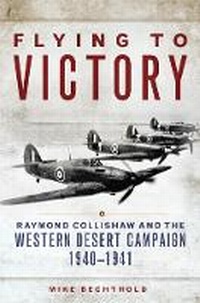
Flying to Victory
Raymond Collishaw and the Western Desert Campaign, 1940-1941
Will be published approx. on 6. April 2017
Book
Hardback
296 pages
978-0-8061-5596-8 (ISBN)
Description
Canadian-born flying ace Raymond Collishaw (1893-1976) served in Britain's air forces for twenty-eight years. As a pilot in World War I he was credited with sixty-one confirmed kills on the Western Front. When World War II began in 1939, Air Commodore Collishaw commanded a Royal Air Force group in Egypt. It was in Egypt and Libya in 1940-41, during the Britain's Western Desert campaign, that he demonstrated the tenets of an effective air-ground cooperation system. Flying to Victory examines Raymond Collishaw's contribution to the British system of tactical air support - a pattern of operations that eventually became standard in the Allied air forces and proved to be a key factor in the Allied victory.
The British Army and Royal Air Force entered the war with conflicting views on the issue of air support that hindered the success of early operations. It was only after the chastening failure of Operation Battleaxe in June 1941, fought according to army doctrine, that Winston Churchill shifted strategy on the direction of future air campaigns - ultimately endorsing the RAF's view of mission and target selection. This view adopted principles of air-ground cooperation that Collishaw had demonstrated in combat. Author Mike Bechthold traces the emergence of this strategy in the RAF air campaign in Operation Compass, the first British offensive in the Western Desert, in which Air Commodore Collishaw's small force overwhelmed its Italian counterpart and disrupted enemy logistics.
Flying to Victory details the experiences that prepared Collishaw so well for this campaign and that taught him much about the application of air power, especially how to work effectively with the army and Royal Navy. As Bechthold shows, these lessons learned altered the Allied approach to tactical air support and, ultimately, changed the course of the Second World War.
The British Army and Royal Air Force entered the war with conflicting views on the issue of air support that hindered the success of early operations. It was only after the chastening failure of Operation Battleaxe in June 1941, fought according to army doctrine, that Winston Churchill shifted strategy on the direction of future air campaigns - ultimately endorsing the RAF's view of mission and target selection. This view adopted principles of air-ground cooperation that Collishaw had demonstrated in combat. Author Mike Bechthold traces the emergence of this strategy in the RAF air campaign in Operation Compass, the first British offensive in the Western Desert, in which Air Commodore Collishaw's small force overwhelmed its Italian counterpart and disrupted enemy logistics.
Flying to Victory details the experiences that prepared Collishaw so well for this campaign and that taught him much about the application of air power, especially how to work effectively with the army and Royal Navy. As Bechthold shows, these lessons learned altered the Allied approach to tactical air support and, ultimately, changed the course of the Second World War.
Reviews / Votes
In Flying to Victory, Mike Bechthold fills a gap in our understanding of the history of the Royal Air Force and Britain's early campaigns in the Western Desert. This is an important book that deserves to be read by scholars, practitioners, and enthusiasts alike.""- Ross Mahoney, Historian, Royal Air Force MuseumMore details
Series
Language
English
Place of publication
Oklahoma
United States
Target group
Professional and scholarly
Illustrations
30 black & white illustrations, 7 maps
Dimensions
Height: 229 mm
Width: 152 mm
Thickness: 25 mm
Weight
576 gr
ISBN-13
978-0-8061-5596-8 (9780806155968)
Copyright in bibliographic data and cover images is held by Nielsen Book Services Limited or by the publishers or by their respective licensors: all rights reserved.
Schweitzer Classification
Person
Mike Bechthold teaches history at Wilfrid Laurier University in Waterloo, Ontario, and is acquisitions editor for military history at Wilfrid Laurier University Press. His research focuses on air power in World War II and Canadian military history. He has also coauthored a number of guides to World War II battlefields.