

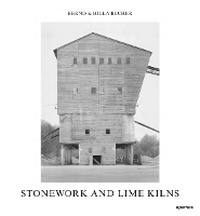
Stonework and Lime Kilns
Will be published approx. on 7. October 2013
Book
Hardback
256 pages
978-1-59711-252-9 (ISBN)
Description
Over the course of nearly five decades, Bernd and Hilla Becher documented almost every type of industrial architecture-from water towers and steel mills to gas tanks and grain silos-in Europe and the United States. Whether presenting single shots or their signature typologi - cal grids, the Bechers created a photographic testament to the industrial revolution that so emphatically shaped the nineteenth and twentieth centuries. At the same time, however, they also captured a much-older manufacturing tradition: the quarrying and processing of stones. This volume, an essential addition to the Bechers' body of work, is devoted to their photographs of rock-processing plants and lime kilns taken in Germany, France, The Netherlands, Belgium, Switzerland, Austria, and Great Britain throughout the 1980s and '90s. Each structure is unique, its details dependent upon the region and the date of its construction, and the book features buildings whose essential function is ancient but which remain important today. Although a small number of these images have been included in previous monographs, this is the first publication to showcase a comprehensive collection of the Bechers' study of stonework and lime kilns.
More details
Language
English
Place of publication
New York
United States
Illustrations
Illustrated in tritone throughout
Dimensions
Height: 290 mm
Width: 270 mm
Weight
2110 gr
ISBN-13
978-1-59711-252-9 (9781597112529)
Copyright in bibliographic data and cover images is held by Nielsen Book Services Limited or by the publishers or by their respective licensors: all rights reserved.
Schweitzer Classification
Persons
Hilla Becher met Bernd Becher at the Kunskatademie Duesseldorf and first collaborated in 1959, while working as freelance photographers. Their lifelong commitment has been the systematic documentation of industrial buildings, including water towers and cooling towers, blast furnaces, coal mines and steel mines, gas tanks, and grain elevators. Starting in the late '60s, their work gained worldwide visibility via exhibition in such venues as the George Eastman House, Rochester, New York; Institute of Contemporary Arts, London: Documenta, Kassel, Germany; Bienal de Sao Paulo; Venice Bienale; and Centre Georges Pompidou, Paris. The Bechers were influential professors at the Duesseldorf Art Academy between 1976 and 1996, training a generation of photographers now known collectively as the Duesseldorf School. The Bechers' work is represented in major collections worldwide, including the Museum of Modern Art, New York, and Tate Gallery, London, and they have received numerous awards, among the the Erasmus Prize and the Hasselblad Award. Over a dozen monographs of their work have been published, all focusing on the many faces of industrial architecture. Hilla Becher met Bernd Becher at the Kunskatademie Duesseldorf and first collaborated in 1959, while working as freelance photographers. Their lifelong commitment has been the systematic documentation of industrial buildings, including water towers and cooling towers, blast furnaces, coal mines and steel mines, gas tanks, and grain elevators. Starting in the late '60s, their work gained worldwide visibility via exhibition in such venues as the George Eastman House, Rochester, New York; Institute of Contemporary Arts, London: Documenta, Kassel, Germany; Bienal de Sao Paulo; Venice Bienale; and Centre Georges Pompidou, Paris. The Bechers were influential professors at the Duesseldorf Art Academy between 1976 and 1996, training a generation of photographers now known collectively as the Duesseldorf School. The Bechers' work is represented in major collections worldwide, including the Museum of Modern Art, New York, and Tate Gallery, London, and they have received numerous awards, among the the Erasmus Prize and the Hasselblad Award. Over a dozen monographs of their work have been published, all focusing on the many faces of industrial architecture. Hilla Becher met Bernd Becher at the Kunskatademie Duesseldorf and first collaborated in 1959, while working as freelance photographers. Their lifelong commitment has been the systematic documentation of industrial buildings, including water towers and cooling towers, blast furnaces, coal mines and steel mines, gas tanks, and grain elevators. Starting in the late '60s, their work gained worldwide visibility via exhibition in such venues as the George Eastman House, Rochester, New York; Institute of Contemporary Arts, London: Documenta, Kassel, Germany; Bienal de Sao Paulo; Venice Bienale; and Centre Georges Pompidou, Paris. The Bechers were influential professors at the Duesseldorf Art Academy between 1976 and 1996, training a generation of photographers now known collectively as the Duesseldorf School. The Bechers' work is represented in major collections worldwide, including the Museum of Modern Art, New York, and Tate Gallery, London, and they have received numerous awards, among the the Erasmus Prize and the Hasselblad Award. Over a dozen monographs of their work have been published, all focusing on the many faces of industrial architecture. Hilla Becher met Bernd Becher at the Kunskatademie Duesseldorf and first collaborated in 1959, while working as freelance photographers. Their lifelong commitment has been the systematic documentation of industrial buildings, including water towers and cooling towers, blast furnaces, coal mines and steel mines, gas tanks, and grain elevators. Starting in the late '60s, their work gained worldwide visibility via exhibition in such venues as the George Eastman House, Rochester, New York; Institute of Contemporary Arts, London: Documenta, Kassel, Germany; Bienal de Sao Paulo; Venice Bienale; and Centre Georges Pompidou, Paris. The Bechers were influential professors at the Duesseldorf Art Academy between 1976 and 1996, training a generation of photographers now known collectively as the Duesseldorf School. The Bechers' work is represented in major collections worldwide, including the Museum of Modern Art, New York, and Tate Gallery, London, and they have received numerous awards, among the the Erasmus Prize and the Hasselblad Award. Over a dozen monographs of their work have been published, all focusing on the many faces of industrial architecture.