

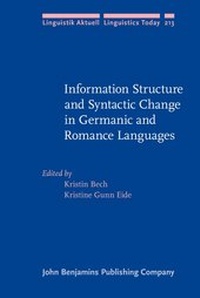
Information Structure and Syntactic Change in Germanic and Romance Languages
Published on 7. May 2014
Book
Hardback
421 pages
978-90-272-5596-9 (ISBN)
Description
The contributions of this volume offer new perspectives on the relation between syntax and information structure in the history of Germanic and Romance languages, focusing on English, German, Norwegian, French, Spanish and Portuguese, and both from a synchronic and a diachronic perspective. In addition to discussing changes in individual languages along the syntax-information structure axis, the volume also makes a point of comparing and contrasting different languages with respect to the interplay between syntax and information structure. Since the creation of increasingly sophisticated annotated corpora of historical texts is on the agenda in many research environments, methods and schemes for information structure annotation and analysis of historical texts from a theoretical and applied perspective are discussed.
More details
Series
Language
English
Place of publication
Amsterdam
Netherlands
Target group
College/higher education
Illustrations
+ index
Weight
910 gr
ISBN-13
978-90-272-5596-9 (9789027255969)
Copyright in bibliographic data and cover images is held by Nielsen Book Services Limited or by the publishers or by their respective licensors: all rights reserved.
Schweitzer Classification
Other editions
Additional editions
Kristin Bech | Kristine Gunn Eide
Information Structure and Syntactic Change in Germanic and Romance Languages
E-Book
05/2014
1st Edition
John Benjamins Publishing Company
€130.99
Available for download
Persons
Content
1. Acknowledgements; 2. Information structure and syntax in old Germanic and Romance languages (by Bech, Kristin); 3. Part I. Information-structural categories and corpus annotation; 4. The theoretical foundations of givenness annotation (by Haug, Dag T.T.); 5. Testing the theory: Information structure in Old English (by Taylor, Ann); 6. Part II. Changes on the interface between syntax and information structure; 7. Quantifying information structure change in English (by Komen, Erwin R.); 8. Tracing overlap in function in historical corpora: A case study of English object fronting and passivization (by Dreschler, Gea); 9. Referential properties of the full and reduced forms of the definite article in German: A diachronic survey (by Coniglio, Marco); 10. The cognitive status of null subject referents in Old Norse and their Modern Norwegian counterparts (by Kinn, Kari); 11. Part III. Comparisons on the interface between syntax and information structure; 12. Word order variation in late Middle English: The effect of information structure and audience design (by Eitler, Tamas); 13. Preverbal word order in Old English and Old French (by Bech, Kristin); 14. Formal properties of event-reporting sentences in Old High German and Old French (by Petrova, Svetlana); 15. Subjects and objects in Germanic and Romance (by Faarlund, Jan Terje); 16. Object position and Heavy NP Shift in Old Saxon and beyond (by Walkden, George); 17. On the interaction between syntax, prosody and information structure: An interface approach to word order developments in Germanic (by Hinterholzl, Roland); 18. Contrastivity and information structure in the old Ibero-Romance languages (by Eide, Kristine Gunn); 19. Index of languages; 20. Databases and annotation schemes; 21. Word index