

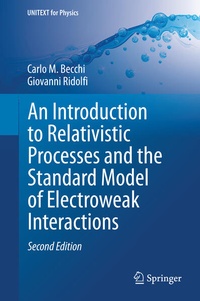
An Introduction to Relativistic Processes and the Standard Model of Electroweak Interactions
2nd Edition
Published on 5. June 2014
Book
Hardback
IX, 198 pages
978-3-319-06129-0 (ISBN)
Description
This book offers a self-contained introduction to the theory of electroweak interactions based on the semi-classical approach to relativistic quantum field theory, with thorough discussion of key aspects of the field. The basic tools for the calculation of cross sections and decay rates in the context of relativistic quantum field theory are reviewed in a short, but complete and rigorous, presentation. Special attention is focused on relativistic scattering theory and on calculation of amplitude in the semi-classical approximation. The central part of the book is devoted to an illustration of the unified field theory of electromagnetic and weak interactions as a quantum field theory with spontaneously broken gauge invariance; particular emphasis is placed on experimental confirmations of the theory. The closing chapters address the most recent developments in electroweak phenomenology and provide an introduction to the theory and phenomenology of neutrino oscillations. In this 2nd edition the discussion of relativistic scattering processes in the semi-classical approximation has been revised and as a result intermediate results are now explicitly proven. Furthermore, the recent discovery of the Higgs boson is now taken into account throughout the book. In particular, the Higgs decay channel into a pair of photons, which has played a crucial role in the discovery, is discussed.
As in the first edition, the accent is still on the semi-classical approximation. However, in view of the necessity of a discussion of H !, the authors give several indications about corrections to the semiclassical approximation. Violation of unitarity is discussed in more detail, including the dispersion relations as a tool for computing loop corrections; the above-mentioned Higgs decay channel is illustrated by means of a full one-loop calculation; and finally, loop effects on the production of unstable particles (such as the Z0 boson) are nowdiscussed. Finally, the neutrino mass and oscillation analysis is updated taking into account the major achievements of the last years.
As in the first edition, the accent is still on the semi-classical approximation. However, in view of the necessity of a discussion of H !, the authors give several indications about corrections to the semiclassical approximation. Violation of unitarity is discussed in more detail, including the dispersion relations as a tool for computing loop corrections; the above-mentioned Higgs decay channel is illustrated by means of a full one-loop calculation; and finally, loop effects on the production of unstable particles (such as the Z0 boson) are nowdiscussed. Finally, the neutrino mass and oscillation analysis is updated taking into account the major achievements of the last years.
More details
Series
Edition
2nd ed. 2014
Language
English
Place of publication
Cham
Switzerland
Publishing group
Springer International Publishing
Target group
Primary & secondary/elementary & high school
Graduate
Edition type
Revised edition
Illustrations
22 s/w Abbildungen
IX, 198 p. 22 illus.
Dimensions
Height: 241 mm
Width: 160 mm
Thickness: 17 mm
Weight
483 gr
ISBN-13
978-3-319-06129-0 (9783319061290)
DOI
10.1007/978-3-319-06130-6
Schweitzer Classification
Other editions
Additional editions
Carlo M. Becchi | Giovanni Ridolfi
An Introduction to Relativistic Processes and the Standard Model of Electroweak Interactions
Book
09/2016
2nd Edition
Springer
€64.19
Shipment within 10-15 days
Carlo M. Becchi | Giovanni Ridolfi
An Introduction to Relativistic Processes and the Standard Model of Electroweak Interactions
E-Book
05/2014
2nd Edition
Springer
€64.19
Available for download
Previous edition
Carlo M. Becchi | Giovanni Ridolfi
An introduction to relativistic processes and the standard model of electroweak interactions
Book
11/2005
Springer
€42.75
Article exhausted; check for reprint
Persons
Carlo M. Becchi is full professor in Theoretical Physics at the University of Genoa since 1976. He is an expert in quantum gauge theories and renormalization, he is one of the discoverers of the Becchi-Rouet-Stora transformation which is now a basic tool for the quantization of systems with constraints. Carlo M. Becchi is Supervisory Editor of Nuclear Physics B.
Giovanni Ridolfi received his doctorate in physics from University of Genoa, Italy, in 1989, and has held research appointments at CERN, Geneva and at the italian Istituto Nazionale di Fisica Nucleare. He is now full Professor of Theoretical Physics at the University of Genoa, Italy. His research interests are in the field of phenomenology of fundamental interactions.
Giovanni Ridolfi received his doctorate in physics from University of Genoa, Italy, in 1989, and has held research appointments at CERN, Geneva and at the italian Istituto Nazionale di Fisica Nucleare. He is now full Professor of Theoretical Physics at the University of Genoa, Italy. His research interests are in the field of phenomenology of fundamental interactions.
Content
Introduction.- Relativistic field theory.- Scattering theory.- Feynman.- Spinor fields.- Gauge symmetries.- The standard model.- Spontaneous breaking of the gauge symmetry.- Breaking of accidental symmetries.- Summary.- Applications.- Neutrino masses and mixing.- A. Large-time evolution of the free field.- B. Scattering from an external density.- C. Dirac matrices.- D. Violation of unitarity in the Fermi theory.- References.