

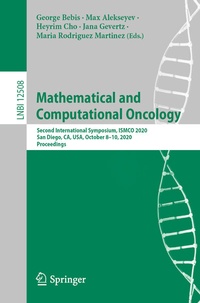
Mathematical and Computational Oncology
Second International Symposium, ISMCO 2020, San Diego, CA, USA, October 8-10, 2020, Proceedings
Published on 3. December 2020
Book
Paperback/Softback
XXII, 119 pages
978-3-030-64510-6 (ISBN)
Description
This book constitutes the refereed proceedings of the Second International Symposium on Mathematical and Computational Oncology, ISMCO 2020, which was supposed to be held in San Diego, CA, USA, in October 2020, but was instead held virtually due to the COVID-19 pandemic.
The 6 full papers and 4 short papers presented together with 1 invited talk were carefully reviewed and selected from 28 submissions. The papers are organized in topical sections named: statistical and machine learning methods for cancer research; mathematical modeling for cancer research; general cancer computational biology; and posters.
More details
Series
Edition
1st ed. 2020
Language
English
Place of publication
Cham
Switzerland
Publishing group
Springer International Publishing
Target group
Professional and scholarly
Illustrations
9 s/w Abbildungen, 25 farbige Abbildungen
XXII, 119 p. 34 illus., 25 illus. in color.
Dimensions
Height: 235 mm
Width: 155 mm
Thickness: 9 mm
Weight
230 gr
ISBN-13
978-3-030-64510-6 (9783030645106)
DOI
10.1007/978-3-030-64511-3
Schweitzer Classification
Other editions
Additional editions
George Bebis | Max Alekseyev | Heyrim Cho
Mathematical and Computational Oncology
Second International Symposium, ISMCO 2020, San Diego, CA, USA, October 8-10, 2020, Proceedings
E-Book
12/2020
Springer
€53.49
Available for download
Persons
Content
Invited.-
Plasticity in cancer cell populations: biology, mathematics and philosophy of cancer.-
Statistical and Machine Learning Methods for Cancer Research.-
CHIMERA: Combining Mechanistic Models and Machine Learning for Personalized Chemotherapy and Surgery Sequencing in Breast Cancer.- Fine-Tuning Deep Learning Architectures for Early Detection of Oral Cancer.- Discriminative Localized Sparse Representations for Breast Cancer Screening.- Activation vs. Organization: Prognostic Implications of T and B cell Features of the PDAC Microenvironment.- On the use of neural networks with censored time-to-event data.-
Mathematical Modeling for Cancer Research.-
tugHall: a tool to reproduce Darwinian evolution of cancer cells for simulation-based personalized medicine.-
General Cancer Computational Biology.-
The potential of single cell RNA-sequencing data for the prediction of gastric cancer serum biomarkers.-
Poster.-
Theoretical Foundation of the Performance of Phylogeny-Based Somatic Variant Detection.- Detecting subclones from spatially resolved RNA-seq data.- Novel driver synonymous mutations in the coding regions of GCB lymphoma patients improve the transcription levels of BCL2.