

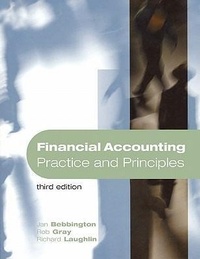
Financial Accounting
Practice and Principles
3rd Edition
Published on 16. August 2001
Book
Paperback/Softback
452 pages
978-1-86152-771-4 (ISBN)
Description
The successful systems based formula for teaching financial accounting that gained such academic acclaim in its first and second editions, is back! Financial Accounting remains the student's favourite! The third edition is more streamlined, more user friendly and even more accessible. An in-depth, worked example from an actual partnership, brings alive for students the accounting issues involved in partnerships, a required topic of accreditation. Financial Accounting is based on a threefold approach: an organizational flow-model is used to locate financial accounting in its organizational context; this model is then used to derive a systematic logical approach to financial accounting and the construction of the financial statements; and the text attempts to forge a firm link between the traditional diet of introductory financial accounting and the wider issues of accounting theory. Financial Accounting is the ideal text for undergraduate Accounting students.
Reviews / Votes
Part One. 1. What is Accounting? And Why Study it Anyway? 2. Cash, Cashbooks and Units of Account. 3. Organizations, Organizational Subsystems and the Flows of Double Entry Bookkeeping. Part Two. 4. Organizational Flows, A Categorization of Basic Transactions, Accounting records and Double-Entry Bookkeeping. 5. Putting the Eight Basic Transactions to work, Producing the Accounting Records and an Initial Trial Balance. 6. The Accounting Information System: Organizing and Controlling the Accounting Records. 7. The Trial Balance and Categorization: The Accounting Conventions, Assets, Liabilities, Revenues, Expenses, Provisions and Reserves. Part Three. 8. Accruals, Prepayments and general Provisions and an Introduction to the Production and Format of the Profit and Loss Account and Balance Sheet. 9. Depreciation of Fixed Assets and Losses on Disposal. 10. Stock Allocation, Valuation and the Cost of Sales. 11. Bad and Doubtful Debts (and another Look at Provisions). 12. From the Trial Balance to the Financial Statements: Ownership Claims, Profit, Appropriations and Social Reality. 13. Partnerships. 14. Accounting Regulation and Company Accounts. Part Four. 15. Reading the Financial Statements and Annual Report: Cash Flow Analysis and Interpreting Financial Numbers. 16. Accounting for Changing Prices: An Introduction. 17. Expanding the Reporting Function: Social and Environmental Accounting Reporting. 18. Thinking about Accounting: Theoretical Perspectives on Financial Accounting and Reporting. Part Five. 19. Where Have we Been? Where Do We Go Next?More details
Edition
3rd edition
Language
English
Place of publication
London
United Kingdom
Target group
College/higher education
Product notice
Paperback (trade)
Dimensions
Height: 251 mm
Width: 183 mm
Thickness: 26 mm
Weight
885 gr
ISBN-13
978-1-86152-771-4 (9781861527714)
Copyright in bibliographic data and cover images is held by Nielsen Book Services Limited or by the publishers or by their respective licensors: all rights reserved.
Schweitzer Classification
Other editions
Previous edition
Book
06/1999
2nd Edition
Cengage Learning EMEA
€99.50
Shipment within 3-4 weeks
Persons
Content
PART ONE.
1. What is Accounting? And Why Study it Anyway?
2. Cash, Cashbooks and Units of Account.
3. Organizations, Organizational Subsystems and the Flows of Double Entry Bookkeeping.
PART TWO.
4. Organizational Flows, A Categorization of Basic Transactions, Accounting records and Double-Entry Bookkeeping.
5. Putting the Eight Basic Transactions to work, Producing the Accounting Records and an Initial Trial Balance.
6. The Accounting Information System: Organizing and Controlling the Accounting Records.
7. The Trial Balance and Categorization: The Accounting Conventions, Assets, Liabilities, Revenues, Expenses, Provisions and Reserves.
PART THREE.
8. Accruals, Prepayments and general Provisions and an Introduction to the Production and Format of the Profit and Loss Account and Balance Sheet.
9. Depreciation of Fixed Assets and Losses on Disposal.
10. Stock Allocation, Valuation and the Cost of Sales.
11. Bad and Doubtful Debts (and another Look at Provisions).
12. From the Trial Balance to the Financial Statements: Ownership Claims, Profit, Appropriations and Social Reality.
13. Partnerships.
14. Accounting Regulation and Company Accounts.
PART FOUR.
15. Reading the Financial Statements and Annual Report: Cash Flow Analysis and Interpreting Financial Numbers.
16. Accounting for Changing Prices: An Introduction.
17. Expanding the Reporting Function: Social and Environmental Accounting Reporting.
18. Thinking about Accounting: Theoretical Perspectives on Financial Accounting and Reporting. PART FIVE.
19. Where Have we Been? Where Do We Go Next?
1. What is Accounting? And Why Study it Anyway?
2. Cash, Cashbooks and Units of Account.
3. Organizations, Organizational Subsystems and the Flows of Double Entry Bookkeeping.
PART TWO.
4. Organizational Flows, A Categorization of Basic Transactions, Accounting records and Double-Entry Bookkeeping.
5. Putting the Eight Basic Transactions to work, Producing the Accounting Records and an Initial Trial Balance.
6. The Accounting Information System: Organizing and Controlling the Accounting Records.
7. The Trial Balance and Categorization: The Accounting Conventions, Assets, Liabilities, Revenues, Expenses, Provisions and Reserves.
PART THREE.
8. Accruals, Prepayments and general Provisions and an Introduction to the Production and Format of the Profit and Loss Account and Balance Sheet.
9. Depreciation of Fixed Assets and Losses on Disposal.
10. Stock Allocation, Valuation and the Cost of Sales.
11. Bad and Doubtful Debts (and another Look at Provisions).
12. From the Trial Balance to the Financial Statements: Ownership Claims, Profit, Appropriations and Social Reality.
13. Partnerships.
14. Accounting Regulation and Company Accounts.
PART FOUR.
15. Reading the Financial Statements and Annual Report: Cash Flow Analysis and Interpreting Financial Numbers.
16. Accounting for Changing Prices: An Introduction.
17. Expanding the Reporting Function: Social and Environmental Accounting Reporting.
18. Thinking about Accounting: Theoretical Perspectives on Financial Accounting and Reporting. PART FIVE.
19. Where Have we Been? Where Do We Go Next?