

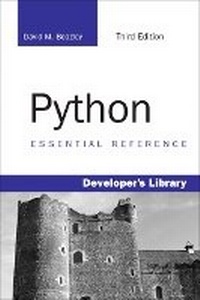
Python Essential Reference
3rd Edition
Published on 9. March 2006
Book
Paperback/Softback
648 pages
978-0-672-32862-6 (ISBN)
Description
Python Essential Reference, 3rd Edition, is a comprehensive reference to the Python programming language. The focus of this latest edition is to add coverage of significant new features and new library modules added to the language over the past five years. Clearly written with concise organization, the new features covered include new style classes, unification of types and classes, xmlrpclip, intertools, bz2 and optparse, making it the most up-to-date Python book on the market.
More details
Edition
3rd edition
Language
English
Place of publication
Indianapolis
United States
Publishing group
Pearson Education (US)
Target group
College/higher education
Dimensions
Height: 228 mm
Width: 152 mm
Thickness: 26 mm
Weight
838 gr
ISBN-13
978-0-672-32862-6 (9780672328626)
Copyright in bibliographic data and cover images is held by Nielsen Book Services Limited or by the publishers or by their respective licensors: all rights reserved.
Schweitzer Classification
Other editions
New editions
David Beazley | David M. Beazley
Python Distilled
Book
11/2021
1st Edition
Pearson
€46.99
Shipment within 15-20 days
David Beazley
Python Essential Reference
Book
07/2009
4th Edition
Addison Wesley
€45.79
Shipment within 10-20 days
Previous edition
Book
08/2004
Cisco Press
€87.48
Article exhausted; check for reprint
Person
David Beazley is a developer of several software development tools including SWIG (a popular tool for integrating C/C++ programs with other programming languages including Python, Perl, Tcl, Ruby, PHP, Java) and PLY) a Python version of the lex/yacc parsing tools). Beazley has been programming Python since 1996 and helped pioneer the use of Python with scientific computing software while working at Los Alamos National Laboratory. From 1998-2005 he was assistant professor in the Department of computer Science at the University of Chicago where he enjoyed tormenting students with insane projects in operating systems, networks, and compilers. Currently he is a freelance software developer.