

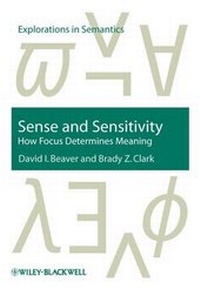
Sense and Sensitivity
How Focus Determines Meaning
Published on 5. September 2008
Book
Hardback
328 pages
978-1-4051-1263-5 (ISBN)
Description
Sense and Sensitivity explores the semantic and pragmatic effects of focus in natural language discourse. The book concentrates on focus sensitivity, the remarkable dependency some words have on the effects of focus. An example is "only": compare "She only LIKES me" (i.e. nothing deeper) to "She only likes ME" (i.e. nobody else). Such interactions between sound and meaning highlight the importance of focus as an interface topic in contemporary linguistic theory, and the book presents results that will be of interest across the gamut of linguistic subfields from phonetics and phonology through syntax, semantics, pragmatics and discourse studies.
The centerpiece of the book is a new account of focus sensitivity, the QFC theory, which involves a three-way distinction between different effects of focus: Quasi association, a special type of pragmatic inference; Free association, the resolution of a free variable; and Conventional association, a grammatical dependency on the current question under discussion. Prior to this new account, it had generally been assumed that focus is a uniform phenomenon; Beaver and Clark refute this with a series of new diagnostic tests, a detailed study of how focus sensitive expressions behave in Germanic and Romance languages, and the first theory of the meaning of exclusives (like "only", "just", and "merely") that explains their focus sensitivity in terms of their meaning and function in dialogue.
Reviews / Votes
"Move over, Austen--and Austin. Prodigiously comprehensive and engagingly presented, Beaver and Clark's rich and subtle study of focus is essential reading on intonational meaning, scalar particles, implicature, presupposition, polarity licensing, and alternative semantics. This is sensitivity training of the highest order." Laurence Horn, Yale University "Sense and Sensitivity merits a close reading by anyone interested in contemporary pragmatic theory. It is clearly written and accessible, and offers a carefully reasoned case for lexical sensitivity to focus. Beaver and Clark's thesis is sure to serve as a touchstone for further work on the subject." Craige Roberts, Ohio State UniversityMore details
Product info
gebunden
Series
Edition
1. Auflage
Language
English
Place of publication
Hoboken
United Kingdom
Publishing group
John Wiley and Sons Ltd
Target group
Professional and scholarly
for advanced undergraduates, graduate students, and faculty and researchers in the fields of semantics, pragmatics, syntax, phonology, and computational linguistics
Product notice
sewn/stitched
Paper over boards
Dimensions
Height: 249 mm
Width: 173 mm
Thickness: 23 mm
Weight
726 gr
ISBN-13
978-1-4051-1263-5 (9781405112635)
Schweitzer Classification
Other editions
Additional editions
E-Book
01/2009
Wiley-Blackwell
€42.99
Available for download
Book
09/2008
Wiley
€46.90
Article not available at the moment
Persons
David I. Beaver is an Associate Professor of Linguistics and Philosophy at the University of Texas at Austin. He is the author of Presupposition and Assertion in Dynamic Semantics (2001); is co- editor of several books, including The Construction of Meaning (2002); has authored numerous articles for prestigious journals including Linguistics and Philosophy and Language; is on the editorial team or board of all the three leading journals in semantics; and is co-founder of a new Open Access journal, Semantics and Pragmatics.
Brady Z. Clark is an Assistant Professor of Linguistics at Northwestern University and a faculty member at the Northwestern Institute on Complex Systems. He is co-editor (with Beaver, Casillas- Martinez, and Kaufmann) of The Construction of Meaning (2002). His many publications range from Semantics to Historical Syntax and Tutorial Dialogue Systems, and include articles in Natural Language Semantics and Language.
Content
1. Introduction.
2. Intonation and meaning.
3. Three degrees of association: quasi, free, and conventional.
4. Compositional analysis of focus.
5. Pragmatic explanations of focus.
6. Soft focus: Association with reduced material.
7. Lacking focus: Extraction and ellipsis.
8. Monotonicity and presupposition.
9. Exclusives: facts and history.
10. Exclusives: a discourse account.
11. Conclusion